Sunday, 2 June 2013

Why have there been no great men since 1950?

Great Britain has been going through a new dark age since 1950 in the arts, ideas and writing. A fall-off much more striking than the simultaneous diminution in our political power. I recently reread this wonderful article by Andrew Thornton-Norris on this subject which I highly recommend.

I think the same is true of Western Europe (and Eastern Europe too under Communism and then the post-Communist explosion of a kind of capitalism). And in all the rich countries,  and in the world in general the story sounds pretty similar.  

Please correct me if I am wrong. 

What is also interesting is that I have never seen this phenomenon remarked on except in this article.

And what are the reasons for this sudden steep decline?

In the West, we seem no longer to do great men. And please do not mention Mrs Thatcher, Martin Luther King or Ronald Reagan. Who after 1950 compares with Keynes, Jung, Joyce, Laurence, Churchill, Evelyn Waugh, Proust? Or the painters like Picasso, Matisse, etc, etc?

Add to that loss of religious faith and loss of faith in Western civilisation as superior to other civilisations and you have have decadence, yet we had technological innovation and the amazing post-war economic miracle.  For everyone, rich and poor, life in Western Europe was better than it had ever been. The Communist Eric Hobsbawm referred to the period 1950-1973 as Western Europe's Golden Age, but things continued to improve since. Even in Communist Eastern Europe between the death of Stalin and 1989, living standards rose slowly and war was avoided.

They were the best of times, they were the worst of times.

From the article I linked to, I particularly liked and completely agree with this aphorism of Maurice Cowling's,


...secularisation so far from involving liberation from religion, has involved merely liberation from Christianity and the establishment in its place of a modern religion whose advocates so much assume its truth that they do not understand that it is a religion to which they are committed.

One of my greatest regrets is that university I did not get to know and sit at the feet of Maurice Cowling (and Edward Norman and the Peterhouse people). Their kind of conservatism appealed to me, even though I did not like their Thatcherite conclusions they drew from it. I found Margaret Thatcher's ideas repugnant and simply completely  uninteresting. I was a romantic. She has been proven right about a lot of things but she was, at best, to quote Sellars & Yeatman's description of the Roundheads, Right but Repulsive. 

Sunday, 26 May 2013

Did Muhammad exist? Yes, I think so.


I never read Robert Spencer but this review of his latest book interests me very much. I have blogged before about the complete lack of trustworthy evidence for the life of Muhammad or the origins of Islam. 

I became interested about ten years ago in this absorbing detective story (what else is history but detective work, though it should not be fiction?) when I read these two fascinating articles. Not only are they very exciting to any historian (nothing is more beautiful than the sound of an unsubstantiated, orthodox interpretation being exploded) but the story they tell is like an Indiana Jones film.

Robert Spencer, an American whose family is Lebanese Christian, is controversial. His books sell well but are not reviewed by scholars very often. His work is anti-Islam, which is fair enough, rather than anti-Islamist, whatever Islamist means. He speaks Arabic, but he did not learn Muslim history or Koranic studies at university and is a self-taught Muslim scholar. I always warm to people who annoy the academic consensus and, for some reason, almost all right-wing historians do so. (Why did history and the other humanities and social sciences move to the left in the 1960s, just as the working classes in developed countries moved the other way?) He is accused of 'being a hero of the American right' but I am not sure why this is an accusation, rather than a statement of fact. Though I do, of course, accept that the American right are sometimes very unsophisticated and bone-headed in their opinions of Islam. Americans' lack of sophistication is their country's greatest strength, but it can become wearing at times.

Spencer probably should be considered as a pamphleteer more than a historian, but he is more reliable than many who have written about Muhammad, including the very silly former nun, Karen Armstrong, whose biography of him elides the fact that the evidence for his life is extremely late. If mainstream historians have not realised this before (Gibbon drew attention to it and anyway it is very obvious) then it might be better to read Spencer first or revisionists such as Patricia Crone and Michael Cook,

Spencer is braver than Tom Holland, another populariser. Holland, from cowardice - I am talking physical cowardice - skirts the question of whether the Koran existed, as we know it today, in the early 7th century. Nick Cohen is very funny about this here, in his wonderful article 'Tiptoeing in the Mecca Ballroom'. 

By the way, what I would give to have come up with that title.

I think the Muslim accounts of the life of Muhammad are too late to have much or even any real historical value, except as evidence that a prophet of that name existed and won battles. Even this is questionable and Spencer, following other writers,  does question it. 

However, I would say, though I am no scholar, that the prophet mentioned in the Doctrina Jacobi is Muhammad, though some historians have not been convinced. The Doctrina Jacobi describes events in 634 and is dated no later than 640, shortly after the traditional date of Muhammad's death, 632. This is the key passage:


And they were saying that the prophet had appeared, coming with the Saracens, and that he was proclaiming the advent of the anointed one, the Christ who was to come. I, having arrived at Sykamina, stopped by a certain old man well-versed in scriptures, and I said to him: "What can you tell me about the prophet who has appeared with the Saracens?" He replied, groaning deeply: "He is false, for the prophets do not come armed with a sword. Truly they are works of anarchy being committed today and I fear that the first Christ to come, whom the Christians worship, was the one sent by God and we instead are preparing to receive theAntichrist. Indeed, Isaiah said that the Jews would retain a perverted and hardened heart until all the earth should be devastated. But you go, master Abraham, and find out about the prophet who has appeared." So I, Abraham, inquired and heard from those who had met him that there was no truth to be found in the so-called prophet, only the shedding of men's blood. He says also that he has the keys of paradise, which is incredible.
The author of this may well have been misinformed about the Prophet's doctrine (the Koran does not claim Muhammad proclaimed the coming of the Christ or has the keys to heaven) and about the fact that he was dead by 634. Or the traditional date for his death may be wrong. It might be that the Koran does not record the teachings of the Prophet accurately. 

There is more evidence for Muhammad from early Christian sources here. Particularly striking are the words of Sebeos, a bishop writing in the 660s.
At that time a certain man from along those same sons of Ismael, whose name was Mahmet, a merchant, as if by God's command appeared to them as a preacher [and] the path of truth. He taught them to recognize the God of Abraham, especially because he was learnt and informed in the history of Moses. Now because the command was from on high, at a single order they all came together in unity of religion. Abandoning their vain cults, they turned to the living God who had appeared to their father Abraham. So, Mahmet legislated for them: not to eat carrion, not to drink wine, not to speak falsely, and not to engage in fornication. He said: 'With an oath God promised this land to Abraham and his seed after him for ever. And he brought about as he promised during that time while he loved Ismael. But now you are the sons of Abraham and God is accomplishing his promise to Abraham and his seed for you. Love sincerely only the God of Abraham, and go and seize the land which God gave to your father Abraham. No one will be able to resist you in battle, because God is with you.

So I do not find the argument that Muhammad did not exist persuasive. The most striking piece of evidence of all is that shortly after the time that Muhammad is supposed to have been active Arabs conquered half the civilised world. But it is clear that we know very little reliably about Muhammad.


We have the Koran, it is true, which mentions Muhammad four times, but, if we do not believe that God dictated the Koran, we do not know when and where and why it was written. There is a good case for it being early 7th century, because of the reference to the war between the Byzantine and Persian Empires which was fought between 602 and 628. But we do not know how or when it came into existence, unless we have faith in Islam, and that whereof we do not know thereof must we remain silent.

By the way, this need not worry Muslims. Lack of evidence for Muhammad's life or even existence does not in any way disprove or even undermine their beliefs. Biblical scholarship is a very much harder stumbling black for Christians. Although, having often been told that there was minutely exact information about Muhammad's life, it seems that there is more historical evidence for Jesus's. 

What would undermine the Muslim religion, on the other hand, would be evidence to suggest that parts of the Koran were based on Christian hymns, as suggested by Christoph Luxenberg.

Personally, I think Islam is a false religion. If I did not think that, I would be a Muslim. Instead, I am a Christian and therefore I hope all Muslims will convert to Christianity as soon as possible, for their sakes (and I am glad a surprisingly large number are doing so). Yet I respect Islam and believe the Holy Spirit is at work in all the religions. I am not sure St Paul would have agreed, but that is what the Second Vatican Council said. In any case, it appeals to my early 21st century sensibility. I am sure we can learn much from all religions, though I am lamentably ignorant about even my own.

There is much in Islam that is austerely beautiful and all beauty comes from God. I am sure most of the ethical teaching of Islam is true. I admire its simplicity and the emphasis it puts on frequent prayer. I find a sense of God and beauty when I enter mosques, though I also start to think I detect in it something synthetic that reminds me of Communism. At any rate, it certainly feels very Protestant. 

I find the Koran seems to be a series of rules and threats of hell, interspersed with promises of Paradise. It does not contain stories and the English translation certainly does not sing, but in the Arabic it is supposed to be very beautiful. The only things I knew about the Koran, before I started to read it (I have only managed a few pages) were Carlyle's and Sebastian Faulks' opinions. 

Mr. Faulks said recently:


“With the Koran there are no stories. And it has no ethical dimension like the New Testament, no new plan for life. It says ‘the Jews and the Christians were along the right tracks, but actually, they were wrong and I’m right, and if you don’t believe me, tough — you’ll burn for ever.’ That’s basically the message of the book.”
He said much more and was criticised for doing so. Carlyle famously said: 
I must say, it is as toilsome reading as I ever undertook. A wearisome confused jumble, crude, incondite; endless iterations, long-windedness, entanglement; most crude, incondite; -- insupportable stupidity, in short! Nothing but a sense of duty could carry any European through the Koran.
Other Europeans have been much more polite, though. Tony Blair, for example:
The most remarkable thing about reading the Koran – in so far as it can be truly translated from the original Arabic - is to understand how progressive it is. I speak with great diffidence and humility as a member of another faith. I am not qualified to make any judgements. But as an outsider, the Koran strikes me as a reforming book, trying to return Judaism and Christianity to their origins, rather as reformers attempted with the Christian Church centuries later. It is inclusive. It extols science and knowledge and abhors superstition. It is practical and way ahead of its time in attitudes to marriage, women and governance.
This sounds like his praise for Hans Kung. Mr Blair seems to see Muhammad (and Father Kung) doing to religion what Mr Blair did to the Labour Party. To be fair to Carlyle, or to Islam, or both, Carlyle also thought that Islam was a progressive and civilising force. So in its time it was, compared to the idolatry it replaced in Arabia, though not compared to the Byzantine Roman Empire. 

Christians and Muslims should and will continue to find ways to coexist - and there are many reasons why they should be natural allies against the materialistic modern world, which replaces the sacred with welfare and the state and regards, for example, abortion, contraception and homosexual marriage as human rights.  

Note at Easter 2015: Radiocarbon of the Sana'a MS of the Koran shows something close to the modern Koran existed 70 years after traditional date for Muhammad’s death.


File:Mosque Bucharest.JPG
The Bucharest Mosque. I must go and look for it one day.

Sunday, 19 May 2013

The strange death of Christian England

St Etheldreda's, Ely Place, Holborn, London


The latest figures from the 2011 census are very important, alarming, saddening, but not really such a very great surprise. 

10 percent of British people under 25 are Muslim, which means one day Britain will be at least 10 percent Muslim. The Russian news agency RT says Islam could be the dominant UK religion in 10 years.  

Damian Thompson in the Daily Telegraph says:


For the first time, the proportion of under-25s who don’t describe themselves as even nominal Christians has risen above 50 per cent. Also, the new breakdown shows that the rate of decline in British Christianity has been masked by the presence of 1.2 million foreign believers in this country. Take them out of the picture, and we can see that home-grown Christianity has shrunk by 15 per cent in just a decade. To quote the demographer Prof David Coleman of Oxford University, “It is difficult to see whether any other change in the census could have been remotely as big.”

A drop of 15% in just ten years... 

It is partly the combination of fear of Islam with fear of being 'Islamophobic' or thinking Christian Europe superior to non-Christian cultures. It is partly because of the horrible sex scandals involving a tiny minority but nevertheless a shockingly large number of Catholic priests. It is partly because Christianity in the UK is no longer rock-like and counter-cultural as Islam is and as, before the 1960s, Catholicism was. Instead Catholic bishops worry about climate change, women's rights and, bizarrely, homophobia, like all other authority figures. But there are much deeper reasons too.


Muslims attend Friday prayers on a rainy first day of Ramadan, at the courtyard of a housing estate next to a small BBC community centre and mosque in east London (Reuters/Chris Helgren)

From a conservative atheist's standpoint this development is disastrous, of course.

T.S. Eliot wrote in The Idea of a Christian Society:


‎'An individual European may not even believe that the Christian Faith is true, but what he says and makes and does will all spring out of this history of European culture and depend upon that culture for its meaning. Only a Christian culture could have produced a Nietzsche or a Voltaire. I do not believe that the culture of Europe could survive the complete disappearance of the Christian Faith. And I am convinced of that not merely because I am a Christian myself, but as a student of social biology.' 


When Eliot wrote those words in 1948, which is pretty recently, he had in mind that Europe would lose belief in Christianity, but did not contemplate that Hinduism, Islam and other  religions would come to Western Europe or England. Nobody did.


He saw, rightly, paganism as the enemy. 

(Elsewhere in The Idea of a Christian Society he says:


The more highly industrialised the country, the more easily a materialistic philosophy will flourish in it, and the more deadly that philosophy will be. Britain has been highly industrialised longer than any other country. And the tendency of unlimited industrialism is to create bodies of men and women — of all classes — detached from tradition, alienated from religion and susceptible to mass suggestion: in other words, a mob. And a mob will be no less a mob if it is well fed, well clothed, well housed, and well disciplined. 

 But the age of Ford has passed. Mass suggestion is rather out of date in the internet age and we are de-industrialising. Is there still a mob?)

Romanian men have the smallest penises in Europe, according to survey


Romanians have the smallest penises in Europe, figures show. Please don't attack me about this. I just read it in the paper and am posting it for information. 

This is a very chaste blog, but since this was on the front page of the Independent it must be acceptable. It would not have been in the papers some years ago.

While on this subject, which I shall not revert to in this blog, in case anyone does not know this, during the war Winston Churchill agreed to supply condoms to Soviet troops with the proviso that each box should be stamped with the words "EXTRA SMALL".

Saturday, 18 May 2013


Whittacker Chambers became a Communist in order to make the world a better place, along rational lines. What he said about Communism applies to the Nazis, who, when they were not atheists, tended to believe in some vague New Age paganism. It applies to many progressives in our day:
“It is Man’s second oldest faith. Its promise was whispered in the first days of creation under the Tree of Knowledge of Good and Evil, ‘Ye shall be as gods.’” These were “irreconcilable opposites—God or Man, Soul or Mind, Freedom or Communism.” [It is] the vision of Man without God." 

Thursday, 9 May 2013

Romania's hospital scandal: Babies left to die as doctors refuse to work without bribes


A telling story from today's Independent, by Alison Mutler, the AP woman here, about bribery in Romanian hospitals.
Dr Catalin Cirstoveanu runs a cardio unit with state-of-the-art equipment at a Bucharest children's hospital. But not a single child has been treated in the year and a half since it opened. The reason? Medical staff he needs to bring in to run the machinery would have expected bribes. 

So Dr Cirstoveanu has launched a lonely crusade to save babies who come to him for care. He flies them to Western Europe on budget flights so they can be treated by doctors who don't demand kickbacks. That's what he did last week for 13-day-old Catalin, who needed heart surgery. Dr Cirstoveanu packed a small bag, slipped emergency breathing equipment into the baby carrier and caught a cheap flight to Italy, where doctors were waiting to perform the surgery.


Wednesday, 8 May 2013

"A nation is a group of people united by a common misunderstanding about their origins."

"A nation is a group of people united by a common misunderstanding about their origins." 

(Ernest Renan). 

The current misunderstanding held by the English does not relate to Hengist and Horsa but to the mistaken idea that they were always an immigrant nation. In fact, there were few immigrants between 1100 and 1940. 50,000 Huguenots came and later about 50,000 Jews. The Irish  among them my forebears, were moving from one part of the UK to another. A useful summary of the figures is here.

Tuesday, 7 May 2013

I never liked Tarby


I never liked Jimmy Tarbuck, who has been arrested charged with sexual crimes. He summarised, in fact, everything in England I did not like. 


Well, apart from feminism, socialism, Scottish and Irish nationalism, business taught at Oxford and Cambridge .. calling strangers by their Christian names ....double glazing, mock Tudor bungalows....those beige coats drivers wear...dice in car windows ...


To be continued..

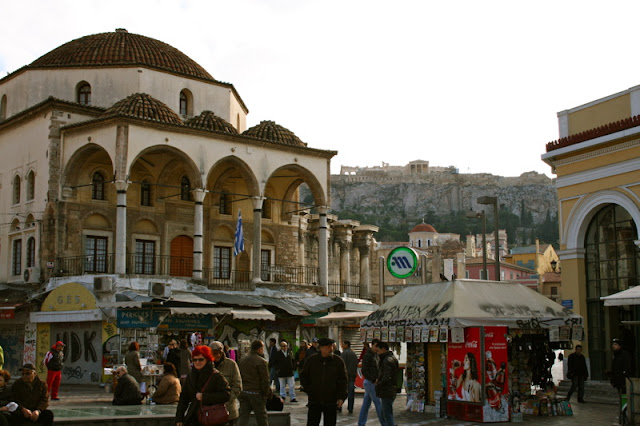
Easter in Athens


I never wanted to visit Greece, had made up my mind against the place before I first came here in 2002, but I hoped I might like Athens, which everyone told me I would hate. I like shabby capitals with many nineteenth century public buildings and I thought Athens could not be less appealing than Sofia, but in fact Athens, which seemed the 1970s incarnate, terribly polluted, traffic choked and boringly first world depressed me utterly in 2002. 

This year, for the first time, I got to like the town. Last year I managed the same feat with Istanbul - one grows tolerant with age. Athens has its charm, despite affluence and post 1960 property development, which have made the whole world dull. 

Athens under Ottoman rule was a very small place of between five and ten thousand inhabitants, half Christian, half Muslim. Bucharest was bigger (with no Muslims), Sofia even smaller. All these Balkan capitals were effectively created when their countries were invented, but though Athens does not have much Byzantine architecture it has some absolute jewels.

Especially, I loved the frieze on the wonderful eleventh century church of Agios Eleftherios,  a tiny church which used to be the cathedral and stands next door to and is completely overshadowed by the preposterously large nineteenth century cathedral. The latter is in the midst of repairs.


I stayed a couple of days with an American friend of mine and his wife, who have lived here for a couple of years and before spent five in Bucharest. They both think Athens is pretty much the same as Bucharest, beneath the Western European veneer, and they do not mean this as a compliment. Buildings are jerry built, people are an hour late for meetings, nothing is efficient. Personally, I don't see why foreign countries  should be as efficient as England or America and find problems give a place texture. that elusive thing that makes life interesting.

I remember another American, years ago, who split his time equally between Romania, Turkey and Greece. He was asked in my hearing how Romanians Greeks and Turks compared in terms of honesty. His answer was that Romanians were far more honest than Greeks and Turks, but that ''Turks are sometimes too proud to cheat you. A Greek never is.' I repeat this to my host who said this was exactly right.

Athens then is something like Bucharest would be had it not been for Communism. Greeks apparently go to great lengths to be ingenious and sometimes crooked, when being straight would actually be easier. That sounds familiar. But there are two big differences: the Greeks are very proud of their history, which Romanians are not, really, having been conquered and exploited for most of it. And Greeks still believe in socialism and often Communism. After all, they were prevented from having a Communist government by the UK and the US, while in Romania until 1944 the Communist party was miniscule. Though there are now plenty of true believing Communists in Romania among the older generation.


An evzone and I. I was told evzones can have all the girls they desire. This is why they become evzones, it seems. I wonder if they have as much success as Etonians.


The Thinker (4500 - 3300 B.C.) at the National Archaeological Museum, Athens. This makes it  more recent than The Thinker in the National History Museum in Bucharest which is dated 5000-4600 BC.


Wonderful sculpture of a boy on a horse, discovered underwater and pieced together in the 1970s — at the National Archaeological Museum, Athens.

The National Archaeological Museum only ten minutes from the centre is in a bad area, with many illegal immigrants who dislike the police. I like bad areas and anyway it seems fine to me but I notice how very few immigrants there seem to be. Brown-skinned ones, at least, are almost nowhere. Not a diverse society.

Muslim immigrants in Athens want to build a mosque, as is their right in a free country. I am very sorry the Muslims were expelled from Greece in 1922-1923, yet I do not want a new mosque in Athens. The making of Albanians into Greeks annoys me too. As I said, I wish Turkey were full of Greeks and Greece full of Turks. But I want countries to withstand the horrible values of the EU and ECHR.

By the way, whenever I am in Athens I go to gaze at the lovely eighteenth century mosque in Plaka. It houses a museum of Greek folk art. Why not use that?

Greek Folk Art Museum in Monastiraki 
There is a second nearby. I am always pleased that they were not destroyed by Greek patriots, as so many mosques were in Greece and as most of the mosques in Sofia were.

Fehtiye Mosque, Plaka, Athens

For the latest on this, click here. I would love Greece and Poland to save Europe from a hundred post-Christian developments. They and we should start by having more children - and I a childless bachelor am in no position to talk.

Saturday, 4 May 2013

Easter on Hydra

The view from my hotel in Hydra, a Greek island where I am spending the Orthodox Easter.

I was so lucky to get a boat ticket from Athens when they had all sold out (it was Good Friday, after all). The island is a kind of Greek Sark, where motor vehicles are banned. Thankfully there are almost no beaches either, so no children. Actually, I like children, but it is parents who are hard to take.  

And actually, there is a small beach, but it is a forty minute walk away from the town of Hydra.  


No families come to Hydra, but middle aged foreign couples do come, sometimes in pairs of couples and some, I regret to say, are British. Not my ambiance. Two German couples in the taverna last night said hello to me as if I were one of their generation and it  shook me. One had a Franz Josef moustache. My parents' generation was the class I put them in, but they might have been only a year or two older than me. Might who knows even be my age. 

This hotel looks like something from the Sunday Times, again not me, and is a climb of over 350 steps from the quay. Leonard Cohen, whose poetry books in the shops I never opened was also a  musician it seems. He lived here, as did Henry Miller and Patrick Leigh Fermor. I do not recommend the hotel, the Nefeli - although it is very pretty and the owner and manager are  amiable. There far, far too many steps from the quay to here and far too many nice British middle middle class or upper lower middle class couples.

A Romanian friend of mine damningly called some people I introduced her to 'ordinary people' and I realised this is a judgment easier to make about ones own race than foreigners. There is absolutely nothing at all wrong with ordinary people, who are essential to the economy of the universe, but they make me scared that ordinariness may be infectious, which of course it is. I went to school with a lot of ordinary people. Some of the ones who were not ordinary, such as the brilliant psychotic who burgled a chemist's, made a cocktail of the drugs and thereby died, were  out of the ordinary in a way I do not find particularly interesting.

The Orthodox Easter is always spell-binding: the funeral processions of the Lord on Good Friday evening and midnight Mass the next evening. Here it is poetic beyond description. On Good Friday evening the hearses, symbolising the corpse of Our Lord, are emptied into the sea to sanctify it. On Easter Saturday late a boat arrives with a flame from the Church of the Holy Sepulchre in Jerusalem. From this flame are lit the candles of all the faithful at midnight. At midnight the cannons explode and fireworks go off. The devout continue with Mass but most of the town goes off to feast and celebrate the end of the arduous, vegan, orthodox Lent, with lamb soup. roast lamb, lamb organs. The feasting, as far as I could see, goes on in restaurants, not at home. Which pleases me - much jollier than the celebrations at home of the reserved, low-key, private English.

Most of the town goes to Mass, the girls in their finest dresses and I revise my opinion of Greek young womanhood. Many are good-looking, some beautiful. Christianity here is  social not an individual thing and it would be sad if relativism, globalisation, loss of belief and immigration change that.


Of course, Hydra was once as, as recently as the 1960s, not part of the tourist industry and now it is. I wonder what I am doing here, but I do like it here.  Except for the foreigners. People speaking Romanian cheer me up - British voices the reverse.

Vlichos, the second hamlet as you go left, forty minutes' walk along a path along the coast from the port  is like Hydra was in the 1970s, I suppose, although it has two restaurants and a beach with deckchairs. Wonderful Easter dinner, meaning lunch, traditional music, lots of offal, almost no damn foreigners. Blue, glittering, transparent sea. 

Tuesday, 30 April 2013

Boring is another word for peaceful


And vice versa.

I owe this insight to Alain De Botton who said that his native Switzerland is boring but boring is another word for peaceful.

I am glad I read this before I went there. I had avoided the place which, until then, was on my very short list of countries I didn't want to visit, with Australia, New Zealand, Japan, the USA and the Gulf states. Armed with this insight, I found Switzerland almost delightful, although villages in the Transylvanian Alps are much more interesting than the prosperous villages in the real ones. 

I also find the insight is useful in many contexts. It is an entire philosophy of life, that perhaps I shall one day adopt. Many around me have.

Hamlet, speaking about Denmark, said something germane.
There is nothing either good or bad, but thinking makes it so. To me it is a prison.

I have an English friend who enjoys living in Bulgaria. I asked him if he didn't find it boring and he simply said


I have a very high boredom threshold.

I think I have a rather low boredom threshold, which is one reason why I like living in Romania. Romania is never boring. Not for one moment. Even the accounting system, the one thing about the country that I do not enjoy, is never boring. It is full of surprises.

Monday, 29 April 2013

Romania still loves the European Union, for materialistic reasons

Euro coin map of Europe


An interesting article today in several European newspapers written by the European Council on Foreign Relations (ECFR), a think tank, says euroscepticism is on the rise everywhere. No surprise there. 

Someone said that Northern Europe believes in the EU because they trust their governments and Southern Europe believes in the EU because they don't. Neither Northern Europe nor the Mediterranean countries trust the EU any more,  but Romania still does, seeing Europe as a source of money and an escape from self-rule. A survey by GfK showed Romanians as the third most optimistic country in Europe regarding economic recovery, a very long way behind Germany and Austria. The Romanian unemployment rate at 6.7% is one of the lowest rates in Europe. Living standards are a lot higher than they were in the 1990s.

The Spanish liberal Ortega y Gasset's remark,


"Spain is the problem and Europe is the solution"

no longer reflects what Spain thinks these days but replace 'Spain' with 'Romania' and it is what most intelligent Romanians under fifty think. By the way, I think Ortega was completely wrong about Spain, but Spain before the Civil War had an old, beautiful, very conservative, un-European tradition. Romania, on the other hand, is a new invention that has gone wrong.

Intellectuals in 19th century Romania genuinely and passionately believed in the ideals which France represented but Romanians these days do not  see the European Union in idealistic terms – for example as a means of keeping peace in Europe or of greater prosperity through greater trade. Europe is popular because it is means money and protection from the Romanian political class – in other words, a providential deus ex machina, the inheritance from an uncle that saves the day in a nineteenth century novel.

But this will change slowly and, in sharp contrast with their Russian contemporaries, who are very right-wing about sex and race and most other things, I foresee in Romania a generation of liberal or left of centre academics and political activists who will look to the EU as a source of politically correct ideals. Non-discrimination, equality of opportunity, feminism and secularism will be the arguments for changing socially conservative Romania. 

The EU is more powerful than any other institution in Romania and it has a lot of money. Academics are rarely able to resist the appeal of power, which is why many European intellectuals liked the USSR during the Cold War. And academics, who derive most of their salaries from taxes, are naturally disposed to sympathise with the public authorities, that feed them, and to dislike the businessmen who make more money than they do. The Marxists among them understand that economics determines culture. Economics in a high tax society determines justifications for high taxes and an active state.

The EU no longer represents prosperity to the countries of Mediterranean  Europe – quite the contrary – but it represents a great deal of prosperity to former Communist countries like Romania. Romanians do not fear another  European war or give much thought to the last one, but they are still living with its consequence, Soviet Russian imposed socialism.

Romania is not in the position of Cyprus, Greece or the other PIGS or PIIIGS. Austerity, as practised by Romanian governments since the crisis began was not ordered by the EU. Romanians who think austerity was a mistake, and there are many of them, blame the IMF or the Romanian governments. But I think sovereignty is less about tax and spending decisions  than decisions about caning in schools and smoking in bars - they and so many other decisions are now taken by the EU. Even Switzerland, which is not in the EU, may have to reverse its law banning minarets on instructions from the European Court of Human Rights. International law is truly the enemy of democracy.

I have never been in favour of capital punishment, but why shouldn't Romanians reintroduce it, if they so decide?

But that is to raise another question: why are so many things removed from discussion these days? In the word of the 1980s light bulb joke:
How many feminists does it take to change a light bulb?  
That's not funny.
A lot more things than just feminism are no longer either funny or discussable and the list keeps growing longer. But what people in Romania care about is not the right to drive their horse and cart along the highway or slaughter their pig where they like. They ignore laws that tell them they cannot do these things. What they care about is economic development and foreign investment. They still hope the EU will help them get these things.

Europeans once cared passionately about national self-determination and personal freedom but the welfare state and prosperity seem to be what people talk about now. At least it is what most politicians mostly talk about and have done since 1945. Perhaps it is the legacy of Communism which played its part in reshaping post-war Europe. In a sense, welfare considerations have replaced politics and religion. In any case, I do not expect the East Europeans to fight within the EU for fewer regulations and less political correctness.

What has changed is that the idea of convergence has been postponed till after the crisis is over. But when a problem has no solution it ceases to be a problem and becomes a fact. Will the crisis end or has it become a fact, simply reality and will convergence be postponed till the Greek calends? If so, how will that reshape Romanian politics, the economy and attitudes to the EU?

Sunday, 28 April 2013

Monasteries close to Bucharest: Cernica, Plătăreşti and Negoiesti


Three churches in the heat yesterday with Mihai, within twenty miles of Bucharest. Cernica, PlătăreÅŸti and  Negoiesti.


Cernica I have been to a couple of times before. It is close to Bucharest and therefore well-known. Cernica is a monastery , in a beautiful setting on a lake, which contains three churches, the principal one being early 19th century.  The lake has good fishing and besides the monastery is a forest. When I first came in 1999, the village felt very remote but it now has a certain number of big houses built in the usual deplorable style, one imagines, inhabited by customs officials and colonels of police.

Across the lake, one owner of a large house is burning tyres, which make that unmistakable dark heavy smoke. I wonder why people burn tyres. Dogs sleep in the hot sun. This, despite the big houses far off, is a lovely serene place, the profound Romania.


Plătăreşti

PlătăreÅŸti, painting of St Mercurie

PlătăreÅŸti under a Mexican sun. The church dates from 1646, in the reign of Matei Basarab, and was fortified against the Turk. It  needs renovation. The outer wall of the monastery is in great disrepair. In the curtilage of the monastery four old women, dressed in old clothes, sit under the shade provided by a metal shelter and chat. They are employed by the monastery and a funeral has just taken place.

PlătăreÅŸti is a fine brick church but most interesting for its wall paintings. Especially the painting of St Mercurie which dates from 1649 and is in very good condition. It is nothing at all like an icon and is very much the sort of painting one might expect to see in Italy.  St Mercurie looks like a character from Ariosto. I wonder who he was.

Negoiesti

Negoiesti was also a fortified monastery, with thick brick walls, now in disrepair, but now it is a parish church. These churches and monasteries, as with the fortified churches in Transylvania, served a defensive purpose as well as a religious one. The parish priest told us that after three years (he thought that a long time but in fact he was lucky) he had succeeded in getting EU funds to have the church renovated. The church’s interior was restored by the famous 19th century painter Constantin Lecca and the iconostasis (what in England would be called the reredos) is exquisite. He chose a wonderful shade of blue for it. Unfortunately some of Lecca's paintings have been badly damaged by 'an inundation'. Two thousand souls live in the parish of whom perhaps thirty come to Mass, said the priest, though for important holidays each family sends one representative to church.

Negoiesti

Romanians are not good at church attendance but attendance figures do not reflect the extent to which people here believe. Belief in the Orthodox religion is the Romanian default setting. It was so under Communism too and under Communism there were more reasons to believe in an anti-materialistic philosophy and fewer things to distract from religious belief.  Here in the Regat is the Byzantine Christian Near and Middle East, an arc that stretched from the Danube to the Holy Land, Mesopotamia and North Africa, before the Muslims came.
½


Saturday, 27 April 2013

Three wonderful churches twenty minutes by car from the centre of Bucharest: Plumbuita, Fundenii Doamnei and Mărcuța


In dreams, unfamiliar buildings turn up in familiar landscapes and I, like many people, quite often dream of churches. Sunday was dreamlike. The sun shone very fiercely in late October and Mihai led me to three astonishingly beautiful old churches whose existence I had never suspected, all inside the city boundaries of Bucharest and inside the ring road.


I always mourned the beautiful old churches destroyed when Bucharest was rebuilt and reinvented as the Paris of the East after independence from in 1877 but there are the very fine ones that still stand, largely unknown even to many Bucuresteni, surrounded by forests of jerry-built Communist blocks of flats. These are churches I would gladly travel three hours to see yet they are fifteen minutes by car on a Sunday from kilometre 0, where I live.


Plumbuita

Mass was being sung when we reached Plumbuita, a fortified monastery rebuilt by Matei Basarab to commemorate his victory over the Turks in 1652. Mihai explained to me that the Sublime Porte did not allow the Wallachians to erect fortresses so monasteries with strong walls and towers were built instead; The name Plumbuita derives from the lead roof which covered the church for centuries.


Fundenii Doamnei is somewhat newer and was built in the reign of Constantin Brancoveanu. It too has a serene garden It is in a poor state of repair, which irresponsibly pleased me because I like the patina of age and am startled when a church is as well restored as say the Stavropoleos church is. 
Fundenii Doamnei is second only to Stavropoleos for sheer beauty and is remarkable for some very fine tracery on the outer walls which Mihai explained was influenced by Persia.


Fundenii Doamnei


Fundenii Doamnei


When I first visited Mogosoaia Palace it seemed to me like my idea of a palace in India. After I had been to India I still saw the similarity. Only today did I learn from Mihai that this is not a coincidence. The Mughal architecture in India is of course Persian in origin and so was the architectural fashion in Romania around the year 1700. a time when Romania, as it was not then called, was cut off from Catholic Europe and open to the Muslim world.


Mărcuța, was a monastery founded in 1579, rebuilt in 1679 by one Marcu, who gave the monastery his name, suffered in an earthquake and was restored in the 1820s when the monastery became a mental asylum. The monastery dissolved in 1864 when Alexandru Ion Cuza laicised many monasteries. It is good-looking and has some very fine wall paintings, but most of all I liked the very serene grounds and palpable sense of deep peace.


Biserica Marcuta - Sfintii Arhangheli Mihail si Gavriil
Mărcuța


Biserica Marcuta - Sfintii Arhangheli Mihail si Gavriil
Mărcuța

Friday, 26 April 2013

"We have been most secure when we kept out of Europe"


A.J.P. Taylor, the greatest 
twentieth century English historian of modern Europe, was strongly opposed to England entering the European Economic Community, then known in England as the Common Market, now called the European Union. This is from an article he published in the The Sunday Express on July 11 1971, under the headline, The Path to Ruin:

We have been most secure when we kept out of Europe. Meddling with European affairs has brought us nothing but toil and suffering. The greatest age of British economic achievement was in the nineteenth century. Then we were truly the workshop of the world. The sole principle of our foreign policy was Splendid Isolation. This was the basis for our prosperity.

Of course we do not want to see new wars in Europe. But if we enter into European alliances or European associations we make war more likely. Already German statesmen are saying that the new European Super Power will be able to challenge Soviet Russia. Is this what British people desire?

During the twentieth-century we were twice involved in great European wars. We were told that this was necessary for our security. On each occasion we came out less secure than when we went in. We were told we could not allow one country to dominate the Continent. And what happened? In 1940 one country did dominate the Continent. Yet we survived thanks solely to our own strength. And we should have been far stronger in the summer of 1940 if we had not previously sent an expeditionary force to France and lost all its equipment at Dunkirk.

The Battle of Britain was the most glorious event in our recent history. We won it without European allies. We won it because we had detached ourselves from Europe. It was the victory of Splendid Isolation. Long ago in the days of sailing ships, there was perhaps a case for saying that we could not allow Antwerp to pass into enemy hands. Even in the days of short-range aircraft and rockets there was a case for saying that we were concerned for the independence of Belgium and Northern France. Now nuclear weapons, if they are ever used, will come from thousands of miles away. The security of western Europe has no special significance for us. In weapons, as in other things, the world has become one.
Historians, even the finest, rarely have any insight into the politics of their own time. We see this with Tony Judt, Norman Davies and a hundred others who trot out Guardian-reader platitudes. We see it too with historians on the right, like Andrew Roberts admiring George W. Bush. This is true of AJP Taylor too, with his fear of German unification and his campaigning for unilateral nuclear disarmament. His views on the EEC and all his other journalism are dated (unlike his books which are timeless) but the point he makes here is very interesting. Though the argument he makes would be an argument for the UK leaving NATO too. NATO, not the EEC,  was what kept 'the Russians out, the Americans in and the Germans down', to quote the words of the first NATO Secretary-General, Lord Ismay. NATO not the EEC kept peace in Europe. I do not take isolationism so far as to wish that we had not been in NATO, though had we stayed out of the war with Hitler it is unlikely, though no-one can possibly know, that the Cold War and NATO would have come into being. 

I loathe Sir Oswald Mosley, the British Fascist leader, who was imprisoned during the Second World War, and think him a bad man and a cynical demagogue, but Mosley was no fool and he was right about one thing. The doctrine of England keeping the balance of power in Europe was a terrible mistake, in the 18th and early 19th centuries and in 1914. Going to war in 1939 was probably also a mistake.  This argument could be used to support the idea that we should have kept out of NATO. War with Soviet Russia after the Soviets acquired the bomb would have been an even greater mistake, of course, but I never believed for one moment during the Cold War that a hot war in Europe was a real possibility. NATO, I believe, prevented war, though it was certainly an application of the balance of power theory.

Keeping out of Europe, even if a federal European state were to come into being across the Channel, was surely the right course. There are many strong arguments for the UK not leaving the EU now and many strong arguments for her doing so but it is hard not to conclude that our joining in the first place was a grave mistake.

More and more, it seems to me that Joseph Chamberlain was far sighted in his hopes for an economic union based on what became the British Dominions: Canada, Australia and New Zealand. How South Africa, Kenya, Rhodesia or India would have fitted in, who knows?


Curious that Chamberlain broke with Gladstone and the Liberals over Home Rule for Ireland, yet Gladstone has very clearly been proven right. Home Rule might very probably have kept Southern Ireland in the UK. Both Chamberlain and Gladstone were political giants, both went through conversions (to Home Rule and Tariff Reform) that made the political weather for a generation and both, it seems to me, were far-sighted, even though there opinions were apparently contradictory. An imperial customs union and Home Rule for Ireland were not incompatible but both would have strengthened the British Empire. Keeping out of war in Europe in 1914 and in 1939 would have done so too.

Sunday, 21 April 2013

Weekend in Rome

Saturday began with the Villa Borghese and astonishing sculptures by Bernini. I wonder what feminists think of statues of rape. Actually I wonder what I think of them. The answer is, of course, that I think they are very beautiful and we cannot blame Bernini for Greek myths. But..

Graham Greene said thrillers were more like real life than real life is and I suppose the classical myths of rapes fall into the same category, if that makes sense.

Great, intelligent lunch with Hilary and Christopher, two Canadian Catholics who live in Rome. She writes for a pro-life news website, he works for Vatican Radio. Both love the Tridentine Mass. I liked Hilary for saying Feminism is evil. 

She suggests I should become a Catholic apologist. Interesting thought. They are badly needed, for sure. But I realise I have a Protestant mind. Should that stop me? Many Catholics these days seem to.

Interestingly, she says Catholic writers are happy to fight again abortion and research on foetuses but shrink from attacking homosexual marriage. This does not surprise me in the least. Protecting life goes with the grain of contemporary culture. Telling people how to live their lives goes against it. Add the anti-discrimination zeitgeist, the sexual liberalism zeitgeist and the Catholic priests who have been guilty of unspeakable sex crimes.

On this issue, both are glad that the scandals have come to light and blame them on homosexuality being permitted in very many seminaries in the 1960s and 1970s. I am not sure. I have often suspected that the problem was less paedophilia than pederasty, but some have said that things were equally bad in the 1950s. Some of the victims were girls but three-quarters were post-pubescent boys.

Pope Francis seems, they think, to be interested in social justice and not at all in liturgy or doctrine. His reign will be back to the 1970s, which, Christopher added, may be what we need now.

Sunday was a wonderful, sunny day with Mass in the Tridentine Rite at the Church of Santissima Trinita dei Pellegri, a church which Pope Benedict XVI gave over exclusively to the Old Rite. then lunch with highly intelligent, well-informed, nice people who meet up after Mass. It is twenty years since I hung out with Traddies, the nicest people in the world. I shall come back to Rome very often, God willing. The perfect city.

I thought when I was a teenager that everything beautiful would come to an end when the generation ten or fifteen years older than me took over but it was not so. There are groups of conservatives, though I thought when looking around the congregation at Mass that those who believe in tradition feel and seem like Bolshevik conspirators before 1914, in the days when Europe was civilised. 

Why is loving tradition, whether in religion, politics or social life, considered subversive or even wicked? To answer that question would be to explain much about the state of the Western world. I really don't know. Can you tell me, dear reader?

Go to Rome if you can to see the marvellous Titian exhibition in the Quirinale. One of the best exhibitions I ever saw.


Note for stingy people:

I recommend the Hotel Paisiello Parioli, Via Paisiello, a place full of character. The price, by Roman standards, was very reasonable (EUR 210 for a single room for three nights).  I had a large room with a bath, not shower, thank God. There is a nice drawing room for guests and the place has character. The hotel is in a great, leafy, quiet area of Rome, very near the lovely Villa Borghese, an area a bit like South Kensington or Bayswater in London, but more central.  However, it is not near a metro, the bus to the centre comes only every twenty minutes and the twenty-five minute walk through the park to the historic centre of Rome, very charming at first, becomes tedious after a couple of times. I therefore, on balance,  prefer my home from home, the Hotel Julia in Via Rasellla, close to the Trevi fountain, which is even cheaper, has three stars and is astonishingly central. A nice hotel though the rooms are rather small and it does not have character. It does a decent breakfast.