Sunday, 27 April 2014

Easter in the Bucovina

In the end, from all my options for Easter, including Mount Athos, Meterora, Kiev, Transylvania, Rome and Clacton-on-Sea, I chose to return to Bucovina and the wonderful painted monasteries, which are for me the most lovely things in Romania, which is saying a very great deal.

Actually, wanting to see what was going on in Ukraine, I went to both Northern and Southern Bucovina. Northern Bucovina has been in Ukraine since the Soviet troops got there in 1944.

For those who don't know, the Bucovina was part of Moldavia that was taken from the Sultan by the Hapsburg Emperor in 1775 to link Galicia (Austrian Poland) to Transylvania. In 1919 the Bucovina was given to Romania but the northern half was seized by Stalin in June 1940. Sometimes people say that this was agreed under the Molotov-Ribbentrop Pact of August 1939 but, in fact, Russia's annexation of Bessarabia (which is now the Republic of Moldova) and the Northern Bucovina had not been agreed with Germany. Romania, allied to Hitler, took it back in 1941. Stalin regained it in 1944. 

Most of the Romanians fled or were deported to Siberia after 1944, but I noticed that the villages near the Romanian border have signposts in both the Cyrillic and Latin alphabets. This means that the villagers, or some of them, speak Romanian, are Romanians.

The name Bucovina means land of the beech trees and they are everywhere on the rolling hillsides. 

The capital of the Bucovina under Austria and until 1940 was Cernauti. This is its Romanian name, it's Czernowitz in German or Cernivtisi in Ukrainian. It was an enormous pleasure to return for my second visit.  Since my first visit I have had the chance to hear a lecture on life in Cernauti before 1914 by an Australian historian - Bucovina was Austria's equivalent of the Wild West, an unsettled place where fortunes could be made and lost and where people of all ethnic groups settled, Jews being the largest group. People of different ethnic groups never live side by side in complete amity but the citizens of Cernauti seem to have got by without too many great problems. The end of the Habsburg monarchy and war was to change this.

For decades I only travelled in post-Communist Europe and I still find it depressing to go to Western Europe. All that shininess and affluence make my heart sink. But I went to Western Europe for the monuments and to places like Burma and Mozambique to see the world until I realised that it is only Eastern Europe that I really love - where people are human and  normal. I especially love Ukraine and dear Cernauti, which are like Eastern Europe used to be in the late 1990s. 

Last time I was there, in 2007, I thought it was much like Satu Mare or Baie Mare or many other Austro-Hungarian towns but it is more charming than they are. The buildings are wonderful pastel shades in the early evening sunshine and there is an indescribable calm here which is only found in countries which are not powerful or rich or in the EU. What a joy it is to leave the EU, although the people of Western Ukraine would probably love to join it.

We arrived on Good Friday, and the mauve-pink Cathedral, once Romanian Orthodox and now one of the three kinds of Ukrainian Orthodox, was thronged with worshippers. I spent ten minutes there but my friend who had driven me to Cernauti stood outside waiting for me and so I went out again by that same door wherein I went, sorry that I should miss the Burial of the Lord ceremony, when a coffin is taken in procession around the church and nearby streets.

We walked around the lovely town bathed in evening sunlight and the sense of pleasing melancholy that you get in provincial towns towards the end of day, especially in obscure countries.I had looked forward to  chatting to locals about revolution and war but there was no-one to talk to. We did see an impromptu shrine to the heroes killed at the Maidan in Kiev, two of whom were local men or boys. Then we looked through the empty town for somewhere to eat and ended up eating a wonderful halibut at our hotel, the Hotel Bukovyna and salmon blinis. Far too big a feast for Good Friday, I know.


We spent Saturday morning mooching around Cernauti and then went back to the future in Romania where we stumbled on the wonderful little painted church at Padrauti. Rain-swept and chilly it was easy to imagine Stephen the Great winning a battle against the Muslims in this remote barbaric spot.


Padrauti

Then Suceava and though the town was closed for Easter we ate a really wonderful tochitura in a brasserie called Centru Vechi. I realise that huge portions are the Bucovinan idea of hospitality. Even I, even I, left half my food.

I found the war memorial in Suceava saddening. Romanians should have avoided war in 1877 and 1916. Had Romanian borders not been enlarged in 1919 Romania might have kept out of Second World War and avoided Communism. On reflection, though, this last idea is unconvincing because even had Romania remained neutral in the First World War Bessarabia (now Moldova) would still have dropped into her arms after the Russian revolution and therefore would have been taken back at some point by Stalin. It would however have been in Romania's interests to stay out of the Great War and in the interests of her allies too. Norman Stone said that the entry of Romania on the Allied side in 1916 delayed the Allies' victory by a year.

In Suceava I read about the fifty thousand Jews rounded up into the Cernauti ghetto by Romanians by order of Antonescu in 1941 and later killed. I had forgotten this until someone reminded me. attended the Catholic Mass and then the Orthodox, which moves me much more deeply. The latter ended at 3.30 and then I found Lidia Rusu, with whom I was staying, who drove me back - it took over an hour - to Vama.
Sunday lunch was cooked by Lidia Rusu's husband who is the best cook I have encountered in fifteen years in Romania. I knew an equally good Hungarian cook in Transylvania in the early 1990s but she moved to Hungary and, alas, she is dead. In any case it is not possible to compare Hungarian food with Romanian food. The meal was wonderful and unfortunately I found I did not a strong enough personality to resist the home-made tzuica.

Vespers at the village church (a pretty one built in 1990 but to the same design as churches had long ago). Then my second visit to the Vama Egg Museum, now much bigger than in 2002 and a thriving business with painted eggs from around the world. I saw an ostrich's egg, which in Switzerland had been cut open and made into the replica of a church complete with congregation. But the painted eggs from the region were the point of the exhibition. Painting eggs (emptied of their contents first) are the Bucovinan tradition.

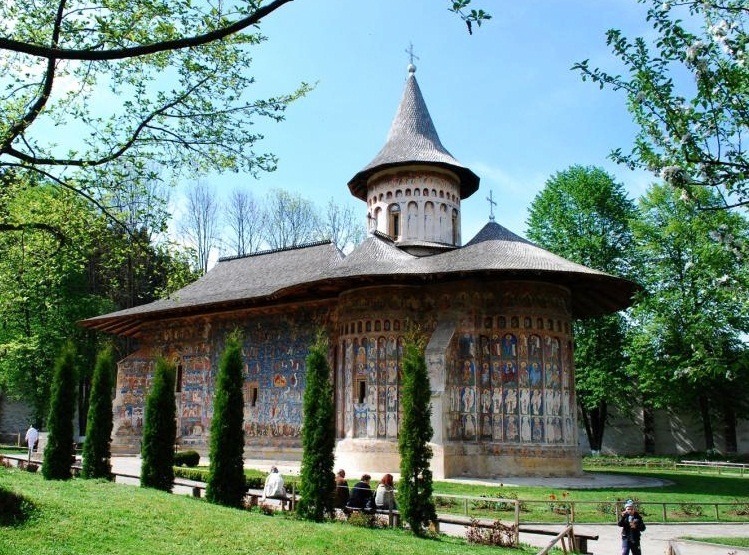
Monday began with Mass on a crisp sunny morning at the beautiful painted monastery at Moldovita. Then lovely Voronet and Humor. For readers who do not know Romania these and several other monasteries have no architectural interest but are famous for their wall paintings inside and outside which form wonderful galleries of mediaeval sacred painting. Romanians come to see them for their great beauty and also for the purpose for which they were made as an aid to prayer.  Bucovina is becoming more developed these days and starting to get a little commercialised but there is still a sense of holiness here and still a traditional rural way of life, though that is changing very much. Now Romanians go and find work in Eastern Europe and Romanian agriculture is, for reasons I do not fully understand, in big trouble.
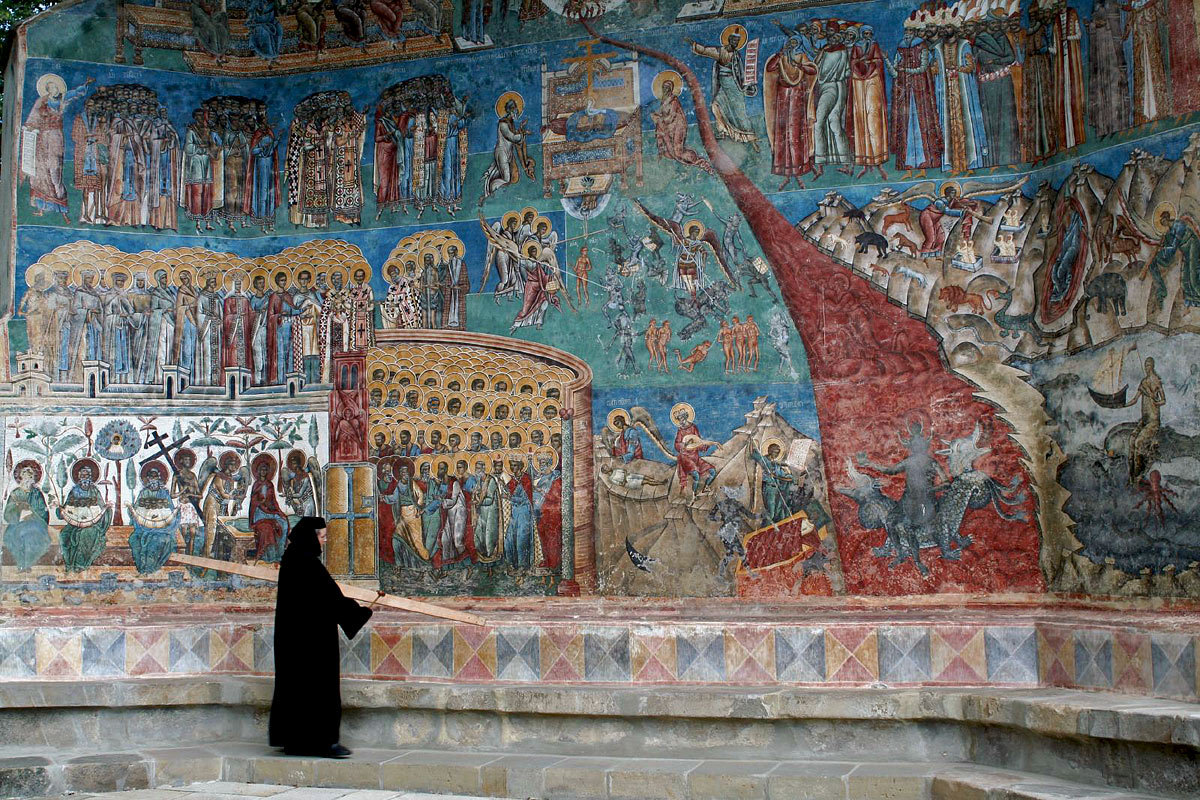


Voroneţ Monastery


Wednesday, 23 April 2014

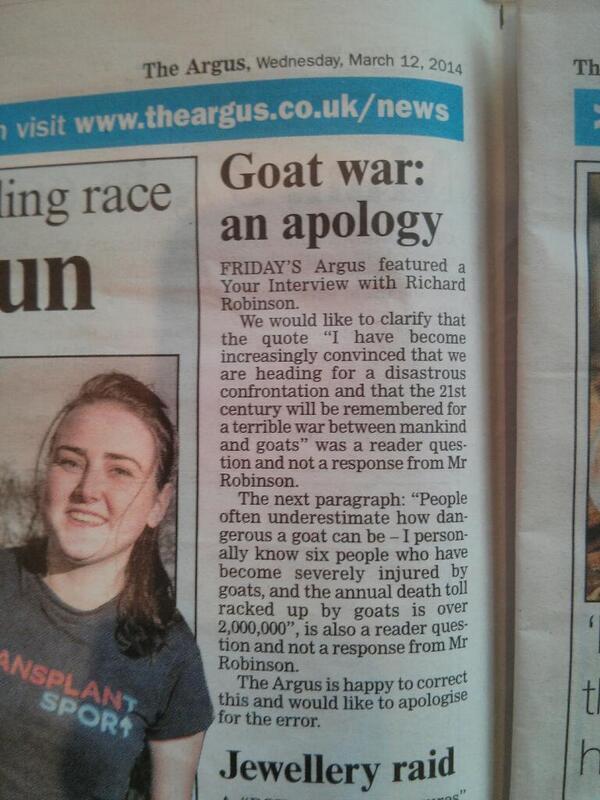
This made me burst out laughing loudly


The Brighton Argus had misattributed the comments about a future "war between mankind and goats" to the director of the Brighton Science Festival. The comments actually came from a reader.
The reader had also suggested the following question, which was submitted to the director:
“In an upcoming war between mankind and goats, which side will you be on? What techniques can science provide in order to give mankind an edge in a conflict against powerful and cunning goats?”


For more local news click here.

Lenin spoke English with an Irish accent

Lenin spoke English with an Irish accent, say Russians.

Is there any footage of Lenin speaking? 

Here is Trotsky speaking English, courtesy of Pathe, which has put its films on the net.

And here is the Kaiser speaking English. 

Monday, 14 April 2014

George Orwell on gun control


How much more free England was in the 1930s is illustrated by this quotation from George Orwell, who turns out to be no friend to gun control.


“That rifle on the wall of the labourer's cottage or working class flat is the symbol of democracy. It is our job to see that it stays there.”

Thursday, 10 April 2014

Today is the 70th anniversary of the liberation of Odessa

Today is the 70th anniversary of the liberation of Odessa - not from the Nazis but from the Romanians. The Romanians are remembered by elderly Odessans for their corruption but were kinder rulers than the Germans or the Communists and, when the Russians started to defeat the Germans, the Romanian government stopped deporting the remaining Jewish population to extermination camps. Mr Putin seems to think that the Soviet troops liberated the city from the Nazis. 

Tuesday, 8 April 2014

The game is up for climate change believers

Charles Moore writes in the Daily Telegraph about the philosophical underpinnings of the global warming fears - what he calls warmism.

"The origins of warmism lie in a cocktail of ideas which includes anti-industrial nature worship, post-colonial guilt, a post-Enlightenment belief in scientists as a new priesthood of the truth, a hatred of population growth, a revulsion against the widespread increase in wealth and a belief in world government." 

He might have added a belief in the power of reason rather than trust in providence, a faith in human nature. As I have said before, it reminds me of Whittaker Chambers's description of Communism. 

'Its promise was whispered in the first days of the Creation under the Tree of the Knowledge of Good and Evil: 'Ye shall be as gods.' It is the great alternative faith of mankind. Like all great faiths, its force derives from a simple vision. Other ages have had great visions. They have always been different versions of the same vision: the vision of God and man's relationship to God. The Communists vision is the vision of Man without God. It is the vision of man's mind displacing God as the creative intelligence of the world."

Tuesday, 1 April 2014

Bulgaria is a foreign country, they do things differently there.

At dinner last night a Romanian friend told me that Bulgarians, visiting their monasteries, behave like holidaymakers, unlike Romanians who behave like pilgrims when they visit theirs. Two Bulgarian academics told me recently that the Church is not liked and respected south of the Danube the way it is here. I wonder why. Are the centuries of Turkish rule the reason? I should have thought Turkish rule would have made the people like the Church more, not less.

Friday, 28 March 2014

Whiskey (or whisky) is not a Protestant drink

I hate whiskey but it is not true, as Belloc says, that it is a Protestant drink. It is an Catholic, Irish drink and when the Scotch copied it they were a beautiful Catholic country. 

The courts found the Scotch had committed the ancient tort of passing off their drink as whiskey and ordered them to stop back in the 15th (?) century, hence the Scotch spelling, whisky.

In case you have forgotten the passage from The Path to Rome:

"I knew a man once that was given to drinking, and I made up this rule for him to distinguish between Bacchus and the Devil. To wit: that he should never drink what has been made and sold since the Reformation--I mean especially spirits and champagne. Let him (said I) drink red wine and white, good beer and mead--if he could get it--liqueurs made by monks, and, in a word, all those feeding, fortifying, and confirming beverages that our fathers drank in old time; but not whisky, nor brandy, nor sparkling wines, not absinthe, nor the kind of drink called gin. This he promised to do, and all went well. He became a merry companion, and began to write odes. His prose clarified and set, that had before been very mixed and cloudy. He slept well; he comprehended divine things; he was already half a republican, when one fatal day--it was the feast of the eleven thousand virgins, and they were too busy up in heaven to consider the needs of us poor hobbling, polyktonous and betempted wretches of men--I went with him to the Society for the Prevention of Annoyances to the Rich, where a certain usurer's son was to read a paper on the cruelty of Spaniards to their mules. As we were all seated there round a table with a staring green cloth on it, and a damnable gas pendant above, the host of that evening offered him whisky and water, and, my back being turned, he took it. Then when I would have taken it from him he used these words--
'After all, it is the intention of a pledge that matters;' and I saw that all was over, for he had abandoned definition, and was plunged back into the horrible mazes of Conscience and Natural Religion.
What do you think, then, was the consequence? Why, he had to take some nasty pledge or other to drink nothing whatever, and become a spectacle and a judgement, whereas if he had kept his exact word he might by this time have been a happy man."

Thursday, 20 March 2014

Life is not a science but an art

I suddenly see why people who studied mathematics or science are not usually interesting when they talk politics - Margaret Thatcher being an obvious example. In their disciplines answers are either right or wrong. Life is not a science but an arts discipline where there are many right answers, though some much more right than others.

Boris Johnson had another insight that deserves to be disseminated.

Life is not course-work. It's one exam crisis after another.

Unfortunately course work has feminised our education system, benefiting girls at the expense of boys and hard-working plodders at the expense of the brilliant but lazy.


Wednesday, 19 March 2014

Another wonderful Daily Telegraph obituary - for Clarissa Dickson Wright

Clarissa Dickson Wright was after my time, which is to say her television programmes were, my time being when I started work and stopped watching television except for the news. This week, however, she was the subject of another great Telegraph obituary.


Some lives are picaresque novels, far more than careers counsellors and writers would have us believe and Miss Wright's was one of these. Not quite so much so as the life of the subject of the funniest obituary of all time, Denisa, Lady Newborough, but comparably interesting.

Her descriptions of Mr. Blair are priceless. 

She observed the budding union between [Cherie] Booth (“desperately needy”) and Tony Blair (“a poor sad thing with his guitar”). Later still she observed that the “wet, long-haired student” that she had known had been replaced by a man with “psychopath eyes. You know those dead eyes that look at you and try to work out what you want to hear?”)
I wonder what changed him. I know what she means about dead psychopathic eyes but I would not have fingered him for a psychopath.

I went in my youth to meet the deputy editor of the Telegraph and told him the obituaries were the best thing in the paper and he said he agreed. They are the best history of the 20th century - the John Aubrey's Brief Lives de nos jours. They outdo Anthony Powell, himself the biographer of Aubrey.

Much as one likes fat people in principal it is worth noting that they die in their fifties and sixties, so note this well dear reader before passing on. On the other hand, Kingsley Amis said that
'No pleasure is worth foregoing for the sake of 10 more years in a nursing home.'
You might decide this goes for steak and kidney pudding, trifle and other glories of English cuisine.

Sunday, 16 March 2014

Irresistible Ronald Firbank

'O, help me heaven,' she prayed, `to be decorative and to do right'.

'I know of no joy,' she airily began, 'greater than a cool white dress after the sweetness of confession.'

"The world is disgracefully managed, one hardly knows to whom to complain."

Mentally, perhaps she was already three parts glass. So intense was her desire to set up a commemorative window to herself that, when it was erected, she believed she must leave behind in it, for ever, a little ghost. And should this be so, then what joy to be pierced each morning with light; her body flooded through and through by the sun, or in the evening to glow with a harvest of dark colours, deepening into untold sadness with the night....What ecstasy! It was the Egyptian sighing for his pyramid, of course.

Although there were moments even still in the grey glint of morning when the room had the agitated, stricken appearance of a person who had changed his creed a thousand times, sighed, stretched himself, turned a complete somersault, sat up, smiled, lay down, turned up his toes and died of doubts. But this aspect was reserved exclusively for the housemaids and the translucent threads of dawn.

'I adore italics, don't you?'

I really must get round to reading Firbank's novels. Apart from anything else, including the fact that he was Evelyn Waugh's greatest influence, how can one resist titles like Concerning the Eccentricities of Cardinal Pirelli and Prancing Nigger? But I have had his books since Mrs. Thatcher was Prime Minister, I brought them to Romania with me in the late 1990s and until now I somehow did resist them.

Friday, 14 March 2014

Best opening lines from books

Harriet Wilson had one of the best opening lines in literature: 
I shall not say why and how I became, at the age of fifteen, the mistress of the Earl of Craven.
My other favourites are, unsurprisingly,
Last night I dreamt I went to Manderley again
and 
The past is a foreign country, they do things differently there.

And, of course, though I feel it goes without saying,
It is a truth universally acknowledged that a single man in possession of a good fortune must be in want of a wife
One more. As an undergraduate, I used to read a great many parodies. Two of the funniest I ever read were '"Summer at Blandings" as it would have been had it been written by Kafka' and '"The Castle" as it would have been had it been written by P.G. Wodehouse.' The latter began,
'''What ho" said K.'
This blog post was inspired by a long tweetfest (is that the word or did I invent it?) that the journalist John Rentoul has been having on this subject on Twitter, based on an article he wrote. Among the lines offered were this from Muriel Spark's The Girls of Slender Means, a book I wanted to like but couldn't.

'Long ago in 1945 all the nice people in England were poor, allowing for exceptions'
This is Sylvia Plath, the opening of The Bell Jar:

'It was a queer, sultry summer, the summer they electrocuted the Rosenbergs, and I didn't know what I was doing in New York'
And Ian Fleming, Casino Royale:

'The scent, smoke and sweat of a casino are nauseating at three in the morning' 
 Please tell me your favourites. 

Malcolm Muggeridge on Jesus

Jesus' subsequent followers have been less careful. They have sent him on Crusades, made him a freedom-fighter, involved him in civil wars and conspiracies, sent him picketing and striking and leading cavalry charges, and finally made him a paid-up member of the British Labour Party, with the strong expectation that in due course he will be given a life peerage and take his place in the House of Lords. In the light of these aberrations I have sometimes asked myself how Jesus would have fared if he had been born into one of the points of conflict in our world as Galilee was in his - in South Africa, say. As a white South African he would assuredly have been killed by his fellow whites for insisting that they should love and serve their black fellow citizens; as a black South African, he would likewise have been killed by his fellow blacks for telling them they must love and serve their white oppressors. In neither case, it is safe to assume, would he have been a beneficiary under the World Council of Churches' munificence in providing financial support for African guerrillas aiming to achieve national independence by means of terrorism.

Wedgie Benn and Eric Heffer

Tony Benn, whose death was just announced, was a foolish, foolish man and much worse. But he was right on this: 
"Britain's continuing membership of the Community would mean the end of Britain as a completely self-governing nation" 
May he be in heaven. 

He was kinder about Lady Thatcher when she died than I have been about him and recorded:
"I remember her at the funeral of MP Eric Heffer. I was asked to make a speech and as I was waiting, there was someone behind me coughing. It was Mrs Thatcher, and at the end I thanked her for coming and she burst into tears. She had come out of respect for someone whose opinions she disagreed with.

Though I do not observe the nil nisi bono rule, most on the right do. The internet is littered with tributes from conservatives to their fallen arch-foe, as it was earlier this week with Tories praising Bob Crow. But then the Conservatives have many strong reasons to be grateful to Mr. Benn. He and General Galtieri won them the 1979 and 1983 general elections, though in 1983 Michael Foot could also take much credit. 

It is Mr. Benn's real foes, in the Labour Party, who have reason to shudder at his memory. People like Denis Healey for example. Healey and the Labour Right of the 1970s were way to the left of people nowadays, on economic  matters - the SDLP were too. Everyone even the loony left look right-wing now on social issues. Even Ken Livingstone did not contemplate homosexual marriage.

The best remark I read was made by someone I don't know called Paul Shankland on Facebook:
"Dear Tony Benn, rest in peace and thank you for so many years of wisdom. Anyone looking at Concorde or the Post Office today would agree that you were indeed a visionary."
I do not have time to offer original insights into the man, but here is an earlier short post which says a lot.

He wanted to nationalise a High Street bank I remember and Harold Wilson joked that he wanted to bring Marks and Spencer's up to the standard of the Co-op. I only learnt today that he very nearly got the telephone boxes of England painted yellow. It would not have mattered much, though, as under Margaret Thatcher the lovely red ones disappeared anyway and today such red telephone boxes as remain are mostly used as improvised urinals.

I had a liking for old Heffer, Benn's lieutenant, who had difficulties in speaking intelligible English. Heffer was a devout Christian and once began a speech with dissolved the House in laughter with the words:
 'My father, like Jesus Christ's, was a carpenter.' 
I liked this as I can say the same thing. We were even in Happy Families, Mr Wood, the carpenter, Mrs Wood the carpenter's wife, Miss Wood, the carpenter's daughter and I was Master Wood, the carpenter's son. I suppose Happy Families is now considered sexist and homophobic.


Thursday, 13 March 2014

Sherlock Holmes and the Mystery of the Missing Aeroplane

The Malaysian airplane that has disappeared reminds me of 
'the cutter Alicia, which sailed one spring morning into a small patch of mist from where she never again emerged, nor was anything further ever heard of herself and her crew', 
a mystery that defeated Sherlock Holmes.

Monday, 3 March 2014

Reflections on the Revolution in Ukraine

Is Ukraine a real country, even by the standards of Eastern Europe? We shall see. Nation-building is what the Ukrainian revolution is about.
Ukraine became an independent country in 1991 as a result of a deal between leading Eastern and Western Ukrainians. To be specific, between people in Western Ukraine, (which was once part of Austria and then Poland) who wanted independence and certain powerful Russian members of the nomenklatura running factories in the East, who wanted to keep control of them rather than ceding it to other Russians in Moscow. This uneasy alliance threatened to fall apart the last time Mr. Yanukovych was toppled in a revolution, ten years ago, and might do so again now.
I am told by reliable sources that the reason Viktor Yanukovych ordered the snipers to stop killing protesters on Friday is because the two richest oligarchs in Ukraine told him to do so, not because he got tired of wallowing in blood. They saw that a Yanukovych victory achieved through great bloodshed would lead Ukraine in a clear direction: Belarus. And Belarus was not a good place for their businesses.
The end of Communism was essentially a management buy-out and the new owners ultimately conduct things on business principles.
For an old cold warrior and Romanophile like me the defeat of Mr. Yanukovych is good news. He is recognizably like but much worse than the worst kind of Romanian politician. He is the Ukrainian equivalent of what Ion Iliescu would have liked to have been had Romania occupied Ukraine’s geographical and political position.
The demonstrators seem like the equivalent of the brave Golani (‘hooligans’ according to the Romanian Government) who were beaten up by the miners in University Square in the summer of 1990, revealing to the outside world that the Romanian National Salvation Front were not the good guys that the Western media had thitherto thought but the Communists.
But some points should be mentioned.
Mr. Yanukovych rigged the election that he won in 2004 but he won the 2010 election fair and square, so he was the legal and democratic president. He was dismissed on Saturday by parliament, it is true, but he was in effect overthrown by an uprising, a rebellion aided to some unknown extent by foreign powers. The EU has also been lending support to the protesters and to some extent (I have no idea what) the EU helped overthrow the government.
Mr. Yanukovych is nasty and corrupt. So are all other Ukrainian politicians who have so far held office.
In opinion polls I saw at the end of last year, he enjoyed the support of over 40 percent of the electorate. By contrast, Victor Yushchenko, who replaced Mr. Yanukovych in 2004 in the ‘Orange Revolution’, became more unpopular than any leader in any democratic country in history, since opinion polls began.
Of course Mr. Putin and Russia were interfering to impede and destroy the governments that held power between 2004 and 2010 and had many means to do so. But Putin has interfered in other countries far less than the USA and UK have done in his time. Remember Afghanistan, Iraq, Libya.
In the rebellion the lives of many protesters were lost, shot by snipers whom we can presume Yanukovych ordered to shoot on the crowd. These people were brave, heroic. But on the first day of bloodshed more police than protesters were killed. The demonstrators in University Square in Bucharest in 1990 did not attack anyone, let alone kill policemen.
When is it right to rebel against a legitimate government, however unsatisfactory? Never, according to the Orthodox Church, who nevertheless swung their support behind the protesters.
Russia has been smarting for a quarter of a century because the West took advantage of Gorbachov’s surrender at the end of the Cold War to unify Germany and later to incorporate Russia’s satellites including the Baltic States which were part of the USSR into NATO. They wanted Georgia in NATO and are now moving into Ukraine which Russians consider part of Russia. Kiev, after all, is where the Russian state originated.
Many social conservatives in Western Europe and elsewhere have decided that the EU is their enemy and Vladimir Putin their great white hope. This is partly Vladimir Putin’s strategy – gone are the days when American conservatives inveighed against ‘Godless Russia’. On the other hand, tn Kiev the Svoboda party, which the BBC calls far right, was fighting against Mr. Yanukovych.
Some say he originally helped create the party. If so it reminds me of how the National Salvation Front helped created the Romanian far right party, even financed a far right newspaper, thus making the government look moderate and statesmanlike. So Svoboda is lined up with those people – they are fewer than they were at the time of the Arab Spring, but include what is left of the the Neo-Cons (in fact Wilsonian liberals) – who think revolutions will make the world more democratic.
The BBC does not like Vladimir Putin – not so much because he is a former Communist and former KGB station chief, or alleged by Wikileaks to have salted away many billions, or even because of the brutal war he waged in Chechnya, but partly because he is alleged to have opponents murdered, partly because he gaoled Pussy Riot and to a large extent because he has made homosexual propaganda a crime. I think the BBC hates him for the reasons some right-wing foreigners like him – he looks like a sexist, racist homophobe, or in the words of Paul Gottfried, the paleo-conservative writer,
Putin gives the exhilarating impression of being a non-reconstructed, non-sensitized MAN.
But if the victors in Kiev include a party that contains anti-Semites and racists, this for some will make Putin seem the lesser of two evils.
I suspect that very few people under sixty in Ukraine are either genuine communists or genuine fascists and that most people in Ukraine are casual racists, homophobes and sexists in the way Romanians were in the late 1990s and the British were in the early 1970s. I expect that goes for people of all parties and none. I also doubt whether homophobia, sexism and racism are of pressing importance in Ukraine right now.
I hope the Ukrainians escape from a future as a satrapy of the Kremlin and become part of Europe and the European Union. This is, on the whole, the best hope for them and for us in the West.
I am sorry that this will mean they are forced to obey Brussels and the ruling human rights ideology of the West – but this is better by a long way than obeying the Kremlin and copying its affronts to human rights. Above all in a post-Communist country the EU means some check on the rule of the post-Communist ‘structure of power’. Let’s hope Ukraine can avoid having her agriculture destroyed by the EU as Romania’s has been.
The alternative is what Ukraine has had for the last twenty years. Putin has done some good things and some bad things for Russia, has above all restored her pride, but he cannot give Ukraine pride.
Ukraine, on the other hand, is just about small enough to be able to be one day absorbed by the EU. She is Western enough too, having Hapsburg Catholic and Polish traditions, as well as a Tsarist one. If Romania and Bulgaria can be part of the West, why not Ukraine?
The failure of the reformist governments between 2004 and 2010 was partly about Russian interference, partly about incompetence, partly about corruption, but partly a failure by the EU to make it clear that Ukraine’s future belonged in the Union. The deal offered to Ukraine by the EU at the end of last year did not offer Ukraine a path to EU membership but an existence outside the EU but closely connected to it. Russia sees the EU as being aggressive and not respecting the Russian sphere of influence but in fact EU has done that only too well.
There are a number of questions.
In 2004 the chanceries of Europe discussed offering Ukraine a path to EU membership and decided against it. Will they do so now?
If not, how can Turkey be considered European and Ukraine not?
What will Russia do now? So far, it is obvious that Mr Putin does not know what to do.
In 2004 Putin said a European Ukraine was good for Russia. He may well be right but he changed his mind.
Does the EU have the money to bail out Ukraine? Does it have the will?
What does this mean for Moldova’s chances of joining the EU?
Will Ukraine split in two? This question was asked in 2004 too. The authorities in Kharkov released Yulia Timoshenko from prison hospital on Saturday in obedience to Parliament, which suggested that Kharkov was not about to secede. Russia has many levers with which to influence Ukraine, without creating an enclave in the Crimea.
Will this revolution be a catalyst for a similar outbreak in Moscow? Probably not, I should say, but we shall see.
Can the next government, after fresh elections, succeed where Mrs Timoshenko’s failed and do better than Mr Yanukovych’s?
Why must Russia and the West be enemies? Russians and other Europeans want the same things: freedom, nice holidays, consumer durables, peace or whatever it is we all want.

Wednesday, 19 February 2014

'Learning maths is even more pointless than Latin'

This interesting article by Simon Jenkins in today's Guardian is a refreshing diatribe against mathematics. 

I wonder what subjects schools should teach. What come to mind immediately are: driving, typing, religious instruction (as opposed to religious education), cooking, history, literature, especially poetry (but nothing after 1945 please), German and at least one other language, probably Spanish or Russian (and teach lots of grammar rather than trying to get thirty boys to make conversation), history of art, useful non-team sports like tennis that people will actually play in adult life and, most important of all, psychology. 

The most important are the life lessons taught by other children in the playground - and these can be incredibly painful for children who do not fit in.  Philip Larkin put it well.
When I was at school I thought I hated the human race, but when I grew up I realised it was just children I couldn't stand.
It would be much better to skip these often very damaging playground lessons which are a form of child abuse. If you can afford a private tutor for your child, get one. In Bucharest they are affordable.

In fact, a lot of schooling can now be done at home over the internet which is the best place for children to learn but if I am right we should need to decide whether schools are necessary to educate children or to enable mothers to go out to work. There is no longer much need for many universities. Most universities should become virtual and teach largely online. This will enable a much wider access to university - to everyone of any age, class, nationality and educational achievement who has sufficient access to the net. There should only remain a few major universities in each country, for educating a small academically-minded elite and for conducting research. Such universities should only teach real subjects and this would not include vocational subjects like law or medicine, or still less that trahison des clercs 'business education'.

I think teaching comparative religion to British schoolchildren instead of Christianity (or another religion if the school is Jewish or Muslim) was the most significant development of that very socially liberal decade the 1980s and will have immensely far-reaching and disastrous consequences.

I do not agree with Simon Jenkins that teaching Latin is necessarily a bad idea, unless like me you were taught using the Cambridge Latin Course and therefore not taught to write Latin. If you are taught by that accursed course, which is still widely used, and get a grade A at A Level, as I did, you still cannot read Latin - or not without a crib. So what is the point? My school gave me a choice between German, Latin and Russian as the second foreign language and I wish I had learnt Russian instead of Latin. If I had, I could now read Pushkin in the original and make myself understood in Samarkand or Yerevan.

In any case, Latin should just be for the fairly few children (few boys at least, more girls) who have literary tastes (as should most courses at universities, come to that, except for maths and the hard sciences). Latin should be accompanied by Greek, which gives you very many more good things to read. Latin literature is overrated. One learns a language to read poetry, as prose can be translated. Catullus is wonderful, I must reread Horace now that I am the age to enjoy him, Virgil and Ovid are very good indeed but none are as good as Shakespeare and English literature has many more great poets than Latin. Latin, though, is enormously influential. Ovid begat Shakespeare, for example. So there is a case for teaching Latin, though not an overwhelmingly strong one. The same is true of maths.

Writing this rigmarole, I am put in mind of the Mock Turtle:
'We had the best of educations—in fact, we went to school every day—'
'I'VE been to a day-school, too,' said Alice; 'you needn't be so proud as all that.'
'With extras?' asked the Mock Turtle a little anxiously.
'Yes,' said Alice, 'we learned French and music.'
'And washing?' said the Mock Turtle.
'Certainly not!' said Alice indignantly.
'Ah! then yours wasn't a really good school,' said the Mock Turtle in a tone of great relief.
These words are uttered sublimely by Sir John Gielgud here. 

Tuesday, 18 February 2014

What the UN really wants from the Catholic Church - it's much more than just about preventing sex crimes

"The UN watchdog for children’s rights denounced the Holy See for adopting policies allowing priests to sexually abuse thousands of children. 
"It heavily criticised the Vatican’s attitudes towards homosexuality, contraception and abortion."

The terrible crimes again children by Catholic priests are truly appalling but the recent Report by the UN Committee on Children berating the Church goes much further than saying this and criticising the Church for the way it responded to the crimes. The Report itself is an extraordinary attack on the Church and, in fact, on Christianity. The Catholic Church's response has been far too mild. 

My friend who wrote this analysis says, "clerical sex abuse was homosexual in nature" - I'd like more information about whether this is so. Most victims of these terrible crimes were boys but some were girls. In any case, people should know that the UN wants the Church to change her teaching on women, abortion and homosexuality. 

This is almost unbelievable but has passed without notice by journalists who spend their time criticising the Church. The UN Children's Committee is not an institution to be respected but an enemy worth fighting. As Guy Crouchback felt about the Ribbentrop-Molotov Pact in Evelyn Waugh's Sword of Honour trilogy - it is 'the modern world in arms'.

An interesting analysis is here.

Monday, 17 February 2014

"I’m annoyed at hearing ‘you’ll kill children’ in the foreign media. We don’t use that kind of language anymore."


The Belgians are “surprised” that much – not enough, but still much – of the world is repulsed by the country legalising child euthanasia. From the Reuters story:

Bart Sturtewagen, chief editor of De Standaard, one of the country’s largest daily newspapers, said that after 12 years of legal euthanasia in the country, Belgians had grown used to it as an option for the final stages of their lives. “I’m annoyed at hearing ‘you’ll kill children’ in the foreign media. We don’t use that kind of language anymore. It’s a very different debate on a different level,” he said..
In Belgium the age of criminal responsibility is 18 but when this law is signed by the King there will be no minimum age below which a child in Belgium is deemed too young to give consent to being killed. At present the age limit is 12.

The last country in Europe to legalise abortion is a pioneer in child euthanasia. This is not just about Belgium but is a trend spreading across Europe. 

Europe is dying in so many senses.

The floods in Great Britain are not caused by climate change - official

For a sixth week storms continue to batter Great Britain. It is a lie that the floods have anything to do with climate change. My friend Tom Cain put it beautifully on Facebook (I quote with his permission).

In case you believe the lie that the floods - whose immediate cause is wet weather brought on by a shift in the jet stream - have anything to do with climate change, listen to Professor Mat Collins. He's the Associate Professor in Climate Systems at the University of Exeter, and co-ordinating lead author to the International Panel on Climate Change 5th Assessment Report, Chapter 12: “Long-term Climate Change: Projections, Commitments and Irreversibility.” Collins said at the weekend: "There is no evidence that global warming can cause the jet stream to get stuck in the way it has this winter. If this is due to climate change, it is outside our knowledge." 
Just guessing, but my suspicion is that having devoted his entire career to the study and modelling of climate change, Collins (a) knows more about it than David Cameron, Ed Miliband, et al and (b) would be only too happy to ascribe the deluge to climate change if there were any scientific justification for doing so. But there isn't. So he doesn't.

The ideology of climate change (it is an ideology because it is no longer susceptible to scientific disproof) reminds me of Whittaker Chambers's explanation of Communism as
'in fact, man's second oldest faith. Its promise was whispered in the first days of the Creation under the Tree of the Knowledge of Good and Evil: 'Ye shall be as gods.' It is the great alternative faith of mankind. Like all great faiths, its force derives from a simple vision. Other ages have had great visions. They have always been different versions of the same vision: the vision of God and man's relationship to God. The Communists vision is the vision of Man without God. It is the vision of man's mind displacing God as the creative intelligence of the world." 
If the weather is awful this does not mean the climate is changing but if the climate is changing - and Bucharest's taxi drivers seem unanimous that it is this, and if human activity has some part in the process, this  does not mean human activity is of crucial importance or that we can prevent warming. We are clearly living in the end of an Ice Age. This was clear to me, who hates physics, as soon as climate change was first bruited abroad. 

I should be a guru or at least a famous writer.