Saturday, 14 September 2013

Quirimba diary


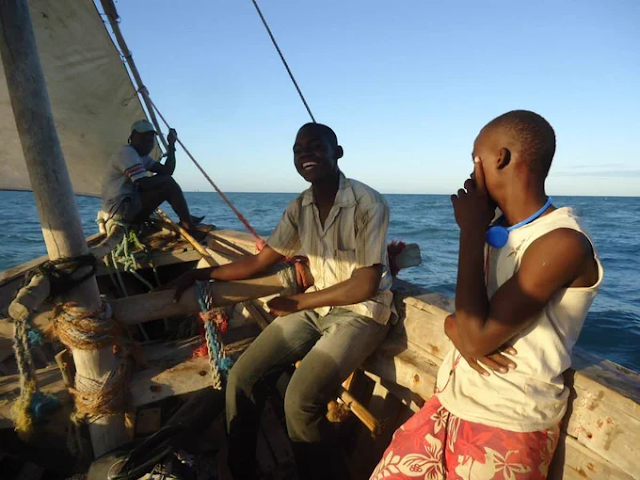
In Zanzibar they advertise Sunset Dhow Rides for tourists and this will be the fate of Ibo, but at the moment there are just teenage boys who come to the Miti Miwiri offering to guide us across the mangrove swamp at low tide to the next island, Quirimba, and bring us
back by boat at high tide. 

One boy suggested this to us, for a reasonable price and we agreed, but he was undercut a moment later by Ibrahim who offered to do take us for whatever we wanted to pay.  He seemed a more enjoyable companion, so my Austrian friends decided to go with him. The first boy was very angry and the next day went to the police to lodge a complaint against the Austrians and the police called on the Miti twice while we were away. I didn’t hear
the end of that story. They were looking for 'a German woman', so the trail was not very hot.

I do not ask enough questions. The walk turned out to take three hours. The mangrove swamps at low tide are a very slithery labyrinth and most of the time we were knee deep in water. It was an interesting walk, fun, but it was not too soon that we came to the open seabed.


As we walked across the seabed the island came into view. Cerulean sky, strange trees, wooden boats on the beach. I suppose one of the most beautiful places I ever saw. And then we saw a Land Rover pull up across on the island, timed perfectly, and one of us said that Johannes has arrived. And so he had. And that meant, after three hours hard walking, that there would be coffee. Good coffee too, because grown locally.


The Portuguese must have felt as if they had found a new planet when they first landed in Africa. When they disembarked at Quirimba they found an important trading post, governed by the Arabs. Perhaps it had been held by the Arabs since the twelfth century, perhaps earlier. Quirimba has not changed very much in eight centuries, although the Arabs are long gone and the Portuguese Empire is gone too. The most important changes, after the conversion of the natives to Islam, probably took place after Mozambique became Communist in 1975: it now has a school, some modern medicine and the people mostly wear flip-flops. The island today has a population of four thousand blacks and two Germans, Johannes and his sister, both in their late fifties. 

Johannes drove us through an Anglo-Saxon village. Huts. A forge.  One man was dressed in scarlet robes and was, Johannes told us, the Muslim priest. Johannes and he are foes. According to Johannes, the priest battens off the villagers and manipulates them to do what he wants,  'because he is slightly more intelligent than they are'.  

Soon we were in their house, being offered brandy, wine or beer – I took local coffee, which tasted good – and Johannes told us his story, which fascinated me.

He and his sister were I suppose among the last survivors of Germany's African empire, which was created by Bismarck and conquered by the British during the First World War, though I know there are some (often very right-wing) Germans in Namibia. I wonder if there are any in Tanzania. These two spoke German, according to the Austrians, of  a dated 19th century kind. They are  German citizens but, until their fifties, neither had been to Germany. Contemporary Berlin was a surprise.

I liked Johannes, a very emotional man, who was dedicating himself to keeping up a tradition that deserved to be kept up and keeping seventy villagers employed. He drank brandy in the morning and smoked hard, which made me feel relaxed in his company. Perhaps he is a Joseph Conrad character. 

Their grandfather had lived in Tanganyika  and, wanting to return to Africa after the Great War, had landed a job in Uganda. One day he decided to leave, ‘took two boys with him’ and began to walk. He walked until he came to Ibo, where he settled. He founded the coconut farm.

At first I thought the Germans were a couple but they were brother and sister and brothers and sisters never grow up in one another’s  eyes and bring out the child in each other. They left the island for South Africa at the age of six but his daughter came back to nurse her father in his last illness and the brother and sister sold their businesses in Johannesburg and came back here six years ago. Things are worse for the blacks they say than in the Portuguese times. Witches from the mainland, whom the Portuguese would never have tolerated, come to the island and con the villagers into paying for potions and spells. One witch conned a man out of his life savings and then gave him a medicine that killed him. I wonder what sort of savings the unfortunate man had.

Johannes does not have a permit for paying guests but they are allowed to have friends to stay. I am tempted to return. With many books on a kindle. No internet.

Do they have any hunting? 
'Only monkeys.' 
Monkeys were everywhere on the island, slipping from trees like small, bald old men.

Johannes took us on a tour but we were pressed for time. He showed us how coconuts are processed. He is busy planting trees, which will take fifteen years to yield useful fruit and have a life expectancy of seventy years. Many trees planted by his grandfather are dying now.  In the coconut warehouse I noticed an odd device made of wood – it was a bow and arrow. The guards use them to keep thieves away and for shooting monkeys. 'I hope they do not kill any people with them', I said. ‘Oh no. Not for twenty years’, Johannes answered airily.

Then he brought us to quite the most wonderful white beach, green turquoise water and one or two children. Reader, if deserted beaches are your thing - but no bars or restaurants - then Quirimba may be for you.

Then back to the house, a coconut curry and much South African wine and we heard more of their story. When the two give up the farm the sister's children will not take it on. They have left Johannesburg for the suburbs of Birmingham and do not want to return to Africa. She said she loves Birmingham. I have always intended not to visit Johannesburg but, hearing that, the picture I had of Jo’burg darkened. 

She said that she had been surprised at how many white people live in Birmingham and told terrible stories of savage murders and rapes in South Africa. These crimes are not racist it seems, just crimes. If whites are often victims it is because they have more stuff. I can see why Quirimba is an attractive alternative.


We could have spent much longer on the island but the tide was high and we had to go. Instead of a three hour walk our dhow ride took an hour and a half through the labyrinthine channels between the mangroves, as darkness fell.  Utter beauty and silence except for the splash of waves and sound of birds.


We had not agreed a price - it was left up to us to give what we thought the day was worth.  We paid $60. We were five so it came to twelve dollars each. Ibrahim, a nice boy, seemed very satisfied. It's a monthly wage in Mozambique.

I wish I were back there now.

For the next stage in my journey, click here,


Friday, 13 September 2013

Second-hand bookshops weaned me

I always loved second-hand bookshops above all things - they were my true alma mater, not my university. But now I see that they are also the last bastions of freedom of speech.

The Bible and Shakespeare would not be published by any publishing house today if they were newly written. Dante consigns Mahomet to Hell, Chaucer is homophobic, Macaulay's opinion of Indians would not be printable, though he liked them, and as for Schopenhauer's views on women, well...

The Bible and all old books and the common law, which is a tradition that goes back to an earlier, era, will increasingly be what keeps freedom of thought alive. Second-hand bookshops are to our age what the monasteries, where monks copied Latin manuscripts, were to the Dark Ages.

Monday, 9 September 2013

Prince of Wales


I think the Prince of Wales is one of the best dressed man in the world but his good taste is not innate. At Cambridge he wanted a suit with horizontal stripes but was dissuaded by his tailor.

There are some English people who say they have nothing against the royal family as people (how could they have?) - it's the idea of a hereditary unelected monarchy that they hate. I, on the other hand, am not interested in the members of the royal family , only in the institution, in the idea of inheritance, a line that goes back to King Edgar and before that to the men in skins who founded Wessex. But I make an exception for the Prince of Wales, whom I love to pieces. He is, I suppose, the Grand Young Fogey, fussing over traditional architecture and the countryside and wanting to reintroduce mutton to England's tables. Not by coincidence does he love Romania so much as do many foreigners who feel out of place in the modern world. Some have even suggested he should be made King of Romania but Romania has a perfectly good king already. 

The Prince is however a collateral descendent of Vlad Tepes as well as a direct descendent of, among many other illustrious men, the Prophet Mahomet.


Monday, 2 September 2013

Which is better - to be a saved or betrayed Syrian?


A.J.P. Taylor once asked this question.

In 1938 Czechoslovakia was betrayed. In 1939 Poland was saved. Less than one hundred thousand Czechs died during the war. Six and a half million Poles were killed. Which was better – to be a betrayed Czech or a saved Pole?

Is it better to be a saved Iraqi or Libyan than to have been left under Saddam's or Gadaffi's rule? We know the answer. So it would be again in Syria if the Americans intervene to

Thursday, 29 August 2013

Speak for England, Ed!

I am in London for several days for the first time in fifteen years and the hot city (scorching hot by British standards) is discussing property prices and  whether 'we' (but do I still feel the British Government is 'we''?) should bomb Syria. Once foolishly I had hoped for democracy in Syria but when the facts change I change my mind and I try to learn from others misfortunes. I prayed yesterday for Mr Cameron to lose his vote in the House and now he has been forced to vote a second  vote before war. Time for public opinion and parliament to try to prevent it.

As the wretched Matthew D' Ancona (repeating, I imagine, what George Osbourne told him) makes clear in this afternoon's Evening Standard, an air strike would not be a punitive strike but a full-scale attempt to win the war for 'the moderate rebels'. 

Monday, 12 August 2013

Ilha de Moçambique diary


The dhow caught the six o’clock tide and after a silent, pellucid journey through mangrove swamps we spent three and a half hours waiting in a bus shelter opposite a baobab tree of

Ibo diary


Mozambique is one of the poorest countries in the world and one of the most expensive to visit. I met lots of backpackers, whom I admired very much (they are almost the only tourists I can tolerate but they call themselves travellers), passing through Mozambique from Malawi by bus, hitch-hiking and dhow. Quite a few were young women travelling
alone. But I simply did not have time. So I paid €350 for two internal flights, one from Maputo to Pemba, the nearest town to Ibo and one from Nampula, the nearest town to Ilha de Moçambique, back to Maputo. I was outraged at this price until I was told I had done very well to get such very cheap tickets. In any case, intermittent fighting has broken out again between FRELIMO and RENAMO in central Mozambique and bussing across the country is no longer advised.

My first childhood holiday abroad was a package holiday in Ostend with a plane that left from Southend airport. In those days people of my grandmother’s generation regularly said things like  ‘Wild horses wouldn’t make me go abroad.’ Yet even though mass tourism had only ruined the Costa Brava, Costa Blanca and Algarve at that stage, I worked out while I was still a schoolboy that the only really undiscovered countries in Europe were behind the Iron Curtain. In the 1980s I wanted to visit Maoist Albania to see Europe’s only untouched coastline, but never did. Now people are travelling as far as Northern Mozambique to see untouched coastline. Southern Mozambique – from the tourist’s point of view a separate country from Northern Mozambique – is resorts for white South Africans. Most of the African coast is beach resorts. 

From Pemba there are many ways to get to the island of Ibo involving minibuses and dhows and the best way is the weekly post-boat. Drivers charge $250 even though the average monthly wage is less than $50. I again chose the easy option which cost $220 and took twenty minutes: a light plane that sailed close to lovely desert islands. My fellow travellers were three very polite and virginal French children in their mid teens, who had travelled from Johannesburg via Maputo that morning and were travelling to meet their parents in Lugenda, which I misheard as Uganda. Their well-bred innocence made the journey seem like chapter 1 of an Enid Blyton story, except that in Enid Blyton foreigners are usually smugglers or gunrunners not heroes and heroines. I felt, dear reader, as if I were in an adventure, by which word I of course have in mind the adventures Enid Blyton’s or Arthur Ransome's children have.

No one from my guest lodge was on the airstrip (a simple field) in Ibo from my hotel to meet me. Entirely my fault. I should have asked them to be. The plane deposited me on a bare field and all there was in sight apart from grass was an enormous four-by-four and a large white South African called John who offered me a lift. He gave an almost imperceptible nod to the black man beside him who took my bag. This seemed like the start of a film. Real life only seems real, for some reason, when it resembles a film or book. I wonder why.

John was retired from the travel business and helping his friend who owns the Ibo Lodge (double rooms $400 a night, all-inclusive). He said something memorable. ‘Travel is part of the entertainment business.’

The Miti Miwiri 

The Miti Miwiri on the edge of the village of Ibo on a sunny afternoon (20 degrees Celsius) – a large house built of stone and dark wood around a central courtyard – was inviting and exuded a calm welcome. Friendly guests and instant camaraderie. A lovely young man called Dimo who said Joerg the owner was away for a day shopping in Pemba. The wide terrace outside my room, overlooking the little town. A single room there  cost me $65 a night, a month's wage in Mozambique, but worth it for what turned out to be a very happy, buzzy, comfortable place, albeit without hot water.

The town is a ghost town. The guide books say that it was an important Portuguese settlement that fell into decay after the 1890s but in fact it was deserted by the Portuguese and Indians in 1975 at independence (Indians from the Portuguese enclave, Goa, colonised the Portuguese Empire just as Indians colonised the British Empire).

The long beautiful coastline that reminded me of the Danube Delta. The same detritus of plastic bottles and rubbish fringing the shore and the same broken buildings. But the Danube, though it has some wonderful desert islands, scotching hot in August too, does not have mangroves.


Ibo is eery and something about the place is unhappy, as ghost towns are. It now consists of ruined stone buildings that did not look much older than a hundred years in most cases and the straw houses where Africans live. They number about 4000. The stone houses are starting to be renovated for tourism but only a very few are so far. So this is the time to go, dear reader. 


The Quirimbas islands are a coral reef. The islands are where the coral extrudes above the surface of the ocean. Ibo is the only island that gets tourists in any numbers and the only one that gets people who do not land from planes. It does not have good swimming, not because of the coral but because it is surrounded by mangrove swamps. This adds to the impression given by the ruined buildings that I have walked into an episode of Scooby Doo. There are no particularly good beaches but the island is great for walking though I was shamefully lazy and sauntered rather than walked.


For sights it has an eighteenth century fortress and church, though Mass is rarely said these days in the church. The Africans are almost all Muslim and were fasting when I arrived for Ramadan, the Muslim equivalent of lent. Eid, the day when Ramadan ends, was much celebrated by people going from door to door dancing, singing and having too much to drink. I was invited to a lunchtime and evening party. Though even in Ramadan drinking had not been noticeable by its absence. Many Mozambiquans are alcoholics, I was told, who drink very cheap industrial alcohol. The Africans in the village seem happy and I think and was told that they are but the boredom of village life must be killing.

Eid


Of course like every good bourgeois I am looking for somewhere authentic and untouched but the sad truth is that Ibo, like Ilha, has just enough tourism to make it fun. Four places to stay plus two camp sites, four restaurants (two pretty good). The best is owned by a Frenchman called Stephan but the elegant Ibo Lodge is good too, inexpensive and  with a wonderful ocean view. The gilded people who stay at the Ibo lodge are more grown-up than the people who stay at the cheaper places and less friendly, because they had purchased an all-inclusive package holiday where luxury was they keynote, not adventure. One of them, a nervous businessman with an attractive younger wife, mentioned to me that he had a friend who owned a nearby island. This was the kind of place for married couples and possibly honeymoon couples. I had the feeling that I was in a Saint story. Why does my mind teem with such unliterary literary parallels?

The Ibo Lodge, incidentally, is by no means the most expensive hotel in the archipelago. One place costs $900 a night.


The island was crowded when I went in early August and my lodge and the Ibo lodge each had 18 guests. The island’s total tourist population probably numbered fifty or more and they were mostly friendly interesting and intelligent. Some gathered for a drink early evening in the courtyard of Miti Miwiri which felt like a subdued cocktail party. It was all instant friends and great fun, my dears, or would have been but for acute sunburn on the backs of my calves after walking for three hours across the mangrove swamps to the next island at low tide.

Two Portuguese factory managers, both born in Angola, told me that nothing had happened after the Portuguese left until Mozambique opened her economy to foreigners in recent years. This is not quite true though as under the dictatorship literacy rates were low in Metropolitan Portugal and Mozambique has registered a huge increase in literacy. A very bright Austrian couple who work for an NGO in Nampula told me that the Portuguese did nothing for the Africans. My own hunch is that the history is written by people who dislike colonialism on principle and that FRELIMO rule was a disaster for the Africans as well for the whites and Asians who fled. The Austrians said that Nampula is a key link in the heroin trail that starts in Pakistan and leads to South Africa. Much of the drugs trade goes through the hands of local Pakistani businessmen who have recently settled in Mozambique. Several people told me that the Asians are much disliked for their commercial acumen by the Africans.


Joerg, who owns half the Miti Miwiri, - he has a partner in Panama who also runs it, one year on, one year off - is a German in his late 30s, who, after ten years in investment banking decided he was not fulfilled so he got on his bike with his then girlfriend and set off across Europe, the Middle East and Africa. In Ibo in 2007, before tourism of any sort had started, although the owner of the Ibo Lodge was preparing to open and he found the place he wanted to live. He bought the title to the ruined house from an African woman who had acquired squatter's rights after the Indian owner had fled in 1975. He forgets whether he paid $1,200 or $1,500 and he had spent many happy years rebuilding the place. He now has a 'local wife' on the island and he nodded in the direction in which the Africans live. 

'He chose a good time to get out of investment banking', said my newly made backpacker friend Maeve, who will be starting work in a bank in Munich in a few short weeks.

I know I have quoted this before but these lines of Philip Larkin came to mind:


"Sometimes you hear, fifth-hand,

As epitaph: He chucked up everything

And just cleared off,

And always the voice will sound

Certain you approve

This audacious, purifying,

Elemental move.


For the next stage in my journey, click here.

Monday, 5 August 2013

Maputo diary


What to do on a Sunday night in Maputo? I am advised not to walk around after dark, not for fear of criminals but of the police. They stop foreigners looking for bribes.

Maputo has the old British provincial Sunday feeling and that introverted Portuguese quality but I think I like it. 

I had a very fine buffet lunch at the famous Hotel Polana, including a wonderful fish which

Thursday, 1 August 2013

Etc.

Nick Cohen 
Terrence Kilmartin the great literary editor of the Observer never went to the office but ran the books pages from Soho pubs (hiring taxis to take the page proofs to Fleet Street). All kinds of young literary types hung around him, and the price for being in his company was they had to drink a great deal. One day one came to him and said, "Terry, I've met this girl." "Good for you," said Terry. "We're going to be married and I can't spend all day and night drinking in Soho anymore. But I want you to know, I'm not stopping because she's made me stop. The truth is I just don't enjoy it anymore." Kilmartin raised his haggard face and his bloodshot eyes bored into the ignorant whelp. "Do you think," he bellowed. "Do you think that any of us do this because we ENJOY it ?"
       

Tuesday, 30 July 2013

Disjointed thoughts on prolific writers, prolific facial hair, pubic hair, and so on

George Saintsbury 


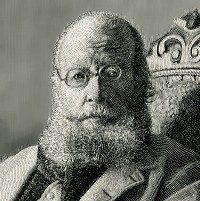
Here is an interesting list of 'the top ten literary beards ranked in order of increasing awesomeness'. A shame though that Edward Lear is missing.
File:Edwardlear.jpg
Edward Lear


Not only did he have a prolific beard but he penned the most famous poem about a beard.

Things I never did


Getting a computer at home that was not connected to the internet simply led me to reread old newspaper articles that I had saved on it. In particular, I enjoyed rereading this one from the peerless Charles Moore, a wonderful writer and a soul-mate, about things he had never done. 

I have never knowingly heard  Bob Dylan, the Rolling Stones, Led Zeppelin, Oasis, Blurr or Coldplay, though my best friend's nephew is the drummer in Coldplay, a fact that makes me feel old. Nor have I heard or heard of almost any other pop group, but I know and like a very few: Bonzo Dog Doodah Band; the Beatles; Mungo Jerry and the Smiths.

I did once try to sew on a button. I have ironed on three or four occasions with limited success. I went twenty years without a camera and now, whenever I buy one, they seem

Sunday, 28 July 2013

Lunch with a Syrian refugee


Until a year or so ago I had never seen a  woman in Bucharest wearing a Muslim headscarf. The head-scarves Romanian peasant women wear are different. Now I see Muslim women and girls almost every day. I started a conversation with two recently and they said they were Syrian refugees staying with their uncle. I  suspect Bucharest is full of Syrians but I can find no  numbers on the internet.


It is a whole year exactly since I last met my Syrian Christian friend, though I had intended to see him much more often. He is a very nice man but I have a self-interested motive, to find out what is really going on in Syria from someone whom I trust and who is a Christian, meaning he is therefore neutral between Sunni, Shia and Alawi.


I invited him to lunch with me but he with characteristic Arab hospitality insisted on inviting me. We ate at Piccolo Mondo, the most famous of Bucharest's Arab restaurants. I of course pumped him.

He is a very discreet man who has a business in Syria and avoids commenting on what is happening there in public. This is why I am not giving his name. A year ago he told me he expected to be back in Damascus in a month, after the Government had been overthrown and peace restored. I knew he would be here for years but said nothing. A year before that, I remember him telling me that he and the other Christians would never leave their country but now I feel he is thinking of spending is life in Bucharest, at least for many years while his children are educated. Two million Syrians he says have left Syria. That's a lot out of twenty-two million and, naturally, they are disproportionately the well-educated and intelligent ones.


Last year he told me all the Christians and almost all the Sunnis wanted the regime to go and even half the Alawis agreed. This time, he talked about the horrors of the war and has even less liking for the regime which has perpetrated so many of them but, in the end, he said quietly that he prefers that the regime wins. The rebels are not organised and if they win or share power chaos will be the result. Rebels are beginning to fight each other and some are coming over to the government side. The best hope, he says, is that the regime remains but reforms itself and a peace is made. I cannot persuade him to say that Christians in general are now on the side of the regime. He is certain that he does not want the UK and France to intervene.

His judgement is, as it happens, exactly the same as the conclusion I had reached, but until I spoke to him I had kept my opinion to myself, waiting to hear what he thought. 


Why did the regime not fall last summer? Because Iran and Hezbollah intervened to support the government.

He also thinks it possible that the fighting in Syria may lead to a redrawing of national boundaries. It is not difficult to imagine the artificial boundaries imposed by Britain and France to create Iraq, Syria and Lebanon being torn up.


He says what he said last year that until the unrest started Shia, Sunni, Alawi and Christian had no problems. I hear many Bosnians tell me the same thing in 1996 immediately after the war ended and I believe him. He emphases now as he did when we first met in Syria long ago that he has very many close Muslim friends and most of the people in his class at school were Muslims. Nevertheless though he likes and admires Muslims, whom he think make good businessmen, he would not invite one into his house '
because their way of thinking is too different'.  Would his unveiled wife wearing lipstick be the reason? Syrian Muslims have told me that if I were invited to their houses their wives would be unveiled. That would only be a small part of the differences my friend says, without enumerating others.


If I were to say that I had many close Muslim or Jewish or black friends but would not let them in my house this would not sound very friendly of me, but in the Middle East, as in Romania, people do not often invite others to their house but entertain in restaurants instead. In addition, in the Middle East men socialise among themselves and Muslims never seem to take their wives out to restaurants.


As I am an imperialist it pleased me to hear him say, without any prompting, how much Syria owed to the French who created the country and ruled it for twenty-five years. His school was built by the French,  the educational system was created by them and they founded hospitals and did other fine things. When the regime complained about French colonial rule this stands in ironic contrast with the way the country was ruled after independence.


It occurs to me as I write this that Ba'athism, founded by a Syrian Christian, in its nationalism, socialism and secularism owes quite a lot to the French, though the former British mandate, Iraq, was also ruled by the Ba'ath. Iraq was ruled brutally and wickedly by Saddam and the Ba'ath, but in Iraq what succeeded the Ba'ath was much worse and so it would be, I think, in Syria.

The Balkans and the Christian Middle East belong to the same cultural space. Syrian Christians, someone in Athens told me recently, like emigrating to Greece more than any other countries, because there they feel most at home. Romania also has many things in common with Christian Syria, including the same Orthodox religion. It will probably also have a sizeable Muslim minority as a result of the refugees. I was told recently that in addition to Syrians there are sizeable numbers of Muslim immigrants entering Romania from other countries and some Romanians have converted to Islam. Until recently Romania had 20,000 Muslims, in the Dobrudgea, the only part of Romania where before 1878 they were allowed to settle, but this figure is out of date.


I believe my friend completely when he says he is not opposed to Muslims but he tells me with utter conviction that I should warn people about the danger of Muslim immigration into Europe. Europe he believes and fears will have a Muslim majority in the foreseeable future. 


Syrian Christians do not understand why European governments are so easy-going and laissez-faire with Muslims and fear that the Muslims will quickly out-breed their Christian hosts. Islam, so Syrian Christians think, is an inherently intolerant and aggressive religion. 

It all sounded like the Catholic Bishop of Zanzibar telling me last year that Westerners should see how Muslims behave where they are the majority.

Friday, 26 July 2013

An Englishman in England might go to prison for calling an MP a coward

This story deserves as much coverage as possible.

Think about it. A man called Alex Cline is being prosecuted simply for calling an MP a coward.

I am not blaming the MP whose complaint led to this grotesque prosecution, though I hope even his party faithful refuse in disgust to vote for him at the next election. No, he did not decide that Mr. Cline should be prosecuted. In any case, I am grateful for this prosecution - because we now know how authoritarian English law has become. Except only readers of the Brighton and Hove local press do. The news may have travelled as far

Monday, 22 July 2013

Praying for a prince, not a princess. Anyway, the rightful King of England is a Bavarian

H.R.H. the Duchess of Cambridge is in labour as I write this. I pray that she is delivered of a healthy prince and we can forget, for a generation, the recent change to the rules of succession to the throne (I assume it has been enacted by now) allowing an elder princess to inherit the throne in preference to a younger prince. If it is a princess I shall feel only great sadness. In the words of the last Lord Chancellor of Scotland, when the Act of Union passed the Scottish House of Lords, it will be the end of an old song.

The new prince or princess will be related to most people you can think of, including Vlad the Impaler and almost all Americans, including: George Washington, Barak Obama, Hillary Clinton and the two George Bushes. He or she will also be a descendant of the Prophet Muhammad, via King Pedro the Cruel of Portugal. If King Edward VII's son and heir the Duke of Clarence was, as some have speculated, Jack the Ripper.... but the better view is that the poor simple-minded Duke was innocent. In any case, the new baby is heir to any number of savage and bloodthirsty conquerors who wore skins. It all reminds me of the birth of Titus Groan, heir to the Earldom of Gormenghast, in Mervyn Peake's great eponymous novel.

I may be wrong but I think this will be the only the second time that three heirs to the English throne in three successive generations are alive at the same time as the Sovereign. The other occasion was the birth of the future King Edward VIII, who was heir to the greatest empire the world had ever known and died a forgotten and déclassé figure living in France. One journalist (A.G.Gardiner I think) described Prince Edward in his teens as 'the greatest gentleman in the Empire', but he was not a gentleman at all. Let us hope the new born baby, who is born to reign over but not rule a social democratic, multiracial island on the western edge of the EU, is a gentleman and that he makes a better king than King Edward VIII.

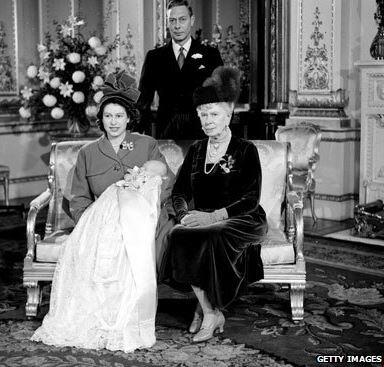
The birth of a royal baby is 'the princely edition of a universal fact', in Bagehot's famous phrase and this is why it is both interesting and boring at the same time, as is the monarchy itself. Here is the new-born Prince Charles, surrounded by King George VI, who had just over three years to live, the present Queen and Queen Mary, widow of King George V:


On July 14th the man whom many (myself included, when I remember) consider the rightful King of England, Scotland and Ireland celebrated his 80th birthday. King Francis II, or as he is usually styled, Francis (Franz), Duke of Bavaria, is the legitimate heir to the House of Stuart. He is the closest living relation to the last legitimate king, King James VII and II, who was overthrown by the English Revolution in 1689 (a coup d'etat or putsch, accompanied by a coup in Edinburgh and, in 1690, a war in Ireland between Protestant rebels and loyal Catholics).

But, though I have been known raise my glass of wine and pass it over the water jug before toasting the King (over the water, the Jacobite toast), would I really want to change matters now? I think I would, actually, although Dr Johnson said if he could restore the Stuarts by lifting his finger he did not know if he would do so and he was speaking twenty years after 1745. However, since the rightful King will never be restored I in practice accept and support the present regime, faute de mieux. Time heals all wounds.

After all, years have gone past and there is a Yorkist claimant too for that matter.

The deputy political editor of The Times, Sam Coates, tweeted today:


Love how Kate gets admitted in early stages of labour. None of the "sod off home again you're not far enough along yet..."

How the National Health Service doth make sullen socialists of us all, all us Britons that is. The implication of his tweet I imagine is that she is getting preferential treatment because she is our future Queen giving birth of our future King or Queen. I assume that she is in any case not using the NHS. Unless the world really has gone mad. 

Hmmm, now I think of it, who knows? Perhaps as part of a drive to make the monarchy seem less elitist? I suspect that the National Health Service means almost as much to the British as the monarchy, possibly more. It certainly means far more than the Church of England or the British Empire.

People are speculating that the baby might be called James or Victoria. Another King James would not be James III but James VIII because James II of England and Ireland was James VII of Scotland- they changed the rules in 1953 to please the Scots. A King James VIII would be very good for unionism in Scotland. Victoria II would be a wonderful name too even though I hope it will not be a princess. Some website opines that the new prince or princess will be named Qatar Airways as part of a sponsorship deal. I thought this rather droll.

Saturday, 20 July 2013

The free society and its enemies

Two stories in today's papers fill me with dread. 


The  Independent today is exercised about the choice of a former Playboy model as television presenter as successor to Barbara Walters, for a leading American show. Some years ago, and not so many, the fact that they she had modelled naked would have caused dismay, at one time from respectable people and later from feminists, but this does not seem to be, as they say now, 'an issue'. The problem is that the former model is opposed to vaccinating children against measles and other childhood ailments, which she thinks can cause autism.

I am not interested in American television presenters, except to note that they are often blonde and very pretty. I am slightly interested in autism but what is much more interesting is the sense that we are living in an increasingly closed society. I suppose that this lady's fears about vaccines are probably baseless, though no-one knows for sure. I have no doubt that by expressing them she will dissuade some parents from vaccinating their children and it may be that deaths of children will even ensue. Perhaps she should be told not to mention the subject on the air. Her employer is certainly within his rights to do so, but in that case what about freedom of speech?

Had she said she was opposed to homosexual marriage things would look much worse for her. Had she admitted in a sworn affidavit, as happened recently with another American television star, that she had used the word 'nigger' (at some unspecified point in her life) she would not have been given the job, although Miss Paris Hilton narrowly got away with it. And so it goes.


The other story is one that has run for several days in England about a sports commentator on the BBC who said of a woman tennis player that 'she is never going to be a looker'. This was probably true, though unchivalrous, but he is not in trouble for being inaccurate, unchivalrous or downright rude, but for being sexist. He has been publicly humiliated and might lose his job. 

I do not accept that considering, talking about and treating women differently from men is wicked, if that is what sexist means. I am also aware that women judge one another on their appearance, just as men judge women on their appearance, and that this is because appearances are very important. Especially for women, but for men too to a lesser degree. I do not think that the remarks were sexist, in any case, though by using the word one concedes ground to the feminists. Plenty of women make cruel remarks about men's appearance.

But this is about political power over people's lives, not courtesy towards women. The idea is to make sure people who have an old-fashioned, inarticulate liking for old ways of thinking, or not thinking, are kept in a state of low-level apprehension about voicing their opinions on the important things in life, such as sex and race. England's cleverest Prime Minister, Arthur James Balfour, said that society is perpetually persecuting, but this does not come from society spontaneously policing itself. It comes from powerful opinion formers, who prod people like cattle about what to think or pretend to think. How did they gain the power they now wield? I do not know, but I do know that, though it began in the 1960s, it largely happened while Conservatives like Margaret Thatcher were in office and Marxists were surrendering in the Cold War,

There are increasingly authoritarian societies on both sides of the Atlantic, and how far removed we are from those two great Anglo-Saxon (well English, anyway) virtues: a sense of humour and common sense. We are living in an age of compulsory niceness and, for people who fail to live up to the rules about niceness, things can instantly become very, very nasty indeed.

Witness Emma West, the woman on the train who ranted about black people not being British and ended up spending Christmas in prison, while her child was taken into care. It took them eighteen months, with the threat of her going back to gaol and losing custody of her child, before she agreed to plead guilty to whatever racially aggravated offence she was charged with. Witness the man demoted at work for saying on his Facebook wall 'Gay marriage in church would be a step too far'. Witness the Oxford undergraduate who spent a night in the cells for making a homophobic remark by telling a mounted policeman that his horse was gay, the Protestant missionaries who were told by the police that they were not allowed to distribute their leaflets in a 'Muslim area' of Liverpool and the man who was fined for revving his car 'in a racist manner' when two people from the Indian Sub-Continent walked past. He said he hadn't noticed them, but he lost his case.

Once, recently, English society had its own power structure, wholly separate from the state, expressed in sexual conservatism, the class system and social deference, which told people how to behave and stigmatised those who broke the rules. Britain's real religion, in Maurice Cowling's phrase, was low-key respectability. People kept an eye on their neighbours and sometimes tutted about things they did not care for. Some people cared about what other people thought and some did not give a damn. People's lives were narrower in those days, but they could say most things they liked. People sometimes used to reply, if you asked if you could sit at their table in a railway station café, 'It's a free country'. Now, instead, we have state-enforced means of telling people how to live their lives. In place of organic inequality we have synthetic egalitarianism, enforced by employment laws and the police. No-one says, even in joke, that this is a free country, because everyone knows that it is not and that this is no joking matter.

We were once a rational civilisation. How do we fight against all this?


Tuesday, 16 July 2013

The world’s ten most beautiful buildings


Taj Mahal

Lonely Planet is always spamming me with things - of course I could unsubscribe but I like being reminded of travel possibilities when I am supposed to be working. As Tony Hawks put it 
'I travel a lot; I hate having my life disrupted by routine.'

I rarely open them as I consider Lonely Planet my sworn foe and the foe of civilisation (along with Al Qaeda, feminism and out of town shopping centres) but I did look at this list of the world's most beautiful buildings.


First the boast, which is what travel is now all about. Which ones have I seen? Four: the Aya Sofia, the Winter Palace; the Taj Mahal and Craque des Chevaliers.

I longed to see the Sagrada Familia from childhood but when I spent 24 hours in Barcelona my childhood training, looking round churches with my father on holiday, was too strong. I did not really have time for both and Barcelona Cathedral, being mediaeval, had to have priority I felt. A mistake, though Barcelona Cathedral is quite wonderful. Did I glimpse the Sagrada Familia from a bus or train? I think yes, for a moment.

I stayed three nights in a hotel a very short distance from the Winter Palace but never entered. A wise Russian woman (that makes her sound like a witch but she was nothing of the sort) whom I made friends with advised me that the Hermitage required an entire day and as I had only three in St Petersburg I should devote them all to St Petersburg. She was right.

Winter Palace

T.E. Laurence visited Craque des Chevaliers about twenty times (he also left the Hotel Baron in Aleppo, where I also stayed, without paying his bill). Craque des Chevaliers is simply astonishingly beautiful. Though I used to love castles so much as a young boy, my adult taste is for churches, but Craque des Chevaliers is incomparable. Do its friends shorten its name to Craque? It seems a gross familiarity for such a noble structure.

Aya Sofya

When I first visited it the Aya Sofia reminded me of a bus station, as the aunt says it does in Graham Greene's Travels with my Aunt. Travels with my Aunt was written in the early 60s, when Istanbul seemed to the meek retired bank manager nephew and to almost all Greene's readers an impossibly exotic place. An era long before Lonely Planet readers settled on every old city like vultures on carrion. I thought the Blue Mosque amply achieved its aim of being more beautiful. I am no longer so sure and in any case think the Aya Sofia very beautiful or at least thinks its icons and interiors very beautiful, which is not quite the same thing.

Which would my ten be?

The Taj Mahal. I suppose the most beautiful building I ever saw. I have almost forgotten its association with Diana, Princess of Wales but for some reason I do not remember it very well. I know it was as beautiful as it looks in pictures, which means the most beautiful thing on earth, women excepted.

The Royal Maritime College, Greenwich, is like a chord of music. It pips Trinity College, Cambridge Great Court. (Why did I let my headmaster talk me out of applying to Trinity?Apart from the Wren architecture, Dryden and Macaulay were two of my great heroes, not to mention Bentley, Wordsworth and Byron. And in my year, the first where women were admitted, I had two girls I thought stupendous, both now TV stars, Vanessa Feltz and Daisy Goodwin.) I might give the Royal Maritime College second place.

Aachen Cathedral

St. Peter's in Rome

The Blue Mosque

St. Mark's in Venice

The Lloyd's Building, London

Where else? I have three places left.

English churches come to my mind like Rochester Cathedral, Waltham Abbey or Wells Cathedral or....  Clare College, Cambridge? One of the wonderful churches in Georgia? The Stavropoleos Church in Bucharest is no slouch and probably beats even the gorgeous monasteries of Armenia. If paintings rather then architecture is our criterion then Suceviţa monastery in the Bucovina certainly deserves a place. The Houses of Parliament, a.k.a. the Palace of Westminster, where I began my career and adult life? For Barry's structure and Pugin's interior design of the House of Lords I think possibly yes. But St James's Palace is more beautiful....

I have decided. The last three places go to:

The Stavropoleos Church, Bucharest

Beaumaris Castle, Anglesey (a surprise finisher which came up suddenly from behind) Perhaps I chose it because I was 11 when I was there and could see beauty much more easily than I can now.

St. Mary's Church, in the market square in Cracow.

And Trinity College Great Court. Even though it fills me with jealousy and regrets that I went to Queens's, which had a 1970s dining hall. Eleven.


Sunday, 14 July 2013

A long weekend in Kadakoy = Chalcedon

I spent a wonderful long weekend in Istanbul, which I do not quite have the courage to call Constantinople, even though an  other worldly parson friend encourages me to do so. Actually I was not in Istanbul but in Kadakoy, on the Asian side, which is very easy to get to from the Gokcem airport, where the budget airline Pegasus flies to. Pegasus is a delight among budget airlines, flying at normal times from Bucharest and using spacious planes. 

And Kadakoy is Chalcedon, where the Council of Chalcedon met! I could google to remind myself what that famous and great ecumenical council decided, but the truth is I do not any longer know and I leave you to  find out. Kadakoy, unlike the tourist museum Sultanhamit, where no Istanbulians venture, is the real Istanbul. More so also than the charming Beyoglu, where the restaurants are, which is the much more charming, Turkish-elegant equivalent of Covent Garden. Kadikoy is not plant for the tourist industry. Relaxingly, it has no sights. It just is and is a busy little port on the Bosporus, full of cheap hotels. The Kadikoy bazaar, which twenty years ago was just shops and stalls, is now home to some restaurants too and they specialise, of course, in freshly caught fish.


Nimet

So my friend Tufan told me after inviting me to meet him in an excellent one, called Nimet, where we sat drinking much raki (I have a childish delight in watching it turn white when water is added), eating delicious fish and discussing God and the events in Taksim Square. 

My friend is an old Communist (Turkey much more even than Greece abounds in them and they are sound anti-Islamists) who feels that thanks to the events in Taksim bliss is it in this morn to be alive, even if he is not young enough for it to be very heaven. He spends every evening there and gives advice to the kids on what to do. He it was who said having gathered a huge crowd they had to do something and persuaded them to march across the Bosporus bridge and confront the police. I felt sorry for my friend that his gammy leg stopped him leading the procession to its denouement. He is the stuff of which charismatic revolutionary leaders are made but is far too decent and good to last long in a real Bolshevik regime.

Kadakoy market has a buzz at night. There seemed no foreigners but probably there were some - foreigners are everywhere these days. People played good street music. A girl, her eyes shining with idealism, came round singing an unmelodious song about the demonstrations in Taksim. Tufan gave her money but I think on political not musical grounds. It was late and dusk was gathering at the close of a long hot summer day. Turkey feels modern but it has a lot of texture. Romania is much less modern but is slightly thinner.

Kadikoy is where the ferries leave for the Spice Market on the European side, one of the areas of maximum interest to visitors, so it is a great place to stay to see Istanbul. The drawback of Kadikoy is the length of time it takes by road to cross the bridge. Getting to Edirne for the oil wrestling festival took me five hours each way as opposed to three hours when i went from Taksim. Istanbul my friend said had a population of two million when he was a boy. Now it is twelve of thirteen, perhaps fifteen million. This is what would happen to all the big cities of Europe were there no planning restrictions and this is why property prices rose so high around the world and then became so disastrous a bubble. The huge drift of Anatolian peasants to Istanbul is a small part of a great exodus of people from the poor world towards richer places, especially Western Europe, which will transform bourgeois Europe.

Dinner with two old friends in Nimet again and breakfasting with some more Turkish friends, still in Kadakoy. At breakfast I met a Turkish political scientist with whom I discussed Erogan and Enver Pasha. Like so many Turks I have known she had just made her first visit to Greece and loved it. Greeks I know have made the same discovery in reverse and when I was in Athens recently I was told a Turkish production - mirabile dictu - was the most popular soap opera. I said that Greeks and Turks had so much in common and the political scientist said it's a shame that Greece and Turkey did not remain one loosely federated country. I warmly agreed and was pleased to hear a Turk say so. And had they held onto the Arab lands they would have had all the oil and there would be no Middle Eastern problem.

Had Turkey and Greece remained one country perhaps Constantinople would have continued to have a Christian majority, as it did in 1914, Adrianople continued to have roughly equal numbers of Turks, Greeks and Bulgarians and Salonica remained a leading centre for Sephardic Jews. I feel that at least Constantinople, Salonica, Smyrna and Jerusalem should have been made international cities or independent city states, but the spirit of the times was strongly in favour of nation states. I wonder if Mr. Woodrow Wilson is in hell.

Now these cities, with the partial exception of Jerusalem, have been ethnically cleansed and are dull reminders of their vibrant pasts. Formerly homogeneous cities in Western Europe, by contrast, have become full of many races, even as their respective host cultures have become semi-American.

By a piece of luck, as I walked back to my hotel to pack and leave, I stumbled on Mass in an Armenian church. I counted about forty people in the congregation. There are, I doscoverd, somewhere between 40,000 and 70,000 Armenians in Turkey, mostly in Istanbul, though no-one seems very sure. There are others who have converted to Islam and become Turks or Kurds or have pretended to have done so (the so-called crypto-Armenians).In 1914 there were up to two million. What happened to them is not well documented at all but it seems that most were killed and the rest fled or shed their national identity. As Adolf Hitler is said to have said (though this has been questioned) 'Who now remembers the Armenians?'

I have decided after some hesitation in the past that, like many of my friends, I do love Istanbul, even though it is a pale shadow of the real Constantinople, built of wood, full of ghosts, where Muslims were a minority. The real Constantinople lasted until property developers ruined the place in the 1950s, 60s and 70s. Until the inter-ethnic riots in 1955 there were still plenty of Greeks too.


Istanbul is wonderful, a bright, happy place, very modern despite its monuments, but, coming back, I definitely prefer Bucharest. Prefer it for being much smaller and much more old fashioned, more shadowed, more provincial, much less globalised too. For being a gossipy 19th century village. Odd to think that fifty years ago both cities had populations of two million. Now Istanbul is a mega-city like Delhi or Bombay and has at least six times more people, housed in 
seemingly well constructed tower blocks built by housing cooperatives. These cut a very favourable contrast with Bucharest's jerry-built blocks of flats. If I lived in one I should much prefer to live in Istanbul. For a weekend or a holiday it is delectable.


Friday, 5 July 2013

Twenty-four hours in Adrianople


Related image
In 1990 when I took a traın journey to Constantınople and fell ın love wıth Romanıa I had planned a day ın Adrıanople or Edırne but dıd not make ıt. I spent a couple of hours here fıve or sıx years ago and now have come back to the loveliest city I have been to ın Turkey.

Adrıanople was capıtal of the Ottoman Empıre for the best part of a century before Constantinople fell. After the Balkan Wars it remaıned ın Turkey but only just. The Bulgarıan and Greek borders are a few mıles away and both Bulgaria and Greece occupied the city at different moments. In the Battle of Adrianople in 1913, in the Second Balkan War, the town had the sad dıstınctıon of beıng the fırst town in the world to be bombed, if we ignore the Austrian bombing of Venice, using bombs carried in pilotless balloons, in 1849.

At one point in the Balkan Wars the Sultan thought it should be made an international city, with provisions to ensure the wonderful mosques were well kept. Part of me wishes it had ended up in Christian hands (a hundred years ago the population of the town was the usual mishmash of Turks, Greeks, Slavs, Armenians, Jews and Gypsies) but I doubt they would have preserved the lovely mosques. (I wonder if there were churches in the city. I saw no reference to any.)

The people have ıncredıble hospitality lıke all Turks. I had just arrıved and a nıce man from the bus ınsısted on fındıng and drıving me to my hotel. The Turkısh hospıtalıty ıs ınfectıous and two foreıgners then bought me lunch then took me to drınk Turkısh coffee ın the wonderful garden of the Hotel Edırne Palace where they allowed me to pay. Nıce people but one of them, grey haired and grey bearded, was  52 and though thıs ıs only one year older than me I feel confused to be wıth such aged people. Especially when they have wives children and own companies in various places. And yet the people of 29, whıch I feel ıs my real age, now seem unınterestıng. 


My pals took me to see the oıl wrestlıng and then to a hamam (Turkish bath). Karım gave me a wonderful massage and then trıed to be over famılıar. No thank you I saıd feelıng very Brıtısh. The last man to feel me up was Danny Blancheflower ın brıght green evenıng dress at a receptıon at the Cambrıdge Union. 

I am supposed to be here for the annual week-long oıl wrestlıng festıval and I must say oil wrestlıng ıs one of the dullest pastımes ımagınable. Far from the stands in which spectators sit, young sallow men grapple with each other. An umpire stands close peering at them until one falls to the ground and then, after a while, that is it. Even crıcket ıs more excıtıng. I remember Dr Johnson said ıt ıs a sad reflectıon on the paucıty of human pleasures that huntıng ıs accounted one of them. He could have been talkıng about oıl wrestlıng. But I am glad I went, because the festival has been held since 1346 and persuasively claims to be the oldest sporting competition in the world. It is also good for the soul to remember how uninteresting sport is. One feels purified.

I love this town, which, now cleansed of all but Turks and a few Jews, feels like Edirne not Adrianople. An obscure jewel, dım, unfashionable  down at heel, full of beauty.  It has three very fine mosques but either they are not as movingly beautiful as the ones in Istanbul or I am losing interest in mosques. The former is likely, but mosques are very empty and one can only admire tiles for so long. Perhaps the austerity of Islam, which had a cold beauty in my eyes, now seems slightly lifeless. 

Raki was very hard to find (Islamisation or just that people prefer beer in Edirne?) but I found it at last in in a little place called, appropriately, Raki, an open air restaurant on a shopping street, where the kebabs were good. Most of the customers were old men (a good sign) and all save one middle-aged couple were men which reminded me of the Middle East.

I am typıng thıs ın an ınternet cafe - Adrıanople ıs the sort of place that stıll abounds ın them (as does Istanbul which tells you Turkey is still Third World) and the Turkısh undotted ıs I hope gıve my post the qualıty of beıng wrıtten ın a mınor Hıttıte scrıpt or in a Moabite cypher. (There was once a dull book by a very dull detectıve story wrıter called R. Austın Freeman called The Moabıte Cypher - one of the best tıtles for a story I ever came across. A book of his I read, The Eye of Osiris, had an equally good title and was equally pedestrian. Someone saıd readıng Freeman was lıke chewıng straw whıch was about rıght.)

I wanted to stop here in 1990 because I knew that it was in its small towns that one saw and felt a country and it is true. Especially of not very prosperous towns that get few tourists, like Edirne, because they are not very accessible. Edirne is one of those towns, Arad and Oradea in Romania are two other examples, which became separated from their hinterlands by political boundaries and have become dusty backwaters where they could have been thriving centres. In the 19th century Adrianople was the capital of all Thrace and had 100,000 inhabitants of various races and faiths, but by 1945 it had about a quarter of that, all Muslim Turks apart from a few Jews.


Edirne is in Eastern Thrace. Western Thrace is in Greece. Although Western Thrace was exempted from the compulsory population exchanges under the Treaty of Lausanne, which ended the Greek-Turkish War in 1923, but Eastern Thrace, including Edirne, was ethnically cleansed, like everywhere in Greece and Turkey except for Constantinople. This was very sad, especially because, oddly enough, most of the Thracian Turks lived in Western Thrace and most of the Greeks in Eastern Thrace. The forced migration caused great suffering, before tobacco was planted by refugee Turkish farmers in the vineyards of Eastern Thrace, where Christians had cultivated the vine for centuries.

Since then bigger population transfers have taken place in Western Europe. As a Greek once said, everything flows.

Thursday, 4 July 2013

Treason ne'er doth prosper

Apparently today is American independence day. a day to remember the brave patriots who fought and in many cases died or were exiled for their loyalty to their king. God bless the American Tories and loyalists. Their defeat was the death of American conservatism.  As Michael Wharton used to say, perhaps one day the rebel colonists will realise the benefits of fealty to Her Majesty. Reunited, our new empire would be the world’s dominant power for the foreseeable future, unchallenged by any other powers brought against it.

Tuesday, 2 July 2013

Three very recent British immigration statistics


9% of British people under 25 are Muslim, according to the 2011 Census, which, incidentally, will be the last census in the United Kingdom.


Mathematicians among my readers will realise that this means, barring some unforeseen event like the arrival of millions of Hindus, Christians or sun worshippers on our shores, that in the future at least 9% of British people will be Muslims. I presume that illegal immigrants in general do not fill out census forms and so this does not take account of them, nor of differential rates of natality among different religious groups. 


Nor does it take into account new immigrants. Sir Andrew Green of Migrationwatch has said that,
'More people migrated to the UK in 2010 than from 1066 to 1950.'

Readers will remember that the Labour Government left office in May 2010 and David Cameron became Prime Minister promising to reduce immigration to 'the tens of thousands'.


Another set of figures just published by the British Department of Education show that almost one fifth of pupils in primary education (I think in England and Wales but the Daily Telegraph does not make this clear) speak English as a second language. This follows a sharp rise in the number of foreign-born pupils over the last 12 months. The details are here.