Thursday, 31 October 2013

Hallowe'en - and vampires - in Romania

Hallowe'en is an ancient Catholic tradition but now just an excuse to make money and for American cultural imperialism. But whatever you think of it, it has an apostrophe in it, people.

This is what I wrote last year about Hallowe'en in Romania.

This, on the subject of real-life vampires, of whom I have known two or three in Romania, might also be of interest.

Catholics celebrate the unknown saints in heaven on All Saints' Day, November 1. The Secklers in Harghita and Covasna, who are Catholics, on this day dress the tombs of their family members and gather at them with candles - it is a very big occasion. On the eve of All Saints - Hallowe'en - the souls of the dead who are in Purgatory are said by tradition to haunt the earth.

This explains Hallowe'en's Catholic origins and why Protestants don't like it.

Saturday, 26 October 2013

A weekend in the Secklerland


No-one knows what these paintings on the church tower at Csikrakos (Racu) mean. The tower is said to have been built in 1080 though no-one is sure. The most recent theory is that the paintings derive from the pre-Christian religion of the Hungarians and their close cousins the Secklers. Without examining the evidence one just knows this explanation is

Thursday, 24 October 2013

Why we live abroad

The heart is the undiscovered country. You travel to a foreign country to discover your unconscious mind.

Laurence Durrell said you have two birthplaces. The place where you are born and the place where you learn about life. For me an adolescent of 36 my second birthplace was Bucharest.

For some people who do not put their feet on the ground and take part in life there can be a transparent sheath between themselves and life. They are tourists all the time, in their home town or when they are travelling. Perhaps I am one of these people. I felt throughout my four years at Cambridge that I was a tourist there. In London where my contemporaries were pursuing paths to money and love I walked around with an acute overwhelmingly passion for the city which you can only feel if you grew up in Southnd-on-Sea. 

Philip Guedala said of Michael Arlen’s characters they walk down Jermyn St with such an acute sense of its being Jermyn St that one almost suspects them of being in London for the day. Perhaps this is how I have lived in Bucharest in the last twelve years. Perhaps this is why I like being a foreigner here rather than feeling a foreigner in my own country. How awful to feel at home somewhere. Does anyone feel at home anywhere? Does anyone interesting? Perhaps grown-ups do. Perhaps that is one definition of being grown-up.

If as Malcolm Muggeridge said sex is the mysticism of materialism, then this can also be true of travel too. And not particularly the beach holiday kind of travel so much as the more adventurous travel. Travel agents sell dreams. Only books and travel have the qualities of dreams and for the young only dreams are real. Reality is a terribly dull thing. When one gets older life acquires a texture and begins at last to one’s surprise to feel real, which means like a novel. About the same time novels seem less interesting. For some people perhaps travel does too?

When I came to live in Bucharest in 1998 I felt that I was a character in a novel by Joseph Conrad in the South Seas in the 19th century. The foreigners who had floated here after the revolution who could have been creations of Conrad in ironic mode. Bucharest had changed a lot between 1990 when I first visited and 1998 when I came to live here but it seemed extremely far away from the western world and it seemed in some ways still living in if not a nineteenth century novel then the early 50s at any rate. Later I refined it to 1959 . When I flew back I felt for a few hours like a character from star trek materializing slowly on another planet. 

Romania was last of all the former Communist countries to become globalised, except for Belarus and possibly Albania but seems infinitely more like everywhere else. At the same time the western world, once known as the civilised world, seems a concept which is time limited. And the idea of Romania has changed because countries mean much less than they did before the internet and cheap travel. 

Will Romania still exist in fifty years? One economist I know doubts if anyone will still speak Romanian in fifty years time. What is the point of the language?

Travel books are like all literary genres from another age, when abroad had another meaning . When John Paget wrote almost no-one among his readers, all people who paid income tax and a tiny fraction of the English population had been to Hungary or heard of Transylvania. For a long time travel was expensive and difficult and travel writing was information for the curious and a story with the writer as protagonist. And funny foreigners. All foreigners for the most liberal Englishmen were very faintly comic until some moment some time after we joined what was then called the Common Market. Now they are something to help us choose where to go on holiday, to prepare for holidays and to compare notes afterwards. And writers create the country they write about. Arabia is about Wilfred Thesiger. Delhi is now about Sam Miller and William Dalrymple a literary construct. 

And countries are an idea which is changing. And the word foreign is changing too. Will Romania be a country in fifty years time or a part of a big non-country called Europe? Countries are about traditions and therefore anachronistic. And about excluding foreigners which seems xenophobic and discriminatory. And about violence in the past the future sometimes in the present. And about languages but languages are being subverted by English. Countries are a difficult concept in the post-modern post-Marxist world.

Wednesday, 23 October 2013

Our Man in Havana

This was first published in Vivid in 2004.


Life in Bucharest has been transformed since the bloody events of December 1989 but three large apartments in a 1960s block in Mihai Eminescu have escaped the changes. Marked only by a discreet  flag and a yawning squaddie on guard they house the Cuban Embassy, a serene place where nothing much has altered since Fidel Castro’s Cuba and Nicolae Ceausescu’s Romania were friendly socialist countries. I was received there recently with

Sunday, 20 October 2013

The strange charm of dereliction


I published this deeply irresponsible article in the Bucharest Daily News back in 2005 and it was and is a cri de coeur. Someone pointed out that it was printed next to a worthy article calling for more investment in infrastructure, by my friend, Dan Visoiu. It is a synopsis in one page of the book I am writing about the Paris of the East.
"Bucharest has a lot to do in order to become a city worthy of the status of a European capital." 
This headmasterly admonishment was made by Jonathan Scheele, the soft-spoken British civil servant who heads the European Commission Delegation in Romania, at last week's "Investment Opportunities in Bucharest" conference.

Am I alone in dreading the day when Bucharest becomes worthy of the status of a European capital? To my mind it's the nicest European capital because it is unworthy of Mr Scheele's esteem. What other capital in Europe is nearly so unself-conscious, so unlike the
rest, so full of energy and shadows and yes so un-European, despite the satanic malls, hypermarkets, highly paid foreign consultants and other horrors of democracy? I know the streets become unfordable rivers when it rains. I know I should be pleased when the
potholes and the broken pavements are renewed with EU pre-accession funding but I am not. Irresponsibly I am elated by a beauty I find in the dereliction and have been since my first visit in 1990.


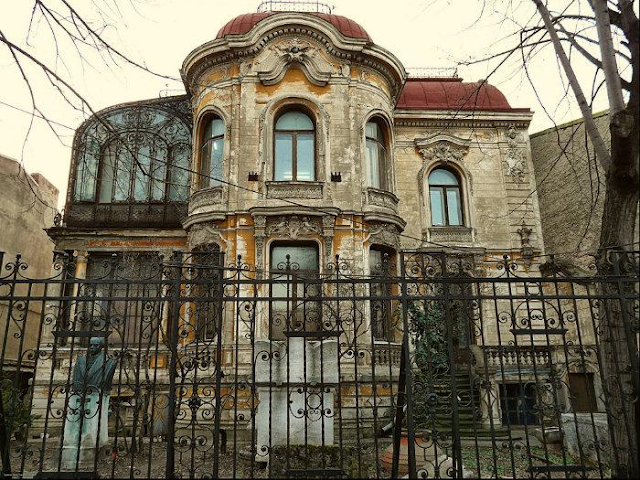
The wooden Ottoman Bucharest of 1830 where the men wore turbans and kaftans was rebuilt in the late nineteenth century in stucco and brick, its architects paying homage to Paris and an imaginary Orient at the same time. Later came Art Deco buildings that are unequalled anywhere in Europe. Bucharest was up to the minute in architectural terms before the war and ahead of for example Paris herself. But the faux-French surface of Carol I's Bucharest has been badly cracked over the last sixty years.


Nothing in this city apart from a score of churches is old but those parts that escaped the 1980s rebuilding feel more than half as old as time. I haven't passed the Museum of Archaeology for a couple of years ago but then behind its padlocked iron gates half-lost amid tall grass stood a long row of Roman tombs and statues, protected from the rain by a rotting eave. It seemed to me whenever I passed as if the Museum itself were becoming an archaeological object and I were the archaeologist stumbling across it for the first time.

Image result for Museum of Archaeology "Vasile Pārvan"


The decrepit fin de siecle villas and filthy Art Deco masterpieces are becoming one by one a real estate broker's dream of avarice as they are painted and varnished to look the way they originally looked. But for me at least the ramshackle way the streets look now, especially under a melancholy November sky, has a greater beauty than when they are new and shiny.


The old town when I moved there five years ago was not a museum but a slum and the one part of Bucharest where you felt you were in the Near East. The gypsies were part of the reason but it went deeper than than. Now especially that it has been pedestrianised it is on the way to being a complex of restaurants and antique shops. When Bucharest starts receiving tourists in numbers it will go the unauthentic way of the historic centre in every other European capital.


Dirty, disreputable, frivolous but gloomy, full of laughter and misery, mercenary and mystical, improvised, exasperating and serendipitous, Bucharest is a city which either repels you or steals your heart. The kiosks which made a Bangladeshi friend of mine compare Bucharest to Dakar have been eliminated at Mr. Basescu's command. So have the packs of occasionally ferocious stray dogs but it will be fifteen or twenty years before Bucharest ceases to feel Third World. When it does will it have become almost as dull as Athens? Very possibly but let us hope if Bucharest must emulate European cities she can become not Athens but Naples.


But one problem cannot wait fifteen years and cannot be romanticised away. The gridlock in the centre of the city gets worse at a tempo so fast that the deterioration can be observed on a weekly basis. Road-widening and road-building unless very sensitive to the city's architectural heritage will destroy Bucharest's semi-rustic character. What after all is the northern stretch of Calea Victoriei than a country lane? Luckily the solution to the traffic problem is easy. Charge motorists for entering the city centre between 8-6 weekdays and encourage Bucuresteni back to their city's excellent public transport system. It worked in London and would work here. Does any politician have the courage to adopt this idea? Mr. Scheele, what do you say?


Saturday, 19 October 2013

The sexual revolution in Iran, Romania and Northern Ireland


This is a very interesting article on sex in Iran, by Afshin Shahi in Foreign Policy. It shows how very Westernised Persians are, thanks, I suppose, to the Shahs. 
It reminds me too that the sexual revolution in the 1960s permeated the Iron Curtain and reached even faraway Bucharest. Though other aspects of the 1960s social revolution did not, for which I am pretty thankful. 
It may be too that sex before marriage is a political gesture in Iran. Irish Catholic girls in the 1980s told me Ulster Protestant girls slept around because they read The Sun and, as Unionists, wanted to resemble girls on the mainland.

A wise thing on the subject of the sexual revolution was said by Dorothy Day, the Communist activist who converted to Catholicism. 
The Sexual Revolution is a complete rebellion against authority, natural and supernatural, even against the body and its needs, its natural functions of child bearing. This is not reverence for life, it is a great denial and more resembles Nihilism than the revolution that they think they are furthering.
This seems to me to be true and to apply, among other things, to homosexual marriage.

Wednesday, 16 October 2013

Ireland, a poor, half-witted, gypsy relative of England

I just came across this brilliant remark about Ireland by Hugh Trevor-Roper, thanks to Henry Hopgood-Phillips. I love it though though I know Trevor-Roper was that most objectionable thing, a Protestant atheist.
'Through all our history she clings to us, a poor, half-witted, gypsy relative, defying our improvement, spoiling our appearances, exposing our pretences, an irredeemable, irrepressible slut, dirty when we are most clean, superstitious when we are most rational, protesting when we are most complacent, and when we are most prosaic, inspired'.

Romanians at work


This article first appeared in Vivid magazine in 2003 and the world it describes has changed enormously, but not completely beyond recognition. 

Romanians have spent thirteen difficult years of transition “encamped like bewilderedtravellers in a garish  and unrestful hotel” in the phrase of Joseph

Tuesday, 8 October 2013

'That so few now dare to be eccentric marks the chief danger of our time'

John Stuart Mill

That so few now dare to be eccentric marks the chief danger of our time.

Ronald Firbank 


`O, help me heaven,' she prayed,`to be decorative and to do right.'

'The life of nations, no less than the life of men, is lived largely in the imagination'


Roger Scruton
The fact is that the people of Europe are losing their homelands, and therefore losing their place in the world. I don’t envisage the Tiber one day foaming with much blood, nor do I see it blushing as the voice of the muezzin sounds from the former cathedral of St. Peter. But the city through which the Tiber flows will one day cease to be Italian, and all the expectations of its former residents, whether political, social, cultural, or personal, will suffer a violent upheaval, with results every bit as interesting as those that Powell prophesied. 


Charles Moore

All this [mass immigration] need not be a total disaster. It is possible, though hard, to forge a United Kingdom made up of many ethnicities. Leaders like Mr Cameron are right to try to insist on common standards and better rules, rather than to despair. But whatever it

Sunday, 29 September 2013

The slave trade 'rescued slaves from night-black Africa'

It is clear that there are certain people who are free and certain who are slaves by nature, and it is both to their advantage, and just, for them to be slaves. Aristotle


It would be very interesting and perilous to write the history of the Africans in North America from an objective point of view. 

Slavery, as opposed to serfdom, faded out in Europe by the 12th century and was abolished by the British Empire in 1833 - other countries following us. Outside Europe, slavery had always existed and was probably justifiable in prehistoric times and in primitive tribal societies. Life in such societies was, in any case, nasty, brutish and frequently short.  

Slavery is in the forefront of people's minds these days not because it was a cruel institution, but because it was an example of white people exploiting brown ones. We hear less about the African slaves owned and traded by Arabs. We hear next to nothing about the 23 million Russian serfs, one-third of the Russian population, who greatly outnumbered the fewer than four million American slaves and who were freed in 1861 by Czar Alexander II. 

At school we might have heard of the English thralls, including those enslaved by the pagan Danes, but one rarely hears of the white slaves captured by the Barbary pirates, or of slavery in India or China. Slavery in China was abolished in 1909 but continued until 1949 under the Nationalists. Under Chinese Communism it continues to this day, of course - the slaves are nowadays prisoners. In its more traditional form, slavery continues in Mali and other parts of Muslim Africa.

Ad


Slavery is therefore not something for which only Europeans, and in particular the British and Americans, are to be blamed. On the contrary, Europeans, in particular the British and to a lesser extent the Americans, can be credited with its abolition.

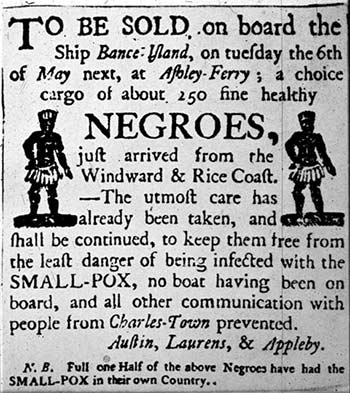
However terrible slavery in the Americas was, and it certainly very often was (as was serfdom in Europe), slavery was an African institution, as it was an institution in most primitive societies, which whites adopted. The African slaves were enslaved by other Africans, who sold some of the slaves to white men. 

Slavery is barbaric, but it brought African slaves to civilisation, as a very good interview with the (black) Governor-General of Jamaica in the Spectator reminds us.  I cannot forbear to quote a few lines from it:
As we waited for the tea, Cooke began to speak in patriotic terms of Jamaica as a colony of "marvellous antiquity", far older even than British India or Australia. 
"Now hear me on this. When Australia was just a convict settlement, Jamaica was an established outpost of British commerce and British civilisation. "Civilisation? "Yes," he replied. "Even during slavery the British were sending some very good people out to Jamaica . . . missionaries, reformers . . . but, as I said, to Australia, just convicts." 
"But Jamaica was a brutal place . . . the plantation," I said. 
Cooke was not going to condone slavery, was he? 
"Well, neither am I going to harp on about the wickedness of slavery. Jamaica's greatness was due entirely to slavery." 
Yes, the iniquities; yes, the horrors; but slavery, for all its manifest brutality, had rescued Cooke and his forebears from "night-black" Africa and shown them "true" (that is, British) civilisation.
Sir Howard Cooke is a British patriot to put both the BNP and British intellectuals to shame.

An interesting proof of the civilising effects of slavery is that the freed American slaves who settled Liberia did not intermarry with the natives but treated them as coolies and regarded themselves as representatives of a higher civilisation, which of course they were. I remember people wrote about Liberia as the first free black African country, when it was in fact the last colony. The rule of the 'Americo-Liberians', the black colonists, was only ended in 1980, by a military coup.

I once outraged a liberal Anglican parson friend of mine, who was a very intelligent trained philosopher, when I suggested slavery was a relative rather than an absolute evil. He congratulated himself that he did not think like this, but I have never known how Christians can square the idea of slavery as an absolute evil with the fact that the Old Testament takes it for granted and approves of it. I recently came across, thanks to Mr. Valentin Dimitrov, this very interesting explanation of why slavery might have been morally acceptable in the time of King David and later but not in America in the 18th or 19th centuries. 

Saturday, 28 September 2013

Bishop Spong and the death of God


I came across these insightful words by John Shelby Spong, about priests facing the congregation, which seem accurate. Spong is the wildly liberal bishop of the Episcopalian Church in the U.S.A. 

"This shift has become almost universal in liturgical churches over the last fifty years. Though it seems a minor change and has been defended by proponents in a variety of ways, it signifies to me the gradual realization of the death of theism. The priest or pastor with his or her back to the people is addressing the

Saturday, 21 September 2013

The Prince of Wales is now the oldest heir to the throne since the Electress Sophia

21 September, 2013

HRH the Prince of Wales was already the heir to the throne who has remained heir apparent the longest. Today he passes the age when King William IV ascended the throne. He was 64 years, 10 months and 5 days old when he became King. He had been heir presumptive to his brother, King George IV (William was heir presumptive not heir apparent because the elderly King George IV could theoretically have married and fathered a child, who would have inherited the throne). 

Prince Charles will be, God willing, the oldest king in our history to ascend the throne. He is the oldest immediate heir to the throne for almost 300 years. 

The one older immediate heir to the throne was the Electress Sophia of Hanover, who died, aged 83, in 1714. after running to escape a shower of rain. (Sophia, of course, has a long 'i' - to rhyme with 'via'.) Queen Anne died a few weeks later at the age of 49 and Sophia's son became King George I. Or the usurper, George of Hanover, if you are a Jacobite. 

Sophia, who never visited England, was the daughter of Elizabeth Stuart, James VI and I's daughter, who was for a few months the famous Winter Queen of Bohemia. The Electress Sophia, unlike her royal descendants, who have been singularly philistine (the present Prince of Wales is the first exception), was a woman of culture and erudition. She was a good friend of Liebnitz, with whom she corresponded. Like Jeeves, her favourite author was Spinoza.


There are some English people who say they have nothing against the royal family as people (how could they have?) - it's the idea of a hereditary unelected monarchy that they hate. I, on the other hand, am not interested in the members of the royal family, only in the institution, in the idea of inheritance, a line that goes back to King Edgar and before that to the men in skins who founded Wessex. 

But I make an exception for the Prince of Wales, whom I have come to love as I have watched him grow out of his long drawn-out and gawky hobbledehoyhood to become the eccentric toff he is today. I suppose being married to a woman with borderline disorder tried him in the fire. He is the Grand Young Fogey, fussing over traditional architecture and the countryside and wanting to reintroduce mutton to England's tables. Not by coincidence does he love Romania so much, as do many foreigners who feel out of place in the modern world. Some have even suggested he should be made King of Romania but Romania has a very good king already. 

The Prince is, by the way, a collateral descendant of Vlad Țepeș and is said to be  a direct descendant of, among many other illustrious men, the Prophet Mahomet, through Peter the Cruel of Portugal, though doubt has been cast on this.

I think the Prince of Wales is one of the best dressed man in the world but his good taste is not innate. At Cambridge he wanted a suit with horizontal stripes but was dissuaded by his tailor. Actually it might not have been a bad joke, but I don't think the Prince was the man to carry it off.

Second-hand bookshops weaned me

I always loved second-hand bookshops above all things - they were my true alma mater, not my university. But now I see that old books are also the last bastions of freedom of speech.

Saturday, 14 September 2013

Quirimba diary


In Zanzibar they advertise Sunset Dhow Rides for tourists and this will be the fate of Ibo, but at the moment there are just teenage boys who come to the Miti Miwiri offering to guide us across the mangrove swamp at low tide to the next island, Quirimba, and bring us
back by boat at high tide. 

One boy suggested this to us, for a reasonable price and we agreed, but he was undercut a moment later by Ibrahim who offered to do take us for whatever we wanted to pay.  He seemed a more enjoyable companion, so my Austrian friends decided to go with him. The first boy was very angry and the next day went to the police to lodge a complaint against the Austrians and the police called on the Miti twice while we were away. I didn’t hear
the end of that story. They were looking for 'a German woman', so the trail was not very hot.

I do not ask enough questions. The walk turned out to take three hours. The mangrove swamps at low tide are a very slithery labyrinth and most of the time we were knee deep in water. It was an interesting walk, fun, but it was not too soon that we came to the open seabed.


As we walked across the seabed the island came into view. Cerulean sky, strange trees, wooden boats on the beach. I suppose one of the most beautiful places I ever saw. And then we saw a Land Rover pull up across on the island, timed perfectly, and one of us said that Johannes has arrived. And so he had. And that meant, after three hours hard walking, that there would be coffee. Good coffee too, because grown locally.


The Portuguese must have felt as if they had found a new planet when they first landed in Africa. When they disembarked at Quirimba they found an important trading post, governed by the Arabs. Perhaps it had been held by the Arabs since the twelfth century, perhaps earlier. Quirimba has not changed very much in eight centuries, although the Arabs are long gone and the Portuguese Empire is gone too. The most important changes, after the conversion of the natives to Islam, probably took place after Mozambique became Communist in 1975: it now has a school, some modern medicine and the people mostly wear flip-flops. The island today has a population of four thousand blacks and two Germans, Johannes and his sister, both in their late fifties. 

Johannes drove us through an Anglo-Saxon village. Huts. A forge.  One man was dressed in scarlet robes and was, Johannes told us, the Muslim priest. Johannes and he are foes. According to Johannes, the priest battens off the villagers and manipulates them to do what he wants,  'because he is slightly more intelligent than they are'.  

Soon we were in their house, being offered brandy, wine or beer – I took local coffee, which tasted good – and Johannes told us his story, which fascinated me.

He and his sister were I suppose among the last survivors of Germany's African empire, which was created by Bismarck and conquered by the British during the First World War, though I know there are some (often very right-wing) Germans in Namibia. I wonder if there are any in Tanzania. These two spoke German, according to the Austrians, of  a dated 19th century kind. They are  German citizens but, until their fifties, neither had been to Germany. Contemporary Berlin was a surprise.

I liked Johannes, a very emotional man, who was dedicating himself to keeping up a tradition that deserved to be kept up and keeping seventy villagers employed. He drank brandy in the morning and smoked hard, which made me feel relaxed in his company. Perhaps he is a Joseph Conrad character. 

Their grandfather had lived in Tanganyika  and, wanting to return to Africa after the Great War, had landed a job in Uganda. One day he decided to leave, ‘took two boys with him’ and began to walk. He walked until he came to Ibo, where he settled. He founded the coconut farm.

At first I thought the Germans were a couple but they were brother and sister and brothers and sisters never grow up in one another’s  eyes and bring out the child in each other. They left the island for South Africa at the age of six but his daughter came back to nurse her father in his last illness and the brother and sister sold their businesses in Johannesburg and came back here six years ago. Things are worse for the blacks they say than in the Portuguese times. Witches from the mainland, whom the Portuguese would never have tolerated, come to the island and con the villagers into paying for potions and spells. One witch conned a man out of his life savings and then gave him a medicine that killed him. I wonder what sort of savings the unfortunate man had.

Johannes does not have a permit for paying guests but they are allowed to have friends to stay. I am tempted to return. With many books on a kindle. No internet.

Do they have any hunting? 
'Only monkeys.' 
Monkeys were everywhere on the island, slipping from trees like small, bald old men.

Johannes took us on a tour but we were pressed for time. He showed us how coconuts are processed. He is busy planting trees, which will take fifteen years to yield useful fruit and have a life expectancy of seventy years. Many trees planted by his grandfather are dying now.  In the coconut warehouse I noticed an odd device made of wood – it was a bow and arrow. The guards use them to keep thieves away and for shooting monkeys. 'I hope they do not kill any people with them', I said. ‘Oh no. Not for twenty years’, Johannes answered airily.

Then he brought us to quite the most wonderful white beach, green turquoise water and one or two children. Reader, if deserted beaches are your thing - but no bars or restaurants - then Quirimba may be for you.

Then back to the house, a coconut curry and much South African wine and we heard more of their story. When the two give up the farm the sister's children will not take it on. They have left Johannesburg for the suburbs of Birmingham and do not want to return to Africa. She said she loves Birmingham. I have always intended not to visit Johannesburg but, hearing that, the picture I had of Jo’burg darkened. 

She said that she had been surprised at how many white people live in Birmingham and told terrible stories of savage murders and rapes in South Africa. These crimes are not racist it seems, just crimes. If whites are often victims it is because they have more stuff. I can see why Quirimba is an attractive alternative.


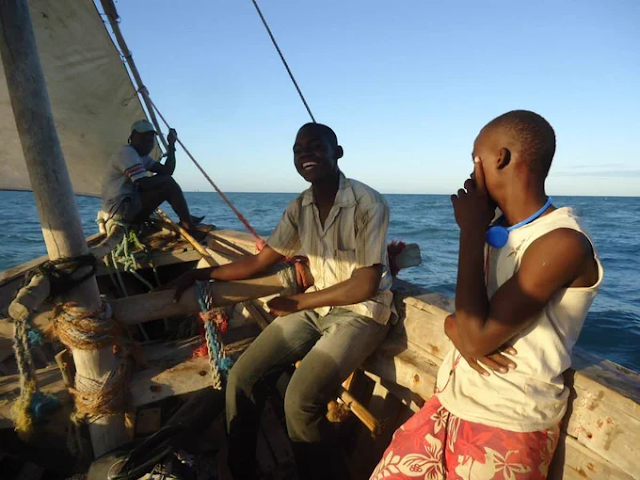
We could have spent much longer on the island but the tide was high and we had to go. Instead of a three hour walk our dhow ride took an hour and a half through the labyrinthine channels between the mangroves, as darkness fell.  Utter beauty and silence except for the splash of waves and sound of birds.


We had not agreed a price - it was left up to us to give what we thought the day was worth.  We paid $60. We were five so it came to twelve dollars each. Ibrahim, a nice boy, seemed very satisfied. It's a monthly wage in Mozambique.

I wish I were back there now.

For the next stage in my journey, click here,


Friday, 13 September 2013

Second-hand bookshops weaned me

I always loved second-hand bookshops above all things - they were my true alma mater, not my university. But now I see that they are also the last bastions of freedom of speech.

The Bible and Shakespeare would not be published by any publishing house today if they were newly written. Dante consigns Mahomet to Hell, Chaucer is homophobic, Macaulay's opinion of Indians would not be printable, though he liked them, and as for Schopenhauer's views on women, well...

The Bible and all old books and the common law, which is a tradition that goes back to an earlier, era, will increasingly be what keeps freedom of thought alive. Second-hand bookshops are to our age what the monasteries, where monks copied Latin manuscripts, were to the Dark Ages.

Monday, 9 September 2013

Prince of Wales


I think the Prince of Wales is one of the best dressed man in the world but his good taste is not innate. At Cambridge he wanted a suit with horizontal stripes but was dissuaded by his tailor.

There are some English people who say they have nothing against the royal family as people (how could they have?) - it's the idea of a hereditary unelected monarchy that they hate. I, on the other hand, am not interested in the members of the royal family , only in the institution, in the idea of inheritance, a line that goes back to King Edgar and before that to the men in skins who founded Wessex. But I make an exception for the Prince of Wales, whom I love to pieces. He is, I suppose, the Grand Young Fogey, fussing over traditional architecture and the countryside and wanting to reintroduce mutton to England's tables. Not by coincidence does he love Romania so much as do many foreigners who feel out of place in the modern world. Some have even suggested he should be made King of Romania but Romania has a perfectly good king already. 

The Prince is however a collateral descendent of Vlad Tepes as well as a direct descendent of, among many other illustrious men, the Prophet Mahomet.


Monday, 2 September 2013

Which is better - to be a saved or betrayed Syrian?


A.J.P. Taylor once asked this question.

In 1938 Czechoslovakia was betrayed. In 1939 Poland was saved. Less than one hundred thousand Czechs died during the war. Six and a half million Poles were killed. Which was better – to be a betrayed Czech or a saved Pole?

Is it better to be a saved Iraqi or Libyan than to have been left under Saddam's or Gadaffi's rule? We know the answer. So it would be again in Syria if the Americans intervene to

Thursday, 29 August 2013

Speak for England, Ed!

I am in London for several days for the first time in fifteen years and the hot city (scorching hot by British standards) is discussing property prices and  whether 'we' (but do I still feel the British Government is 'we''?) should bomb Syria. Once foolishly I had hoped for democracy in Syria but when the facts change I change my mind and I try to learn from others misfortunes. I prayed yesterday for Mr Cameron to lose his vote in the House and now he has been forced to vote a second  vote before war. Time for public opinion and parliament to try to prevent it.

As the wretched Matthew D' Ancona (repeating, I imagine, what George Osbourne told him) makes clear in this afternoon's Evening Standard, an air strike would not be a punitive strike but a full-scale attempt to win the war for 'the moderate rebels'. 

Monday, 12 August 2013

Ilha de Moçambique diary


The dhow caught the six o’clock tide and after a silent, pellucid journey through mangrove swamps we spent three and a half hours waiting in a bus shelter opposite a baobab tree of