Tuesday, 20 May 2014

Do 97% of climate scientists agree that mankind is causing global warming? Apparently not

Is there anything more fun than a bad-tempered academic debate? It looks more and more that climate change fears are a lot of hot air but it is great watching warmists getting angry. 

I think the trouble all flows from liberalism, classical liberalism, with its overvaluing of reason and humanity. 

Here is today's blow in the prize-fight, yet another good jab by the sceptics.

Rethinking universities


Universities should only exist online (with a small number of exceptions like Oxford and Cambridge, which are needed to create an elite and provide a holiday camp for clever boys and girls). 


University lectures should be put online. Universities should be online. (Except Oxford and Cambridge and a small number of others where academics would be reared.) That would increase life chances, spread learning, reduce class discrimination and reduce student indebtedness.


Online lectures and courses already exist but it is not about online courses - it is about making degrees taken by distance learning have the same weight as conventional ones. In fact abolishing almost all conventional universities. It is about breaking the way education is misused to create unjustified stratification of society. Let universities be about learning not about tickets to get a job and let them be open to all regardless of brains or money.


Vocational training courses - such as accounting and business - should also be available online of course. I don't see why places that teach 'business' should be allowed to usurp the noble name of university but perhaps that is not so important as destroying conventional universities. These seem nowadays to be businesses, which provide their consumers with tickets to middle class jobs while, in the arts subjects, they also disseminate socially liberal or left-wing ideas.

Wednesday, 14 May 2014

"Academics say that traditional teachers' titles such as 'Sir' and 'Miss' should be axed"


Today's Daily Telegraph bears this baleful news:
"Academics say that traditional teachers' titles such as 'Sir' and 'Miss' should be axed, with pupils being expected to use first names to drag schools into the 21st century."
I remember how shocked I was to learn in 1996 that the boys at my grammar school, Westcliff High School for Boys, Essex, no longer call each other by their surnames. Even as sixth formers drinking illegally we did so. 

Anyway, here is the enemy of civilisation, hierarchy and tradition in clear sight. This is what we are fighting against. 

Why call schoolmasters by their Christian, sorry first, names? The reason is to do with sexual equality. 'Sir' apparently sounds well but not 'Miss' (which is rather working-class but this is not the point) or Madam or Ma'am. The article quotes,
Robin Lakoff, professor of linguistics at the University of California, Berkeley, in the US, said the traditional title for male teachers “always conveys respect” while Miss does not. 
“It’s very hard to create linguistic equality between people who, in many people’s minds, aren’t equal,” she said. “At school, we have children who are still really only learning language. They pick up on it very readily and then the next generation gets exposed to the prejudices of the previous generation.”
Once this kind of thing would have been laughed at by most people, certainly by most readers of the Daily Telegraph, but many of the opinions of what, in the late 1970s, was known as the Loony Left are now part of the ruling consensus. While the free marketeers concentrated on moving economics rightwards society and culture continued to be moved (it was mostly not spontaneous) in the opposite direction. We all know this but what do we do about it? Fight back, obviously - with laughter and argument. Instead of calling teachers by their christian names insist they wear gowns, as in Will Hay films - something they would love and which would cheer us all up. 

Once schools were supposed to teach the catechism, love of country, knowledge of national history, Latin and Greek, the manly and womanly virtues. Of course they did not do a good job of it and schools were awful places, but now schools, British state schools at least, proselytise a secular religion of equality and 'human rights'. To its adherents, who are include most teachers and opinion-formers, this philosophy is manifestly good, but objectively it is propaganda.

[I am an enormous Will Hay fan by the way - this can be the subject of another post. For now here is 'Good Morning, Boys'.]

Saturday, 10 May 2014

Why we travel

I was so saddened to be told last night that there are now budget flights from England to Georgia.

I want Georgia to remain my secret country, like something out of a children's story, my secret garden. It's like learning there are now budget flights to Narnia.

I suppose this remark may indicate my intrinsic immaturity, but if so so be it.

After someone, I think it was Gertrude Bell made her way, with difficulty to Samarkand she was surprised to find that as she left they were organising charabanc trips there though I do not recall from where. Now Tibet is ruined by tourist tat and I wonder whether Xanadu is tourist-free. If so then it is some dreary Communist town in China.

The past is the undiscovered country and ones unconscious mind. It is ones unconscious that one is really exploring when one goes abroad. This is the attraction of all travel, a form of spirituality.

Great books not to bother with


What great books should we leave unread? An article in the Guardian asking this question prompted me to answer it.


I would start with all books by Henry James. Perhaps Fitzgerald and Hemingway too? And T.S. Eliot's poetry, but not his prose. Definitely The Scarlet Letter. Three or four people recently have assured me that Don Quixote is worth reading. I have grave doubts but may have a go. I did start and hugely enjoyed the Decline and Fall, then put it aside but shall finish it. I managed to get through and enjoy even Paradise Lost by listening to the BBC audio version. I started the Fairy Queen when I was 11 which was much too young (or perhaps was exactly the right age). Perhaps I shall go back but I know I am kidding myself.
Looking at what I wrote it seems I like all books that are not American but I do like some Americans: Raymond Chandler, Mark Twain, Damon Runyon up to a point, Archy and Mehitabell, James Thurber sometimes, Dr. Seuss.


I am annoyed to find people who studied or even lectured in English are not particularly well-read but then the hero of Lucky Jim, was a university lecturer "whose policy it was to read as little as possible of any given book." Someone quite well-known, I forget who, who went to my college did a Ph.D. on Morte d'Arthur without having read it. I read it and loved it aged 11 -the only age when you can enjoy it - and was furious when I learnt about this.

Another article in the same paper gives an interesting list of overlooked books that you should perhaps read. I only read one, The Young Visiters, which is very funny. I have been meaning to read Oblomov all my adult life but have been too lazy.

Another overlooked novel is The King of Elfland's Daughter which I thought the best book ever written when I was 12. Then it was replaced by Taras Bulba which held the title till I was 26 and discovered Stendhal. Charterhouse of Parma still my fave but I am no longer the same person I was at 26.

My teenage tastes sound highbrow but I also read Conan the Barbarian which is the thirteenth stroke of the clock.


Thursday, 8 May 2014

Why is Romania different? Religion has a lot to do with it

I realised only now that Romania's intense religiosity is not an Orthodox or Balkan thing. Serbia, Bulgaria and Russia are much less religious. About Greece I don't know. Quite unconsciously it is one of the reasons why Romania is so much more more attractive a country than her neighbours.

People go to India for spirituality - but I do not find India or the East very spiritual. They should come to Romania, especially Bucovina or the monasteries in Moldavia. Or for a very spiritual pre-Christian place, Sinca Veche.

On the subject of Eastern spirituality, I want to quote again Edward Norman, my favourite living historian, religious commentator and favourite Englishman:
"Through contact with liberal and Christian values the other world religions were sanitised and made acceptable to Western sensibilities: widows were no longer incinerated alive on their husbands funeral pyres, and the way was opened for that late-20th-century phenomenon, the Western idealising of Oriental religiosity, beads and mantras in Californian condominiums."

Tuesday, 6 May 2014

I finally got to Kosovo


I decided to get to Kosovo after many years of thinking about it. I took a plane from Bucharest to Belgrade as the night train has been discontinued for a couple of years. Then a bus to Novi Pazar, which I had wanted to visit for over twenty years, since reading about the Sanjak of Novi Pazar in Barbara Jellavic's History of the Balkans.


Enchanting Serbian countryside seen from the window of the crowded bus. It is good to leave the European Union and to be in a nice unglobalised country. The scenery and the monasteries are what Serbia offers - the towns are unremarkable. The same is true of all the Balkans except the towns that the Germans and Hungarians built in the Hapsburg lands.


The Hotel Vrbak, Novi Pazar, once considered an architectural gem. The reception was eerily empty when I went in to ask directions. Nothing is more dead than a future that has failed.

Novi Pazar was a rather typical Yugoslav town, albeit a Muslim one, with some headscarved and some veiled women. It was a public holiday - 1 May - and the town was closed and it drizzled. Yugoslav towns always abound in cafes, terraces that stay open very late, 1970s architecture and - in Belgrade at least - a kind of 1970s sexiness, like a film version dubbed into Serbo-Croat of a Jackie Collins novel.


I took a cab for EUR 35 to Mitrovica which is divided between the Serbian north and the Albanian south and put up in the North City Hotel. I enjoyed a typical Kosovar dish, prizrenska tava, in my hotel in the divided town of Mitrovica. It is made of minced veal, cheese and eggs. Rather good. Belgrade just offers grilled meat, but very good grilled meat. In Northern Mitrovica the main streets full of wooden shacks and kiosks from which goods are sold. Unlike in Novi Pazar where the town was dead because of the public holiday North Mitrovica at sunset was buzzing with activity and a sense of improvisation. It felt poor.

To my surprise the next morning I walked across the bridge that divided the Serbian north of the city from the main city which is purely Albanian and was not asked for my passport by the KFOR soldier who stood there. Checkpoint Charlie it is not. Serbs and Albanians can go freely from one part of the town to the other but they do not.


The bridge that divides Serbian, Christian Northern Mitrovica from the Albanian, Muslim side of the town. The KFOR man did not look at me when I crossed.
Jonathan Swift said, 'We have just enough religion to make us hate, but not enough to make us love one another.'

We in the West are now busy creating an ethnic and religious mosaic like the one that used to exist in Eastern Europe before ethnic cleansing gave things a terrible simplicity.

In the 1990s I was certain Milosevic and Serbia 
were in the wrong in all the Yugoslav wars and wanted Western intervention. Since then Western intervention has almost always been disastrous. Were Messrs Blair and Clinton right about Kosovo? The atrocities committed by the Serbs were extremely exaggerated, we now know, and the Kosovo Liberation Army did terrible things. I suspect that this war too was a mistake, but I need to find out much more

The next day a driver recommended by a friend who lives in Pristina took me to the lovely old town of Prizren. The town was once the capital of Old Serbia but what can be seen today is Turkish. It reminds me of the wonderful Albanian towns of Berat and Gjirokastra but both of them were when i went there several years ago absolutely untouched by tourism, uncommercial, a place where old men sipped tea and smoked cheap cigarettes on stools outside cheap shops. Prizren too is innocent of tourism but is a buzzy warren of bars, restaurants, shops and life.


Castle half a mile outside Prizren

The interior of the beautiful old church was destroyed by Muslims in 2004 , five years after the Serbs were forced out, as, the keeper told me, were one thousand other churches in Kosovo. I am opposed to capital punishment but would happily see the perpetrators hanged in public.


Pristina proved an interesting place. It has two or three noble mosques (the mosques are noble inside, though from outside they are less so) but its interest is in its present-day political situation. I was shown around, unfortunately after dark, by a very intelligent American who loves there and who believes Kosovo was the 'last just war'. 

Two weeks later the Guardian published this article about Pristina's new mayor. It confirmed my intuition that the Kosovo war was not just, was unwise meddling. I was interested to read recently Andrew Rawnsley say that it was Tony Blair who persuaded bill Clinton into this adventure.


Prizren, Kosovo, the Sinan Pasha mosque: unusual non-geometrical frescoes.


Monday, 5 May 2014

Was the Cold War necessary?

This is a fascinating article by one of my favourite historians, Lord Skidelsky, about the Cold War and whether it will start all over again now. I did not known that the Cold War dismayed George Kennan "who claimed that containment was meant to be economic and political, not military. He was one of the main architects of the post-first world war Marshall Plan. He opposed the formation of NATO". This is exactly what I always thought - that the Cold War was unnecessary. The Cold War did however to a large extent keep the peace, if you were not living in Angola or Vietnam.

Sunday, 27 April 2014

Easter in the Bucovina

In the end, from all my options for Easter, including Mount Athos, Meterora, Kiev, Transylvania, Rome and Clacton-on-Sea, I chose to return to Bucovina and the wonderful painted monasteries, which are for me the most lovely things in Romania, which is saying a very great deal.

Actually, wanting to see what was going on in Ukraine, I went to both Northern and Southern Bucovina. Northern Bucovina has been in Ukraine since the Soviet troops got there in 1944.

For those who don't know, the Bucovina was part of Moldavia that was taken from the Sultan by the Hapsburg Emperor in 1775 to link Galicia (Austrian Poland) to Transylvania. In 1919 the Bucovina was given to Romania but the northern half was seized by Stalin in June 1940. Sometimes people say that this was agreed under the Molotov-Ribbentrop Pact of August 1939 but, in fact, Russia's annexation of Bessarabia (which is now the Republic of Moldova) and the Northern Bucovina had not been agreed with Germany. Romania, allied to Hitler, took it back in 1941. Stalin regained it in 1944. 

Most of the Romanians fled or were deported to Siberia after 1944, but I noticed that the villages near the Romanian border have signposts in both the Cyrillic and Latin alphabets. This means that the villagers, or some of them, speak Romanian, are Romanians.

The name Bucovina means land of the beech trees and they are everywhere on the rolling hillsides. 

The capital of the Bucovina under Austria and until 1940 was Cernauti. This is its Romanian name, it's Czernowitz in German or Cernivtisi in Ukrainian. It was an enormous pleasure to return for my second visit.  Since my first visit I have had the chance to hear a lecture on life in Cernauti before 1914 by an Australian historian - Bucovina was Austria's equivalent of the Wild West, an unsettled place where fortunes could be made and lost and where people of all ethnic groups settled, Jews being the largest group. People of different ethnic groups never live side by side in complete amity but the citizens of Cernauti seem to have got by without too many great problems. The end of the Habsburg monarchy and war was to change this.

For decades I only travelled in post-Communist Europe and I still find it depressing to go to Western Europe. All that shininess and affluence make my heart sink. But I went to Western Europe for the monuments and to places like Burma and Mozambique to see the world until I realised that it is only Eastern Europe that I really love - where people are human and  normal. I especially love Ukraine and dear Cernauti, which are like Eastern Europe used to be in the late 1990s. 

Last time I was there, in 2007, I thought it was much like Satu Mare or Baie Mare or many other Austro-Hungarian towns but it is more charming than they are. The buildings are wonderful pastel shades in the early evening sunshine and there is an indescribable calm here which is only found in countries which are not powerful or rich or in the EU. What a joy it is to leave the EU, although the people of Western Ukraine would probably love to join it.

We arrived on Good Friday, and the mauve-pink Cathedral, once Romanian Orthodox and now one of the three kinds of Ukrainian Orthodox, was thronged with worshippers. I spent ten minutes there but my friend who had driven me to Cernauti stood outside waiting for me and so I went out again by that same door wherein I went, sorry that I should miss the Burial of the Lord ceremony, when a coffin is taken in procession around the church and nearby streets.

We walked around the lovely town bathed in evening sunlight and the sense of pleasing melancholy that you get in provincial towns towards the end of day, especially in obscure countries.I had looked forward to  chatting to locals about revolution and war but there was no-one to talk to. We did see an impromptu shrine to the heroes killed at the Maidan in Kiev, two of whom were local men or boys. Then we looked through the empty town for somewhere to eat and ended up eating a wonderful halibut at our hotel, the Hotel Bukovyna and salmon blinis. Far too big a feast for Good Friday, I know.


We spent Saturday morning mooching around Cernauti and then went back to the future in Romania where we stumbled on the wonderful little painted church at Padrauti. Rain-swept and chilly it was easy to imagine Stephen the Great winning a battle against the Muslims in this remote barbaric spot.


Padrauti

Then Suceava and though the town was closed for Easter we ate a really wonderful tochitura in a brasserie called Centru Vechi. I realise that huge portions are the Bucovinan idea of hospitality. Even I, even I, left half my food.

I found the war memorial in Suceava saddening. Romanians should have avoided war in 1877 and 1916. Had Romanian borders not been enlarged in 1919 Romania might have kept out of Second World War and avoided Communism. On reflection, though, this last idea is unconvincing because even had Romania remained neutral in the First World War Bessarabia (now Moldova) would still have dropped into her arms after the Russian revolution and therefore would have been taken back at some point by Stalin. It would however have been in Romania's interests to stay out of the Great War and in the interests of her allies too. Norman Stone said that the entry of Romania on the Allied side in 1916 delayed the Allies' victory by a year.

In Suceava I read about the fifty thousand Jews rounded up into the Cernauti ghetto by Romanians by order of Antonescu in 1941 and later killed. I had forgotten this until someone reminded me. attended the Catholic Mass and then the Orthodox, which moves me much more deeply. The latter ended at 3.30 and then I found Lidia Rusu, with whom I was staying, who drove me back - it took over an hour - to Vama.

Sunday lunch was cooked by Lidia Rusu's husband who is the best cook I have encountered in fifteen years in Romania. I knew an equally good Hungarian cook in Transylvania in the early 1990s but she moved to Hungary and, alas, she is dead. In any case it is not possible to compare Hungarian food with Romanian food. The meal was wonderful and unfortunately I found I did not a strong enough personality to resist the home-made tzuica.

Vespers at the village church (a pretty one built in 1990 but to the same design as churches had long ago). Then my second visit to the Vama Egg Museum, now much bigger than in 2002 and a thriving business with painted eggs from around the world. I saw an ostrich's egg, which in Switzerland had been cut open and made into the replica of a church complete with congregation. But the painted eggs from the region were the point of the exhibition. Painting eggs (emptied of their contents first) are the Bucovinan tradition.

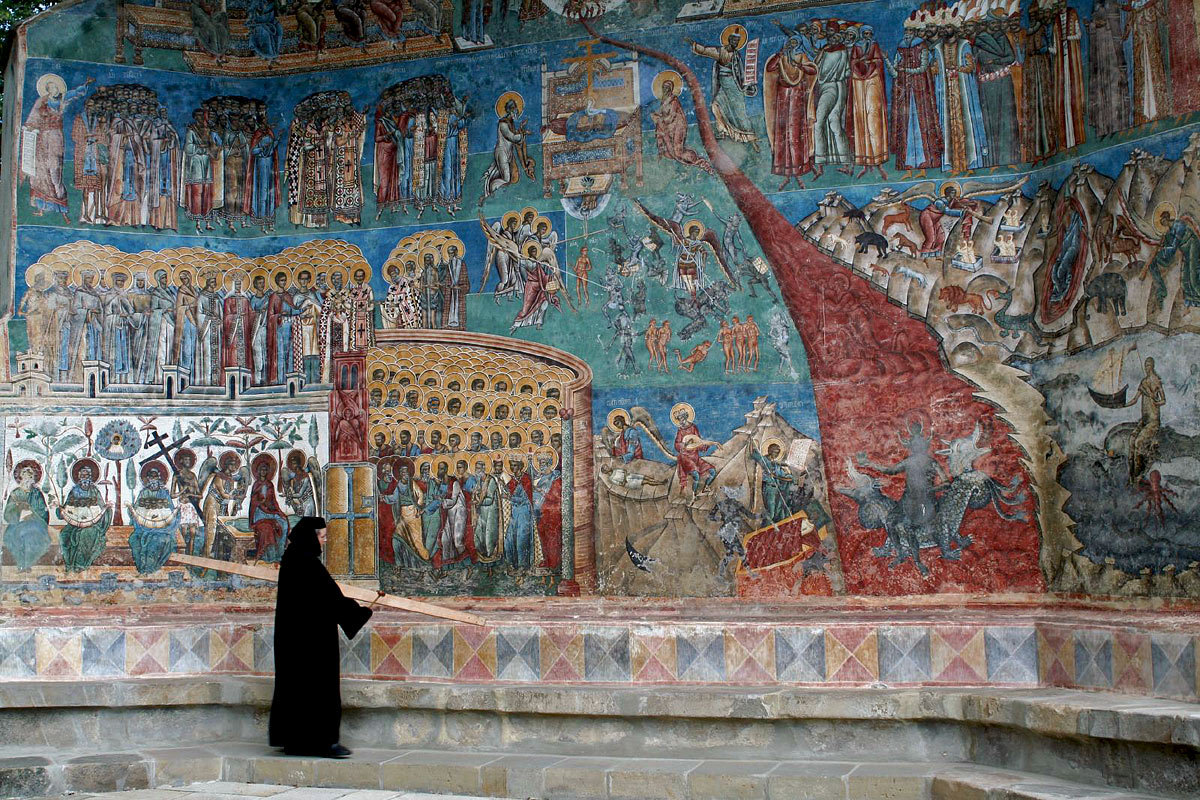
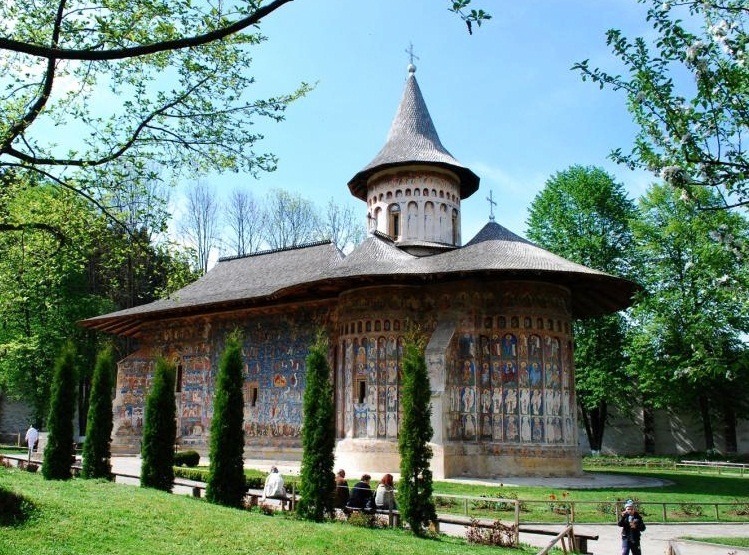
Monday began with Mass on a crisp sunny morning at the beautiful painted monastery at Moldovita. Then lovely Voronet and Humor. For readers who do not know Romania these and several other monasteries have no architectural interest but are famous for their wall paintings inside and outside which form wonderful galleries of mediaeval sacred painting. Romanians come to see them for their great beauty and also for the purpose for which they were made as an aid to prayer.  Bucovina is becoming more developed these days and starting to get a little commercialised but there is still a sense of holiness here and still a traditional rural way of life, though that is changing very much. Now Romanians go and find work in Eastern Europe and Romanian agriculture is, for reasons I do not fully understand, in big trouble.


Voroneţ Monastery


Wednesday, 23 April 2014

This made me burst out laughing loudly


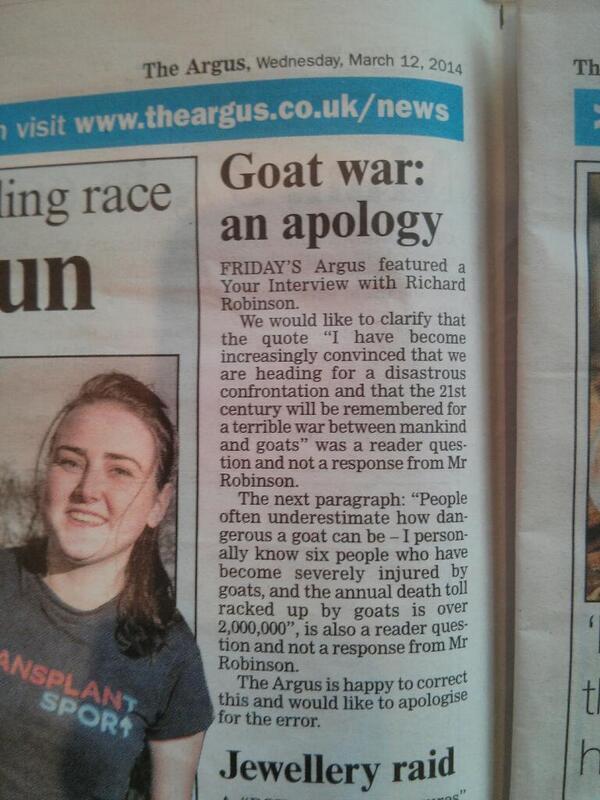
The Brighton Argus had misattributed the comments about a future "war between mankind and goats" to the director of the Brighton Science Festival. The comments actually came from a reader.
The reader had also suggested the following question, which was submitted to the director:
“In an upcoming war between mankind and goats, which side will you be on? What techniques can science provide in order to give mankind an edge in a conflict against powerful and cunning goats?”


For more local news click here.

Lenin spoke English with an Irish accent

Lenin spoke English with an Irish accent, say Russians.

Is there any footage of Lenin speaking? 

Here is Trotsky speaking English, courtesy of Pathe, which has put its films on the net.

And here is the Kaiser speaking English

Monday, 14 April 2014

George Orwell on gun control


How much more free England was in the 1930s is illustrated by this quotation from George Orwell, who turns out to be no friend to gun control.


“That rifle on the wall of the labourer's cottage or working class flat is the symbol of democracy. It is our job to see that it stays there.”

Thursday, 10 April 2014

Today is the 70th anniversary of the liberation of Odessa

Today is the 70th anniversary of the liberation of Odessa - not from the Nazis but from the Romanians. The Romanians are remembered by elderly Odessans for their corruption but were kinder rulers than the Germans or the Communists and, when the Russians started to defeat the Germans, the Romanian government stopped deporting the remaining Jewish population to extermination camps. Mr Putin seems to think that the Soviet troops liberated the city from the Nazis. 

Tuesday, 8 April 2014

The game is up for climate change believers

Charles Moore writes in the Daily Telegraph about the philosophical underpinnings of the global warming fears - what he calls warmism.

"The origins of warmism lie in a cocktail of ideas which includes anti-industrial nature worship, post-colonial guilt, a post-Enlightenment belief in scientists as a new priesthood of the truth, a hatred of population growth, a revulsion against the widespread increase in wealth and a belief in world government." 

He might have added a belief in the power of reason rather than trust in providence, a faith in human nature. As I have said before, it reminds me of Whittaker Chambers's description of Communism. 

'Its promise was whispered in the first days of the Creation under the Tree of the Knowledge of Good and Evil: 'Ye shall be as gods.' It is the great alternative faith of mankind. Like all great faiths, its force derives from a simple vision. Other ages have had great visions. They have always been different versions of the same vision: the vision of God and man's relationship to God. The Communists vision is the vision of Man without God. It is the vision of man's mind displacing God as the creative intelligence of the world."

Tuesday, 1 April 2014

Bulgaria is a foreign country, they do things differently there.

At dinner last night a Romanian friend told me that Bulgarians, visiting their monasteries, behave like holidaymakers, unlike Romanians who behave like pilgrims when they visit theirs. Two Bulgarian academics told me recently that the Church is not liked and respected south of the Danube the way it is here. I wonder why. Are the centuries of Turkish rule the reason? I should have thought Turkish rule would have made the people like the Church more, not less.

Friday, 28 March 2014

Whiskey (or whisky) is not a Protestant drink

I hate whiskey but it is not true, as Belloc says, that it is a Protestant drink. It is an Catholic, Irish drink and when the Scotch copied it they were a beautiful Catholic country. 

The courts found the Scotch had committed the ancient tort of passing off their drink as whiskey and ordered them to stop back in the 15th (?) century, hence the Scotch spelling, whisky.

In case you have forgotten the passage from The Path to Rome:

"I knew a man once that was given to drinking, and I made up this rule for him to distinguish between Bacchus and the Devil. To wit: that he should never drink what has been made and sold since the Reformation--I mean especially spirits and champagne. Let him (said I) drink red wine and white, good beer and mead--if he could get it--liqueurs made by monks, and, in a word, all those feeding, fortifying, and confirming beverages that our fathers drank in old time; but not whisky, nor brandy, nor sparkling wines, not absinthe, nor the kind of drink called gin. This he promised to do, and all went well. He became a merry companion, and began to write odes. His prose clarified and set, that had before been very mixed and cloudy. He slept well; he comprehended divine things; he was already half a republican, when one fatal day--it was the feast of the eleven thousand virgins, and they were too busy up in heaven to consider the needs of us poor hobbling, polyktonous and betempted wretches of men--I went with him to the Society for the Prevention of Annoyances to the Rich, where a certain usurer's son was to read a paper on the cruelty of Spaniards to their mules. As we were all seated there round a table with a staring green cloth on it, and a damnable gas pendant above, the host of that evening offered him whisky and water, and, my back being turned, he took it. Then when I would have taken it from him he used these words--
'After all, it is the intention of a pledge that matters;' and I saw that all was over, for he had abandoned definition, and was plunged back into the horrible mazes of Conscience and Natural Religion.
What do you think, then, was the consequence? Why, he had to take some nasty pledge or other to drink nothing whatever, and become a spectacle and a judgement, whereas if he had kept his exact word he might by this time have been a happy man."

Thursday, 20 March 2014

Life is not a science but an art

I suddenly see why people who studied mathematics or science are not usually interesting when they talk politics - Margaret Thatcher being an obvious example. In their disciplines answers are either right or wrong. Life is not a science but an arts discipline where there are many right answers, though some much more right than others.

Boris Johnson had another insight that deserves to be disseminated.

Life is not course-work. It's one exam crisis after another.

Unfortunately course work has feminised our education system, benefiting girls at the expense of boys and hard-working plodders at the expense of the brilliant but lazy.


Wednesday, 19 March 2014

Another wonderful Daily Telegraph obituary - for Clarissa Dickson Wright

Clarissa Dickson Wright was after my time, which is to say her television programmes were, my time being when I started work and stopped watching television except for the news. This week, however, she was the subject of another great Telegraph obituary.


Some lives are picaresque novels, far more than careers counsellors and writers would have us believe and Miss Wright's was one of these. Not quite so much so as the life of the subject of the funniest obituary of all time, Denisa, Lady Newborough, but comparably interesting.

Her descriptions of Mr. Blair are priceless. 

She observed the budding union between [Cherie] Booth (“desperately needy”) and Tony Blair (“a poor sad thing with his guitar”). Later still she observed that the “wet, long-haired student” that she had known had been replaced by a man with “psychopath eyes. You know those dead eyes that look at you and try to work out what you want to hear?”)
I wonder what changed him. I know what she means about dead psychopathic eyes but I would not have fingered him for a psychopath.

I went in my youth to meet the deputy editor of the Telegraph and told him the obituaries were the best thing in the paper and he said he agreed. They are the best history of the 20th century - the John Aubrey's Brief Lives de nos jours. They outdo Anthony Powell, himself the biographer of Aubrey.

Much as one likes fat people in principal it is worth noting that they die in their fifties and sixties, so note this well dear reader before passing on. On the other hand, Kingsley Amis said that
'No pleasure is worth foregoing for the sake of 10 more years in a nursing home.'
You might decide this goes for steak and kidney pudding, trifle and other glories of English cuisine.

Sunday, 16 March 2014

Irresistible Ronald Firbank

'O, help me heaven,' she prayed, `to be decorative and to do right'.

'I know of no joy,' she airily began, 'greater than a cool white dress after the sweetness of confession.'

"The world is disgracefully managed, one hardly knows to whom to complain."

Mentally, perhaps she was already three parts glass. So intense was her desire to set up a commemorative window to herself that, when it was erected, she believed she must leave behind in it, for ever, a little ghost. And should this be so, then what joy to be pierced each morning with light; her body flooded through and through by the sun, or in the evening to glow with a harvest of dark colours, deepening into untold sadness with the night....What ecstasy! It was the Egyptian sighing for his pyramid, of course.

Although there were moments even still in the grey glint of morning when the room had the agitated, stricken appearance of a person who had changed his creed a thousand times, sighed, stretched himself, turned a complete somersault, sat up, smiled, lay down, turned up his toes and died of doubts. But this aspect was reserved exclusively for the housemaids and the translucent threads of dawn.

'I adore italics, don't you?'

I really must get round to reading Firbank's novels. Apart from anything else, including the fact that he was Evelyn Waugh's greatest influence, how can one resist titles like Concerning the Eccentricities of Cardinal Pirelli and Prancing Nigger? But I have had his books since Mrs. Thatcher was Prime Minister, I brought them to Romania with me in the late 1990s and until now I somehow did resist them.

Friday, 14 March 2014

Best opening lines from books

Harriet Wilson had one of the best opening lines in literature: 
I shall not say why and how I became, at the age of fifteen, the mistress of the Earl of Craven.
My other favourites are, unsurprisingly,
Last night I dreamt I went to Manderley again
and 
The past is a foreign country, they do things differently there.

And, of course, though I feel it goes without saying,
It is a truth universally acknowledged that a single man in possession of a good fortune must be in want of a wife
One more. As an undergraduate, I used to read a great many parodies. Two of the funniest I ever read were '"Summer at Blandings" as it would have been had it been written by Kafka' and '"The Castle" as it would have been had it been written by P.G. Wodehouse.' The latter began,
'''What ho" said K.'
This blog post was inspired by a long tweetfest (is that the word or did I invent it?) that the journalist John Rentoul has been having on this subject on Twitter, based on an article he wrote. Among the lines offered were this from Muriel Spark's The Girls of Slender Means, a book I wanted to like but couldn't.

'Long ago in 1945 all the nice people in England were poor, allowing for exceptions'
This is Sylvia Plath, the opening of The Bell Jar:

'It was a queer, sultry summer, the summer they electrocuted the Rosenbergs, and I didn't know what I was doing in New York'
And Ian Fleming, Casino Royale:

'The scent, smoke and sweat of a casino are nauseating at three in the morning' 
 Please tell me your favourites.