Sunday, 17 November 2013

The Bucharest I love

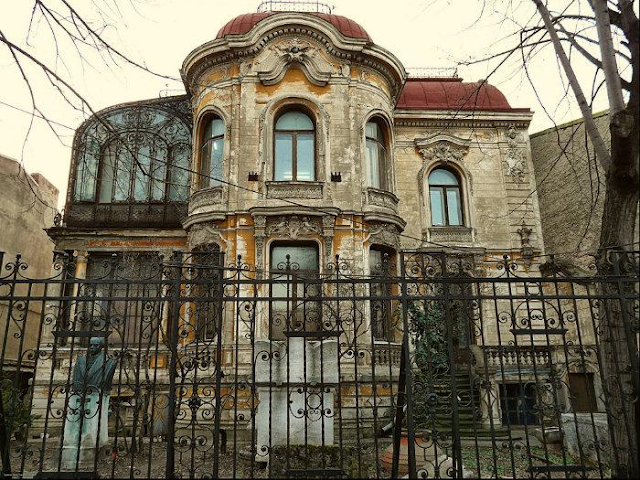
Bucharest used to be mostly shops like this fifteen years ago. I have watched the advance of progress here with dismay. Acknowledgements to Bucurest Saizecist and Bucuresti Realist, whose wonderful page I recommend.


Saturday, 16 November 2013

Pasajul Englez


Oddly, a couple of hours after seeing this picture on the Bucharest Realist Facebook page and hearing of Pasajul Englez, I accidentally found and walked down Pasajul Englez  - for

Thursday, 14 November 2013

Belgium


"I've come here more times as prime minister than I've been anywhere other than Belgium." 
- David Cameron , New Delhi , November, 2013 ...

" ... if India should go ... England, from having been the arbiter, would sink into the inglorious playground of the world. Wondering pilgrims would come to see us just as they climb the Acropolis or inspect the Nile... A congested population would lead a sordid existence with no outlet for its overflow, no markets for its manufactures ... swallowed up in a whirlpool of American cosmopolitanism ... our aspirations defined only by a narrow and selfish materialism ... England would become a sort of glorified Belgium."

- Lord Curzon , Birmingham, December, 1907 ...


"In the seventies we tried being Belgium and we didn't like it."

Julie Burchill, sometime in the 1980s


(Acknowledgments to Julian Craig for bringing the first two quotations to my attention.)

Saturday, 9 November 2013

Getting bored with Islam

I'm beginning to get bored with reading about Islam in the news every day. Do others feel this way? Interesting though the subject was for a long time. 

This thought was provoked by reading this sad article in The Spectator. Not only are tomb robbers rife in Egypt today but Muslim fanatics trying to destroy ancient Christian and much older monuments for being un-Islamic. This makes me wish we could reconvert Egypt to Christianity, though it reminds me of the fanaticism of the Iconoclasts and the 16th century Protestants. A friend of mine, an American who lives in Nazareth and is trying to encourage conversions of Jews and Muslims, says that many Muslims in the region are converting to Christianity. Far, far more Christians, though, are fleeing the region. Canada beckons and the multiracial post-Christian West.


When I was at university - and I was better read than any undergraduate I met - I did not know anything about Islam or Hinduism or have any idea what the difference between the
two was. I am  pretty sure I did not know that Muslims were circumcised, did not eat pork and did not drink. 

I asked a financial journalist friend when I was in my late 20s, 
'You know the Jews have the sabbath and Christians have Sunday, do the Muslims have a holy day?'
and I remember my amour propre being hurt that she knew that they did and it was Friday. I felt very proud of myself, entering my first mosque, the Blue Mosque, aged 28, because I knew that you have to take your shoes off entering a  mosque. 

I suspect that Macaulay's omniscient schoolboy (to whom, as an annoyingly well-informed child, I in some ways approximated) would nowadays know all these things. Times change and we change with them but, although I want people to be as well informed as possible about the humanities (I don't give a fig for the sciences, of course) this increase in knowledge does not elate me.

I am much more interested in Yazzidism, since I visited Lalish the centre of the Yazzidi faith, in Iraq.

Wednesday, 6 November 2013

A mystic solidarity with the land of one’s birth


I just found this quotation from Mircea Eliade. This is probably from his semi-fascist early phase but still it is good.

“Until recently there persisted among Europeans the obscure awareness of a mystic solidarity with the land of one’s birth. It was not a commonplace love of

Are you a Catholic atheist or a Protestant atheist?

"Every major question in history is a religious question. It has more effect in moulding life than nationalism or a common language." 
Hilaire Belloc
Religion underlies economics, not vice versa as the Communists thought. This is true at all times and in all places, including our own as Roger Scruton shows here, talking about the

Tuesday, 5 November 2013

Sweden and the decline of the West

On October 1, four candidates to be Archbishop of Uppsala, the highest position in the (Lutheran) Church of Sweden, were interviewed by church officials in front of the media and, among other questions, were asked, “Does Jesus provide a truer picture of God than Muhammad?” Only one of the candidates said that He does. (This candidate came second.)
The woman who got the job, Antje Jackelén, answered:
“One cannot reduce the whole of religious theology, that is to say the question of how different religions relate to one another, to a yes-and-no question. It
amounts to doing violence to a wealth of knowledge and experience that can be found there.”
I would have thought the question could easily have been answered skirting the subject of Muhammad altogether and talking about the divinity of Jesus. Even Hans Kung would agree that Jesus is essential to salvation.

The Archbishop-elect of Uppsala is not to be confused with the Bishop of Stockholm, who is a lesbian, lives with her woman priest partner and is the world's first openly active
homosexual bishop. I am not making this up.

As it happens, I saw my first ever woman priest in 2007 in Stockholm Cathedral. It was a surprise to see a woman priest but I was astonished to see that she was an absolutely beautiful blonde. I hadn't expected that. This seems to me an additional reason to think women cannot be clergy. However, women have been ordained in the Swedish state church for fifty years.

Despite its strongly feminist public culture, Sweden, once a very law-abiding country, has the worst rape figures in Europe. Many rapes are committed by immigrants. The conservative Norwegian blogger Fjordman wrote this very interesting essay, which deserves reading, on the subject of Swedish attitudes to what I call sex but is now called gender.

A day after writing this comes fresh news from Sweden: they are going to introduce ratings to warn about sexism in films.

Sunday, 3 November 2013

My take on the Middle East

I wish Libya, Egypt and Iraq were still pro-British monarchies and I think Eisenhower's sabotage of the UK over the Suez intervention is the reason the Middle East is such a mess. 

It would be better yet if the whole Middle East were all still in the Ottoman Empire, including Palestine. The Ottoman Empire after the Young Turks took over in 1908 became a parliamentary state. King Abdullah I of Jordan was before the First World War the freely elected MP of Mecca in the parliament in Constantinople. A democratic federal Ottoman Empire would have all the oil and ideally would be a confederation with Greece but if such a confederation had joined the EU it would, of course, be bankrupt now.

Instead we have the situation we have, and Israel, a transplant that has not taken. Israel is in a strong position but the strength of the Arabs is the strength of their huge anger.

The Left nowadays hate Israel (it wasn't so, thirty years ago) and not only for the bad things but also for the good things about the country, such as it being an ethnic state and being an outpost of Western civilisation, what Theodor Herzl called
"a rampart of Europe against Asia, an outpost of civilisation as opposed to barbarism".
The  bad things, on the other hand, start with the fact that Israelis are squatting on land to which they do not have a very good claim - in many cases literally as well as figuratively - though they have acquired squatters' rights. In fact, they acquired those rights at the latest in 1948, when the Arab countries expelled their Jews who found refuge in Israel. The numbers of Arabs who fled Israel and Jews who were expelled from the Arab lands were roughly equal. This does not excuse the Jews' behaviour up to 1948.

The bad things continue with the way in which Israeli Jews are colonising the West Bank. 

The Arabs in Israel have the best conditions in the Arab world but they have nevertheless suffered a great injustice in what is now Israel and to visit the country is to feel this strongly. But the same is true of the Turks and Greeks who ethnically cleansed each other. So did Pakistan and India. 

People are right to sympathise with the Arabs but the Israelis are pilloried in large part because they are seen as white, not because they have a wicked regime by the standards of the world we live in. Ironically, after being hated for centuries for being Asiatic, Jews are now hated for being European. 

I am delighted Israel exists, by the way, love the country, love going there, yet certainly regret its existence too. I think this position is not illogical, but it only seems to make me enemies.

Please click here to see what people told me in Jerusalem when I was there this summer.


Was Winston Churchill a great man?

The short answer is yes, of course. The quotations and the books show a man comparable to the Pitts, Fox, Disraeli or Dr. Johnson. He was a very great war leader who led the UK to victory, but was it a Pyrrhic victory? What if anything was his lasting achievement?

On his last birthday, Churchill said to his daughters:

I have achieved much to have achieved nothing at all.

The Wrong Box

Which is the funniest book of all time in your opinion? 

It might be Decline and Fall, Scoop or A Handful of Dust but it might be this unjustly obscure (and oddly modern) masterpiece by Robert Louis Stevenson and his stepson.

Thursday, 31 October 2013

Hallowe'en - and vampires - in Romania

Hallowe'en is an ancient Catholic tradition but now just an excuse to make money and for American cultural imperialism. But whatever you think of it, it has an apostrophe in it, people.

This is what I wrote last year about Hallowe'en in Romania.

This, on the subject of real-life vampires, of whom I have known two or three in Romania, might also be of interest.

Catholics celebrate the unknown saints in heaven on All Saints' Day, November 1. The Secklers in Harghita and Covasna, who are Catholics, on this day dress the tombs of their family members and gather at them with candles - it is a very big occasion. On the eve of All Saints - Hallowe'en - the souls of the dead who are in Purgatory are said by tradition to haunt the earth.

This explains Hallowe'en's Catholic origins and why Protestants don't like it.

Saturday, 26 October 2013

A weekend in the Secklerland


No-one knows what these paintings on the church tower at Csikrakos (Racu) mean. The tower is said to have been built in 1080 though no-one is sure. The most recent theory is that the paintings derive from the pre-Christian religion of the Hungarians and their close cousins the Secklers. Without examining the evidence one just knows this explanation is

Thursday, 24 October 2013

Why we live abroad

The heart is the undiscovered country. You travel to a foreign country to discover your unconscious mind.

Laurence Durrell said you have two birthplaces. The place where you are born and the place where you learn about life. For me an adolescent of 36 my second birthplace was Bucharest.

For some people who do not put their feet on the ground and take part in life there can be a transparent sheath between themselves and life. They are tourists all the time, in their home town or when they are travelling. Perhaps I am one of these people. I felt throughout my four years at Cambridge that I was a tourist there. In London where my contemporaries were pursuing paths to money and love I walked around with an acute overwhelmingly passion for the city which you can only feel if you grew up in Southnd-on-Sea. 

Philip Guedala said of Michael Arlen’s characters they walk down Jermyn St with such an acute sense of its being Jermyn St that one almost suspects them of being in London for the day. Perhaps this is how I have lived in Bucharest in the last twelve years. Perhaps this is why I like being a foreigner here rather than feeling a foreigner in my own country. How awful to feel at home somewhere. Does anyone feel at home anywhere? Does anyone interesting? Perhaps grown-ups do. Perhaps that is one definition of being grown-up.

If as Malcolm Muggeridge said sex is the mysticism of materialism, then this can also be true of travel too. And not particularly the beach holiday kind of travel so much as the more adventurous travel. Travel agents sell dreams. Only books and travel have the qualities of dreams and for the young only dreams are real. Reality is a terribly dull thing. When one gets older life acquires a texture and begins at last to one’s surprise to feel real, which means like a novel. About the same time novels seem less interesting. For some people perhaps travel does too?

When I came to live in Bucharest in 1998 I felt that I was a character in a novel by Joseph Conrad in the South Seas in the 19th century. The foreigners who had floated here after the revolution who could have been creations of Conrad in ironic mode. Bucharest had changed a lot between 1990 when I first visited and 1998 when I came to live here but it seemed extremely far away from the western world and it seemed in some ways still living in if not a nineteenth century novel then the early 50s at any rate. Later I refined it to 1959 . When I flew back I felt for a few hours like a character from star trek materializing slowly on another planet. 

Romania was last of all the former Communist countries to become globalised, except for Belarus and possibly Albania but seems infinitely more like everywhere else. At the same time the western world, once known as the civilised world, seems a concept which is time limited. And the idea of Romania has changed because countries mean much less than they did before the internet and cheap travel. 

Will Romania still exist in fifty years? One economist I know doubts if anyone will still speak Romanian in fifty years time. What is the point of the language?

Travel books are like all literary genres from another age, when abroad had another meaning . When John Paget wrote almost no-one among his readers, all people who paid income tax and a tiny fraction of the English population had been to Hungary or heard of Transylvania. For a long time travel was expensive and difficult and travel writing was information for the curious and a story with the writer as protagonist. And funny foreigners. All foreigners for the most liberal Englishmen were very faintly comic until some moment some time after we joined what was then called the Common Market. Now they are something to help us choose where to go on holiday, to prepare for holidays and to compare notes afterwards. And writers create the country they write about. Arabia is about Wilfred Thesiger. Delhi is now about Sam Miller and William Dalrymple a literary construct. 

And countries are an idea which is changing. And the word foreign is changing too. Will Romania be a country in fifty years time or a part of a big non-country called Europe? Countries are about traditions and therefore anachronistic. And about excluding foreigners which seems xenophobic and discriminatory. And about violence in the past the future sometimes in the present. And about languages but languages are being subverted by English. Countries are a difficult concept in the post-modern post-Marxist world.

Wednesday, 23 October 2013

Our Man in Havana

This was first published in Vivid in 2004.


Life in Bucharest has been transformed since the bloody events of December 1989 but three large apartments in a 1960s block in Mihai Eminescu have escaped the changes. Marked only by a discreet  flag and a yawning squaddie on guard they house the Cuban Embassy, a serene place where nothing much has altered since Fidel Castro’s Cuba and Nicolae Ceausescu’s Romania were friendly socialist countries. I was received there recently with

Sunday, 20 October 2013

The strange charm of dereliction


I published this deeply irresponsible article in the Bucharest Daily News back in 2005 and it was and is a cri de coeur. Someone pointed out that it was printed next to a worthy article calling for more investment in infrastructure, by my friend, Dan Visoiu. It is a synopsis in one page of the book I am writing about the Paris of the East.
"Bucharest has a lot to do in order to become a city worthy of the status of a European capital." 
This headmasterly admonishment was made by Jonathan Scheele, the soft-spoken British civil servant who heads the European Commission Delegation in Romania, at last week's "Investment Opportunities in Bucharest" conference.

Am I alone in dreading the day when Bucharest becomes worthy of the status of a European capital? To my mind it's the nicest European capital because it is unworthy of Mr Scheele's esteem. What other capital in Europe is nearly so unself-conscious, so unlike the
rest, so full of energy and shadows and yes so un-European, despite the satanic malls, hypermarkets, highly paid foreign consultants and other horrors of democracy? I know the streets become unfordable rivers when it rains. I know I should be pleased when the
potholes and the broken pavements are renewed with EU pre-accession funding but I am not. Irresponsibly I am elated by a beauty I find in the dereliction and have been since my first visit in 1990.


The wooden Ottoman Bucharest of 1830 where the men wore turbans and kaftans was rebuilt in the late nineteenth century in stucco and brick, its architects paying homage to Paris and an imaginary Orient at the same time. Later came Art Deco buildings that are unequalled anywhere in Europe. Bucharest was up to the minute in architectural terms before the war and ahead of for example Paris herself. But the faux-French surface of Carol I's Bucharest has been badly cracked over the last sixty years.


Nothing in this city apart from a score of churches is old but those parts that escaped the 1980s rebuilding feel more than half as old as time. I haven't passed the Museum of Archaeology for a couple of years ago but then behind its padlocked iron gates half-lost amid tall grass stood a long row of Roman tombs and statues, protected from the rain by a rotting eave. It seemed to me whenever I passed as if the Museum itself were becoming an archaeological object and I were the archaeologist stumbling across it for the first time.

Image result for Museum of Archaeology "Vasile Pārvan"


The decrepit fin de siecle villas and filthy Art Deco masterpieces are becoming one by one a real estate broker's dream of avarice as they are painted and varnished to look the way they originally looked. But for me at least the ramshackle way the streets look now, especially under a melancholy November sky, has a greater beauty than when they are new and shiny.


The old town when I moved there five years ago was not a museum but a slum and the one part of Bucharest where you felt you were in the Near East. The gypsies were part of the reason but it went deeper than than. Now especially that it has been pedestrianised it is on the way to being a complex of restaurants and antique shops. When Bucharest starts receiving tourists in numbers it will go the unauthentic way of the historic centre in every other European capital.


Dirty, disreputable, frivolous but gloomy, full of laughter and misery, mercenary and mystical, improvised, exasperating and serendipitous, Bucharest is a city which either repels you or steals your heart. The kiosks which made a Bangladeshi friend of mine compare Bucharest to Dakar have been eliminated at Mr. Basescu's command. So have the packs of occasionally ferocious stray dogs but it will be fifteen or twenty years before Bucharest ceases to feel Third World. When it does will it have become almost as dull as Athens? Very possibly but let us hope if Bucharest must emulate European cities she can become not Athens but Naples.


But one problem cannot wait fifteen years and cannot be romanticised away. The gridlock in the centre of the city gets worse at a tempo so fast that the deterioration can be observed on a weekly basis. Road-widening and road-building unless very sensitive to the city's architectural heritage will destroy Bucharest's semi-rustic character. What after all is the northern stretch of Calea Victoriei than a country lane? Luckily the solution to the traffic problem is easy. Charge motorists for entering the city centre between 8-6 weekdays and encourage Bucuresteni back to their city's excellent public transport system. It worked in London and would work here. Does any politician have the courage to adopt this idea? Mr. Scheele, what do you say?


Saturday, 19 October 2013

The sexual revolution in Iran, Romania and Northern Ireland


This is a very interesting article on sex in Iran, by Afshin Shahi in Foreign Policy. It shows how very Westernised Persians are, thanks, I suppose, to the Shahs. 
It reminds me too that the sexual revolution in the 1960s permeated the Iron Curtain and reached even faraway Bucharest. Though other aspects of the 1960s social revolution did not, for which I am pretty thankful. 
It may be too that sex before marriage is a political gesture in Iran. Irish Catholic girls in the 1980s told me Ulster Protestant girls slept around because they read The Sun and, as Unionists, wanted to resemble girls on the mainland.

A wise thing on the subject of the sexual revolution was said by Dorothy Day, the Communist activist who converted to Catholicism. 
The Sexual Revolution is a complete rebellion against authority, natural and supernatural, even against the body and its needs, its natural functions of child bearing. This is not reverence for life, it is a great denial and more resembles Nihilism than the revolution that they think they are furthering.
This seems to me to be true and to apply, among other things, to homosexual marriage.

Wednesday, 16 October 2013

Ireland, a poor, half-witted, gypsy relative of England

I just came across this brilliant remark about Ireland by Hugh Trevor-Roper, thanks to Henry Hopgood-Phillips. I love it though though I know Trevor-Roper was that most objectionable thing, a Protestant atheist.
'Through all our history she clings to us, a poor, half-witted, gypsy relative, defying our improvement, spoiling our appearances, exposing our pretences, an irredeemable, irrepressible slut, dirty when we are most clean, superstitious when we are most rational, protesting when we are most complacent, and when we are most prosaic, inspired'.

Romanians at work


This article first appeared in Vivid magazine in 2003 and the world it describes has changed enormously, but not completely beyond recognition. 

Romanians have spent thirteen difficult years of transition “encamped like bewilderedtravellers in a garish  and unrestful hotel” in the phrase of Joseph

Tuesday, 8 October 2013

'That so few now dare to be eccentric marks the chief danger of our time'

John Stuart Mill

That so few now dare to be eccentric marks the chief danger of our time.

Ronald Firbank 


`O, help me heaven,' she prayed,`to be decorative and to do right.'

'The life of nations, no less than the life of men, is lived largely in the imagination'


Roger Scruton
The fact is that the people of Europe are losing their homelands, and therefore losing their place in the world. I don’t envisage the Tiber one day foaming with much blood, nor do I see it blushing as the voice of the muezzin sounds from the former cathedral of St. Peter. But the city through which the Tiber flows will one day cease to be Italian, and all the expectations of its former residents, whether political, social, cultural, or personal, will suffer a violent upheaval, with results every bit as interesting as those that Powell prophesied. 


Charles Moore

All this [mass immigration] need not be a total disaster. It is possible, though hard, to forge a United Kingdom made up of many ethnicities. Leaders like Mr Cameron are right to try to insist on common standards and better rules, rather than to despair. But whatever it