Monday, 13 October 2014

Yazidi girls kidnapped by Isil tell of their captivity

Here are some stories of Yazidi girls who escaped from Isil. The stories are harrowing,  but oddly like stories from the Arabian Nights. 

They also remind me of Henry Mayhew's spare narratives and Philip Larkin's poem inspired by reading Mayhew, Deceptions.

When I was a child my parents worried that because I read so much I would live life at second hand, mediated through books, and rereading this post I see that this is exactly what I do.  Illiterates and people who do not like read much see things more clearly. This is why people who read engineering and science at university are dull while at university but become interesting in middle age. They do not see things mediated through literature. Unfortunately they do not escape television and the internet so easily, though.

I have been to Lalish, the centre of the Yazidi religion, and I am horrified by this attempt to destroy an ancient community. Allowing Yazidis asylum in the rich world will do even more to destroy their culture. Even though I would prefer the Yazidis to convert to Christianity the antiquity of Yazidism holds me enthralled. I am convinced that it Is one of the very oldest religions in the world, perhaps the oldest. 

The Americans and British have no choice but to act against ISIS or ISIL or whatever their name is this week, but what is worrying is that this is exactly what they want us to do. It does feel like the beginning of the Vietnamese war. And we Anglo-Saxons are fighting in a region where we have no great strategic interest, oil or no oil, for the interests of countries like Saudi Arabia, the Gulf States and Israel, whose interests are not ours.

Meanwhile, in England, the National Union of Students refuses to condemn ISIS/ISIL and speak of ‘Islamophobia’, a very pernicious word that should be expunged from the dictionary. The words racism and sexism by contrast are also used to close down debate but mean something and are, at least occasionally, useful.

Saturday, 11 October 2014

UKIP, Dad's Army and the Matter of Britain


Jonathan Freedland has written a thought-provoking, if condescending, article in The Guardian, likening Nigel Farage, the leader of the British Eurosceptic party UKIP, to Captain Mainwaring in Dad's Army. 

I think Private Walker is more apposite but let that pass.  (If you don't know the programme it is pointless for me to explain but you might enjoy this.)

I prefer to point out that Captain Mainwaring, Pooterish, self-important, ridiculous, was a hero, whereas his much more agreeable adjunct, Sergeant Wilson, intelligent, suave, funny and upper middle-class, was weak. 
Mainwaring would have laid down his life for his country. Wilson would have been a defeatist, perhaps a quisling, had the Germans conquered Sussex, at least if not carefully watched by Mainwaring. 

Actually, the real myth bequeathed by the Second World War is that fascism is still a great danger or will be in Europe in the next twenty years. Evil morphs. 

The nearest thing to a fascist threat today and for the foreseeable future comes from Muslim extremists, not anti immigration parties.

Going to war with Germany with 1939 was in any case catastrophic for Britain, for the country we ostensibly went to war to save, Poland, for our ally France - and for the whole world. This truth is obscured by heroic myths.


In the Middle Ages the Matter of Britain meant the legends of King Arthur (while the Matter of France meant those recounting the imaginary deeds of Child Roland and Charlemagne). In our time the Matter of Britain is the myth of Britain standing alone in the Second World War. It's curious that when we British think about that war it is not war films or stories we think of nearly as much as a comedy programme broadcast over forty years ago about a group of part-time volunteers, in a genteel resort on the South Coast of England, preparing to meet German invaders. It's about a time when Britain was still a great power, still all white, still had class distinction. Instead of being about courage in battle, or the horrors of world war, or about our country's abrupt passage from global domination to a purely secondary role, it's a myth of cosiness, a national comfort blanket, a cuddle. 


As the man says,
The Americans had Private Ryan; we had Private Pike.
John Charmley, Professor of Modern History at the University of East Anglia, more than twenty years ago eloquently made the case for Britain not declaring war on Germany in 1939 and for making terms with Germany in 1940, as Lord Halifax and Rab Butler favoured. Over time, I have slowly come to find his ideas very persuasive. They are discussed here. 

How I wish I could discuss this with my father who was called up on September 1, 1939.

Friday, 10 October 2014

15 years age gap is acceptable between husband and wife

A 15 years age gap is acceptable between husband and wife - 16 is not. So said Enquire Within Upon Everything - the 1888 edition we had at home when I was growing up. It also had the rules for cribbage and much useful information.

Nevertheless men still pursue young women much more than fifteen years their junior, as if they never consulted Enquire Within, and at least one British journalist feels this requires explanation. Romanians, who understand human nature, do not. 

I was shocked when I first came here sixteen years ago to see so many lovely women with men so much older than them. A rather extreme example of a trend was Iosif Constantin Drăgan who was the richest man in Romania. He married a lady almost sixty years his junior, who is now the richest woman in Romania. Later on these age gaps became reassuring and still later one began to see it less and less, partly because more people had more money and partly because so many lovely women, like so many other people, left the country to find their fortune.

Clacton was a defeat for the BBC, the Church of England and politicians who don't like ordinary people

Congratulations to Clacton for relecting an outstanding Member of Parliament and offending the Anglican clergy, the BBC and people like Dan Hodges and Matthew D'Ancona. Douglas Carswell is a Conservative who joined UKIP and resigned to fight a by-election. 


You might ask why the clergy should dislike the only British political party that opposed single-sex marriage. That's a very good question, which I cannot answer, but according to the well informed Damien Thompson they do.

For the first time in my life I had a vote in a parliamentary by-election and what a by-election! Douglas Carswell, the MP I probably most admired in the House, swept to a landslide victory for UKIP. More surprisingly - and yet I wasn't surprised - and almost more importantly, UKIP came within a whisker of winning the safe Labour stronghold of Heywood and Middleton. 

Nigel Farage, the UKIP leader, decided Heywood and Middleton wasn't winnable and put little effort into it, something he must now regret. 

If the House of Commons was still powerful Mr. Carswell would be UKIP leader now - he would be very good indeed - but the House scarcely matters anymore - except when it roused itself like the Kraken in Tennyson's poem to prevent Great Britain bombing Syria last year.

This is an article worth reading about Clacton by Spectator editor, Fraser Nelson. I grew up in more vibrant Southend-on-Sea (WestclIff-on-Sea actually, though both places are not on the sea but on the Thames estuary) but my family live just outside Clacton and I lived there briefly before coming to Bucharest.

I find that Clacton is a depressing, unlovely place which makes my native town seem beautiful, but I do not much like the slurs of Matthew Parris who wrote

Clacton-on-Sea is a friendly resort trying not to die, inhabited by friendly people trying not to die… These are not wealthy retired professionals (almost 40 per cent of residents have no qualifications at all) and if you associate tattoos with youth, Clacton will surprise you. Father Time is busy with his scythe here: I counted 19 estate agents on Station Road, and you can get a three-bedroom detached bungalow for £94,995. Only in Asmara after Eritrea’s bloody war have I encountered a greater proportion of citizens on crutches or in wheelchairs....

I am not arguing that we should be careless of the needs of struggling people and places such as Clacton. But I am arguing — if I am honest — that we should be careless of their opinions.
In other words, he thinks the electorate is out of touch with the modern world. 

In this Matthew Parris is speaking for David Cameron and the Conservative modernisers. An anonymous 'senior moderniser' is quoted as saying

We have to respect these people. But we must not change our policy to go nearer to where they are ...

Since I was a little boy I have sided with the views of the elderly so I am not able to be objective but Peter Oborne answers Matthew Parris very well here. In fact the argument that the Conservative brand is 'toxic' and the party needs to be socially liberal to win elections has surprisingly little evidence from polling to sustain it but this is not really about focus groups. It's about the values of opinion-formers and the people they meet. 

The truth is that many Conservative politicians, and many more Labour ones, just do not like England very much. Someone on the left said Clacton was classic UKIP territory - white, poor and uneducated. I thought that was supposed to be classic Labour territory but times have changed. The working class have few friends left and very few on the left.

When I went to Twitter and put in the word 'Clacton' I was astonished and saddened at the malice and hatred directed at that blameless town because it had the temerity to vote to leave the EU. You'd have thought Clacton had collectively committed treason. The antiracists who feel entitled to hate Clacton or UKIP voters are, paradoxically, themselves being racist.


The Independent printed a collection of this stuff - which I think would make any reader feel like sending off for a UKIP membership form.

Wednesday, 8 October 2014

Hell, I suspect, resembles Liechtenstein

An article about Lichtenstein in this week's Spectator reminded me of my trip there and how much I hated the place. As much as Dubai. Fishing around for my diary of the trip which I posted back in 2010 I found it had been archived, so here it is.


The mad old woman who keeps the hotel told me it was 500 metres to Liechtenstein and was astonished I proposed to walk it.


I wish I enjoyed the magnificent mountains. Instead I counted and recounted the numbers of countries and capitals I had visited. Lichtenstein according to Wikipedia is one of 4 doubly landlocked countries. Unlike Einstein signing the patent for toblerone which is a poem enlarging the universe this fact is deeply un life enhancing and train spotterish. But I try without success to think of another. Slovakia! Yes. Belarus no. Rwanda? Burundi?

The road asphalted suburban. 2 miles? Then the border. Empty police station with photograph of the prince. Mountains as beautiful here as anywhere else. I am doing this for my 10 year old self fascinated by miniature countries. A village called Mauren.


A woman drives me to the bus stop and then I take the bus and change at another village. The village is called Mauren. All the buildings are no older than late 70s. Like Japan. Prosperous people eat on balconies and the place is calmly disgusting. An inscription names many distinguished persons who were born there including an auditor general in the department of military justice in the 1860s. Such is the nature of fame for which men give their lives.
I reach Vaduz in the intense heat. Vaduz is entirely modern. Well spoken British tourists buy souvenir visas and I do too. This is another world from mine. Chinese or Japanese. The toy train which inevitably twines through the place. Paul Gallico. Frank Muir. A fat porcine faced man running in an ill fitting suit. Banks. A five star hotel which turns out to be a law firm. The castle hanging over the placed. How lucky the Liechtenstein family were. Others submerged by Communism or the lucky ones bled by progressive taxation in Austria.


Hell I suspect resembles Liechtenstein. Underground garages, large new houses, ugly Victorian churches, crucifixion statues, money laundering for distant dictators.


Christianne who says she was 50 the day we met is nice, young in spirit and looks around 38 or 40. Just divorced. She knows the Prince of course and after forty years has become one of his subjects. Her father was the first German officer killed in the Second World War. I am not sure how sympathetic to be.

Tuesday, 7 October 2014

'All our great men are dead. I don't feel so well myself.'


Who is the greatest living Englishman after Edward Norman, who is easily top?


Charles Moore? Are there any comedians, actors, writers these days? I liked Ian McEwan in 1980. No politicians or actors come to mind.

I might have considered Rod Liddle till I read the book he brought  out this year. I love Lord Salisbury, who saved the right of some hereditary peers to sit in Parliament, and Lord Sudeley who makes me look like a Jacobin, but there must be someone greater.


Martin Amis? Money was the last of his books I could read, though I once adored him.

Oh I have it. Sir Tom Stoppard the one great dramatist, surrounded by utterly talentless ones like Hare etc etc.

I mourn Sir Alec Guinness, Sir John Betjeman, Brian Johnson, Lord Deedes, AJP Taylor, Philip Larkin, Enoch Powell and despite his calling for Powell's resignation from the shadow cabinet, Lord Hailsham. Also Gerry Fitt, but he wasn't English. Nowadays I suspect Maurice Cowling, whom I am so sad I never met, might have been the greatest of all. 


The truth is though that I am terribly out of touch.

Boris Johnson might be a great Englishman in time, though I very much dislike his adulteries and his keenness to bomb Syria - and his keenness on immigration. Douglas Carswell shows promise. Lord Tebbit, whom I alway liked as a man even when I disagreed with his politics, improves with age like good Burgundy. Alan Bennett? 

Not Stephen Fry, though - or any of the other alleged national treasures.

Are there any Englishwomen of any note? Patricia Routledge comes to mind first. Lady Lucinda Lampton? The  great novelist Sybille Bedford is dead and was really German. 


Sunday, 5 October 2014

Life as a café: Vienna

In the Café Landtmann for the first time since the first week of January, 1990. I find myself liking Vienna, for the first time. I was going to say despite it's never having been Communist but some people say Austria is the last Communist country in Europe.

Or is that Greece? How hateful are English voices in a foreign city. An Englishmen is sitting behind me. His voice is nasal and of course I detest him.

Of course, one third of Vienna was ruled by the Soviet Union from 1945 to 1955, something future generations will remember only because of The Third Man, the greatest film so far ever made, which will always continue to be watched with delight. 

Khrushchev gave up the Russian sector of Austria in 1955 in return for Austrian neutrality and proposed the same solution for  Germany. The Americans were unforgivably foolish to turn down this opportunity. Ulbricht was greatly relieved. His tyranny thus continued in the misnamed German Democratic Republic.

I can't help feeling that Austrians, who caused the First World War and the Second, escaped rather lightly from the debris. This is worth remembering when you see how much fuss they make now of the Emperor Francis Joseph who declared war on Serbia and caused the nearest we have so far come (fairly near) to the end of civilisation. Someone famously said that Austria's greatest achievement was to convince the world that Beethoven was Austrian and Hitler was German. An even greater achievement was to
 reinvent themselves as Scandinavians.

The food is at best passable in the Landtmann but the waiters are wonderful and they have the slicked back hair one associates with Viennese. The Monarchy is gone but the cafes remain and have been duplicated in Budapest.

In 1990 I came to the Landtmann by accident. It was only last week that I discovered it was famous and that Freud was a regular until he fled the Germans. I also stumbled by chance on the famous Hotel Orient and stayed there, not knowing it was a house of ill fame. It was a very charming, pretty old fashioned hotel. When I looked it up on my last visit in 2006 It rented rooms by the hour. Books had been written about its cupidinous history. Graham Greene stayed there while writing The Third Man.

In 1990 I didn't think of Freud or Hitler or Strauss or Francis Joseph but Harry Lime. There was three feet of snow underfoot then and snow fell heavily and spying was heavy in the air but I was very impatient for Budapest which then seemed the most exotic place on earth along with Bucharest.

1990 is very recent but another age without mobile telephones or Wi-Fi. People smoked in restaurants. Yet it felt just as repellently modern and up-to-date as now.

A friend told me that the Landtmann was the favourite hangout of the British historian, David Irving, who spent his last freemoments there before being arrested by the Austrian police for minimising the numbers dead in the holocaust. It sounds from all I read that he is a pretty useless historian, which is a shame because a good historian who had some sympathy for the Nazis, repellent though this would be, might add to the sum of human knowledge.


The next day I discovered another famous but very different café, the Hawelka, founded just as the Nazis took over. It is untidy and slightly shabby, warm and very MittelEuropa. Young Mr. Hawelka, in his early 60s, greets visitors like old friends which many are and exudes warmth. Quite properly he had not heard of Wi-Fi though in fact they have it. I love the place. 


Prague was long ago ruined by tourists but Vienna isn't, is its own place, not nearly so globalised as you would expect, full of characters, but nevertheless heartless. Not a place that permits itself to be loved easily but I now like it. But it is artificial, the artificial capital of three artificial countries: the Holy Roman Empire, the Austrian Empire and now the (second) Austrian Republic.


A very intelligent Jewish-American historian, Jeremy Friedman, with whom I once by chance shared a sleeping wagon on the night train to Belgrade, told me that all the cities of Europe seemed to him museums with the exception of London. In Vienna one feels this acutely. Odd though that he was travelling from Bucharest but did not make it another exception, because Bucharest is certainly no museum. It is certainly utterly alive in its curious way.

It's not beautiful, though it has beauty in it, but it is always a joy to return home, when coming back from what is still 'the West'.

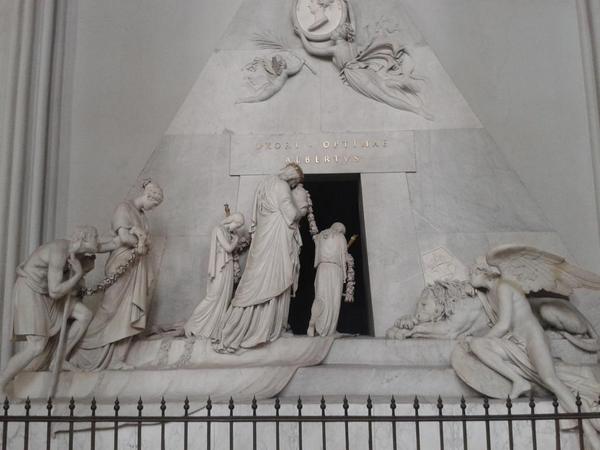
Embedded image permalink
Curious tomb by Canova of Marie Christine of Habsburg, in the Augustinerkirche.

Saturday, 4 October 2014

Slovakian journey


We took a cheap flight  with Tarom to Vienna and drove all day to Kosice in Eastern Slovakia. We missed the turning to Eger because Hungary is very badly signposted, were depressed by Miscolz and I was elated to reach beautiful Kosice as dusk fell. Kosice Timisoara and Cluj in Romania are the three most beautiful Hungarian cities among many. All the most beautiful, Budapest excepted, lie outside Hungary, which adds to Hungarians' genetic melancholy.


At university the only time I did any hard work was when I studied Hungarian 19th and 20th century history. I chose Hungary at random as the Eastern European country to take an interest in. Over the last twenty years I have slowly come to suspect I chose the least interesting country in this fascinating part of Europe. Slovakia, on the other hand, where I lived for six months in 1990-1991, without taking great interest in it, turns out now to be utterly enchanting. 

Like Romanians Slovaks were until recently peasants. In Slovakia as in Transylvania the landowners were Hungarian. In the towns lived Hungarians, Germans and Jews. Now the Slovaks like Romanians dwell in cities that they did not build. Towns that remind me of the beautiful towns in Southern Ireland built by the Protestant Ascendancy.

This is German Europe, destroyed by Hitler's irrational racial theories. How paradoxical that the Jews, who embodied so much of German, and later Hungarian, civilisation were murdered by people who believed in German supremacy.

Kosice, like Bucharest, is a city of one street. In Kosice's case one of the loveliest in Europe, Hlavná ulica, which translates as High St or Main St, and contains a serried rank of baroque buildings. The rather pompous author of my 1999 edition of the Blue Guide was very upset that the street had been pedestrianised and this is something I too usually dislike. I don't think it was pedestrianised when I came here so recently in 1992 but I can't remember. Anyway, I think it works pretty well. I wish Bucharest does a similarly good job with Calea Victoriei if they must pedestrianise it, but I have few hopes. 

The centre of the street is the wonderful, gothic St. Elizabeth's cathedral, which is the easternmost gothic cathedral in Europe. Kosice no longer is home to large numbers of Germans or Hungarians since the post-war ethnic cleansing it still has  a fair number of Orthodox and Uniates. You feel that are at the edge of Catholic Europe, where it meets the steppe, that below the baroque and the age of reason is something else, older, more visceral..

We didn't explore Kosice before we drove across Slovakia looking for wooden churches and found not only them but the peerless Bardejov. Eastern Slovakia is a paradise for a lover of gothic churches and particularly gothic altars. The church of St. Aegidius, Bardejov, has seven of them each of extraordinary beauty. The large church was full at 12.00 Mass on a Friday. I wondered if it was some special saint's day but was told that every 12.00 Mass is full. 

It was unseasonably cold. it rained from time to time. Bardejov town square is perfect and the closed grey sky gave it a haunted quality like the opening chapter of Dracula. This is not touristland. 


Embedded image permalink
Kosice Cathedral


We drove back to Vienna after two days in Eastern Slovakia stopping at the wonderful SpiÅ¡ castle, the surprisingly interesting old town of PreÅ¡ov (the Blue Guide did not tell us to expect so marvellous a place) and spending our third night at the best place of all, the very beautiful town of Levice to which I shall return. We stayed at a very pleasant hotel, staffed by nice people, the U Leva.

The next morning was Sunday and while my friend slept I went to Mass. I couldn't understand the words, of course, and felt as always that this was something very different from the Mass as it was said from the time of the conversion of Europe to the early 1960s when Mass in the vernacular came in. It is the reason why the Catholic Church unlike the Orthodox, does not feel old, but seems as if it dates from the John F Kennedy epoch. I thought these thoughts, tried to pray and studied the faces of the agricultural labourers who made up the congregation, mostly over forty, more women than men. How very fine it is to live or even to visit a country where believing in God is not a lifestyle choice but as normal as the sun rising each morning and, importantly, where religion is a real religion, full of saints and rules, not polite, understated Anglicanism.

On our fourth and last day we had the most beautiful journey to Vienna. I usually prefer the works of man to those of God usually but the avenues of trees, their leaves turning a bright orange, which strongly reminded me of cathedral quires, were more beautiful than any. No one wrote a poem as beautiful as leaves in autumn.

We came by chance on the Liptov village museum, founded in 1991, where village buildings and a church - most from a village flooded to make way for a reservoir -have been collected. Every Sunday they have a concert of folk music and stalls home-made excellent food and drink. We luckily were the only foreigners. Then drove through the Tatras towards Vienna.

Friday, 26 September 2014

How to be old-fashioned

Oscar Wilde said 
It is only the modern that ever becomes old-fashioned.
This is true and I accordingly think that young fogeys probably never grow old. I am told I am one and if so we shall try the experiment.

I never steal other people's limes without attribution, which leaves me open to the charge of name-dropping when I quote. The fascist zoo-keeper John Aspinall, I recall, whenever he wanted to strengthen a point would preface whatever he wanted to say with
As Schopenhauer once said...
However, I did break my own rule twice. Once when I quoted an anodyne remark by Robert Graves about sex being secret to a girl and she recognised it. She had read it in my commonplace book. And once when I purloined the expression
nothing is as old-fashioned as a future that has failed
and sowed it into my account of a my first visit to Havana, where it fits very well. 
Shakespeare stole - it's how you steal that matters, I contend, to comfort myself.

If cities could be fogeys Havana, like many Communist cities, would be one. So would Bucharest. But Communist and post-Communist cities are not young fogeys, but old ones, aged by being cut off from modernity, beautiful and tragic.

Wednesday, 24 September 2014

Bucharest's City Gates at dusk


A wonderful photograph taken by Adrian Savin and reproduced with his permission.