Friday, 5 April 2013

The profound Romania


I should leave Bucharest much more often (I hardly ever do except to go abroad). 

Romania is wonderful, deeply old fashioned though not conservative at all, Latin, still  unglobalised - a profound place in a superficial world.


Romania is very old but also very new. She is certainly not old in terms of her architecture or her institutions like England is old, where every village has a mediaeval church, but the way of life in the country is still very old indeed. Romania, outside the smallish towns,  was living in the Middle Ages in the countryside until Communism.

It has so far escaped the revolution - the 1960s did not happen here. The EU will change that, but not quite yet.

Thursday, 4 April 2013

"It wasn't because we liked immigrants, but because we didn't like Britain."


When I was a Revolutionary Marxist, we were all in favour of as much immigration as possible.


It wasn't because we liked immigrants, but because we didn't like Britain. We saw immigrants - from anywhere - as allies against the staid, settled, conservative society that our country still was at the end of the Sixties.


Also, we liked to feel oh, so superior to the bewildered people - usually in the poorest parts of Britain - who found their neighbourhoods suddenly transformed into supposedly 'vibrant communities'.

Peter Hitchens, who used to have roughly the same Marxist politics as his brother Christopher, saw the light and is now one of the very few social conservative voices in England. In this article, he explains something I never understood, the attraction for the Left of mass immigration.

The Kaiser speaking English.


This made my mouth gape: a recording of the Kaiser speaking in English (with a good, rather classless accent).

This terrible, foolish man is clearly utterly unrepentant for the terrible evils he caused: millions dead: the defeat of his own country; the end of the Austrian, Russian and Ottoman Empires; indirectly Communism, Fascism and Hitlerism. He sounds like a teenage boy talking about war games.

Wednesday, 3 April 2013

Cluj = Kolosvar = Klausenberg, Transylvania.


A beautiful city still sans tourists. It has escaped the fate of Brasov and the now rather awful Sighisoara.

“[Transylvania] is in the midst of the Carpathian mountains; one of the wildest and least known portions of Europe.”—Bram Stoker’s Dracula 

Actually Timisoara was the first city to have electric lighting I think but Stoker was an ignorant hack.

The Hotel Baron at war


I occasionally google the Hotel Baron, Aleppo to see how the grand old lady is enduring the war in Syria but did not do so recently. Then I came across this article by chance and I was very sad to hear of Mr. Maziourman's difficulties. He is a very nice man.

The Baron is my favourite hotel in the world and my spiritual home. Laurence of Arabia stayed there and decamped without paying his bill. (If I had done that I would have been arrested, perhaps by the secret police, but in his case they are proud of it.) It still has BOAC posters on the wall from the 1940s. They are just like the reproduction BOAC posters that you used to see everywhere in England in the BOAC except that these are originals which are still there because nobody ever thought to replace them.

I wrote this about my visit to the Hotel Baron back in 2007:

Heavenly - a reason in itself to visit Syria. Hard to book a room even well in advance, shabby, holes in the carpets, run to seed but like stepping into a 1936 film. When I was there in 2007 most rooms were $40 but I paid $70 for the suite where Assad snr stayed in the 70s. Please stay here unless you like modernity and luxury. Awful breakfast. Enormous enormous fun. A. Christie finished Murder on Orient Express here.

My diary of my visit to Syria, a country I love madly, is here. 

Tuesday, 2 April 2013

'People think I'm stupid but it's all a facade'

The Dan Quayle character says this in an otherwise unmemorable comedy, as he takes out a gun in the Oval Office.


'People think I'm stupid but it's all a facade'.  

He pronounces façade with a hard 'c', to rhyme with parade. 

It runs through my head a lot.

Sunday, 31 March 2013

Duchesses and chambermaids


Virginia Woolf said duchesses and chambermaids alike despise scholars. Is this because scholars have found something more interesting than sex? Or simply women's strong attraction for biological reasons to virile fighters? Yet the female attraction to powerful men makes them attracted to intelligent men. But perhaps it is intelligence deployed outwards, so to speak, that attracts them, not deployed in writing commentaries on Horace or Virgil.


For their part do men prefer duchesses? Dr. Johnson said a chambermaid would be as attractive as a duchess were it not for imagination. Would she be as attractive as a footballer's wife? Would a duchess? I suppose it depends on the duchess and the footballer's wife, although, for obvious socio-economic and biological reasons, duchesses tend to be very attractive while of nubile age. Being a duchess is not something that they are born to or have thrust upon them. It is something that they achieve.

Easter in England

Sir John Betjeman once began an essay with the words:
St Pancras was a 14-year-old Christian boy who was martyred in Rome by the Emperor Diocletian. In England, he is better known as a railway station.

John Betjeman was a writer of light verse which I think will live and which excels Praed and Frederick Locker Lampson. But as well as his verse he has left us other monuments in the buildings that he successfully campaigned to save from demolition, in the black days of the 1960s and early 1970s, especially St Pancras Station. Coming in from Luton the Searcy's Champagne Bar on the platform transports you to from the mundane railway travelling world to something very glamorous and nineteenth century, an infinite distance away from the British Rail offices which used to take up the station or the 1970s. 

Actually the whole of St Pancras seems glamorous as befits an international railway station and like so many places in England it seems to have become a 'shopping centre' (dread words as Wallace Arnold would have said - am I becoming Wallace Arnold in my middle age? It might be so.)

Everyone in London despite the crisis seem to do themselves in great style but I am not sure whether we should worry that people have become more materialistic. I think the 1970s were very materialistic and selfish, which is why we had all those strikes. And they also hated the past and knocked down lovely buildings. 

Hard, on Good Friday, to eat a frugal haddock and I succumbed to a glass of champagne with my Godless friend and ordered cheesecake.

A wonderful full English breakfast the next morning (how I love the full English,  especially the black pudding) in a greasy spoon in the Old Brompton Rd beat our expensive dinner at Searcy's. Somerset Maugham said:

It is not true that you cannot eat well in England. You can eat better in England than in any country in the world so long as you eat breakfast three times a day.

You can eat very well in England now, unlike in his day, but it is still true that breakfast beats everything else hands down. This truth is immutable.

Then Tenebrae at the Oratory, Latin psalms sung interspersed with readings that were part of Holy Week everywhere before the Second Vatican Council and which were continued at the Oratory at the insistence of the congregation. Beauchamp Place after more than twenty years (when I was a sixth former in London for the day that street was the epitome of style), shirt shopping in Jermyn St (go to Harvey and Hudson, people, for the real thing), then lunch and exquisite conversation with Ruth Dudley Edwards. 

The restaurant where we had arranged to meet was closed, happily, and we eat in the wonderfully inelegant India Club which has not changed since I was there thirty years ago or since Nehru was eighty years ago. The food was nothing special, the prices ridiculously low and the general setting (formica tables and radiators with peeling paint) was how everything was when C.R. Attlee was Prime Minister  and we gave away India at the cost of up to a million people killed, all because Nehru and Jinnah were old and in a hurry for power. I told Ruth, who loved the place, 'This is what we are fighting for.'  Lunch with three large bottles of Indian beer and one of cider came to £28.

I knew of and esteemed Ruth for many years for her revisionist view of Irish history (exactly the one I had always held) and her strong opposition to the Irish peace process. She is better known, however, as a writer of detective stories and she would make a very good detective herself in one of her own books, a post modernist twist I must suggest to her. If Martin Amis can appear in his own novel, why not Ruth?


My sister's house and home pleasures. Last night I watched the first episode of 'Sherlock' - the first TV programme I have watched for many years. Wonderful - but the internet has made it incredibly hard to watch TV for 90 minutes. I find myself identifying closely with Sherlock Holmes, because my brain span too fast for TV, but I am not a psychopath.


Easter Sunday on the North Essex coast. Mass. I cannot forgive Pope John Paul II for altar girls but my niece Emily is terribly good and very solemn. Dreadful guitar music and communion ministers. If only every church had to celebrate a Mass in Latin each Sunday. Too much grinning and someone went up and gave the priest an Easter card at the end of the Mass. (Romanians celebrate Mass with much more dignity and solemnity.) Still a happy occasion. 

The English taking their pleasures not sadly at all, in fact we are a very happy race, but quietly and unostentatiously. I walked two miles along the North Sea in 35 minutes at a pleasant stroll. 1930s architecture which seems from another epoch in former colonies like India and Zanzibar seems so very recent in provincial England. The Easter Egg hunt. Sunday lunch. Afterwards High Society on a DVD which actually rather bored me even though I suggested it. But Sundays in my youth were boring and so is I suppose is family life - and boring is just an unkind word for peaceful. England outside London is very peaceful.

Monday at St Alban's - not only is the cathedral wonderful, despite the tragic restoration by a clown, but the whole old centre is enchanting. A wonderful place to live and only twenty minutes from St Pancras (am i growing middle-aged?). But the abiding feeling is how desperately sad the Reformation was, which cut England Scotland and Wales off from their religion and their culture.  The next most sudden and arbitrary change was mass immigration after 1950 but the Reformation was a far bigger change and one that permanently maimed our country. 

Yet would we have had representative government in the eighteenth century had we remained Catholic? We developed common law while England was Catholic but who knows? Had freedom come to the world not from England but from the French Revolution things would be much worse even than they are now though the EU is the triumph of that Revolution over Anglo-Saxon ideas of freedom.

Thursday, 28 March 2013

Ceauşescu's sceptre

File:Ceausescu receiving the presidential sceptre 1974.jpg

On 28 March 1974 Romania created the position of President to which Nicolae Ceauşescu was elected. On April 4, 1974, the Romanian newspaper Scînteia published on its front page a telegram, in which Salvador Dalí congratulated Ceauşescu on "introducing the presidential sceptre." The editor was dismissed immediately. 

Mircea Toma, when he was editor of Academia Caţavencu, told me this was the only instance of a satirical publication in Communist Romania.

Friday, 22 March 2013

My little article on 'Bucharest – the most interesting city in Europe' is a palpable hit

My article in Romania-Insider yesterday got over 3,000 clicks. It will be the theme of my book on Bucharest. 

I never felt Bucharest was uncivilised. I could see in 1998, when I came here, that is was in plenty of ways a more civilised place than England. As an Englishman, I always considered France the acme of sophistication and civilisation. Romania, though a very much less sophisticated place than France, was Latin enough to make me feel slightly clean-cut and, well, American. In the fifteen years I have lived here  Western Europe has become increasingly unfree, authoritarian and drifting from its traditions and Romania seems more and more a redoubt of civilisation.


davin ellicson pic 3

Thursday, 21 March 2013

The individual is foolish but the species is wise

Edmund Burke:


"The individual is foolish; the multitude, for the moment is foolish, when they act without deliberation; but the species is wise, and, when time is given to it, as a species it always acts right." 

This is why long held prejudices often contain profound truth.

Friday, 15 March 2013

Five profound thoughts today

Lazy people are stressed, not relaxed, unless stupid.
Stupid people should be relaxed, because they do not know there is anything to worry about, but often they suspect there might be and do not know what it is.
Happiness and fulfilment are found in giving ourselves.
Hope springs eternal in the human breast. This hope itself can actually stop us facing the truth and changing things. 
Every British and French generation produced marvellous people between about 1550 and 1950. What went wrong then? Why are there so very few great men any more?

Saturday, 9 March 2013

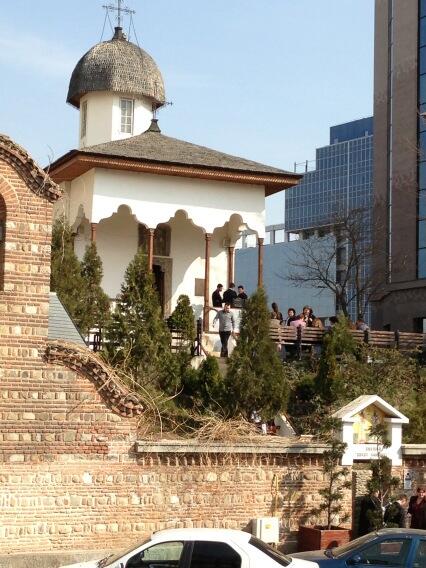
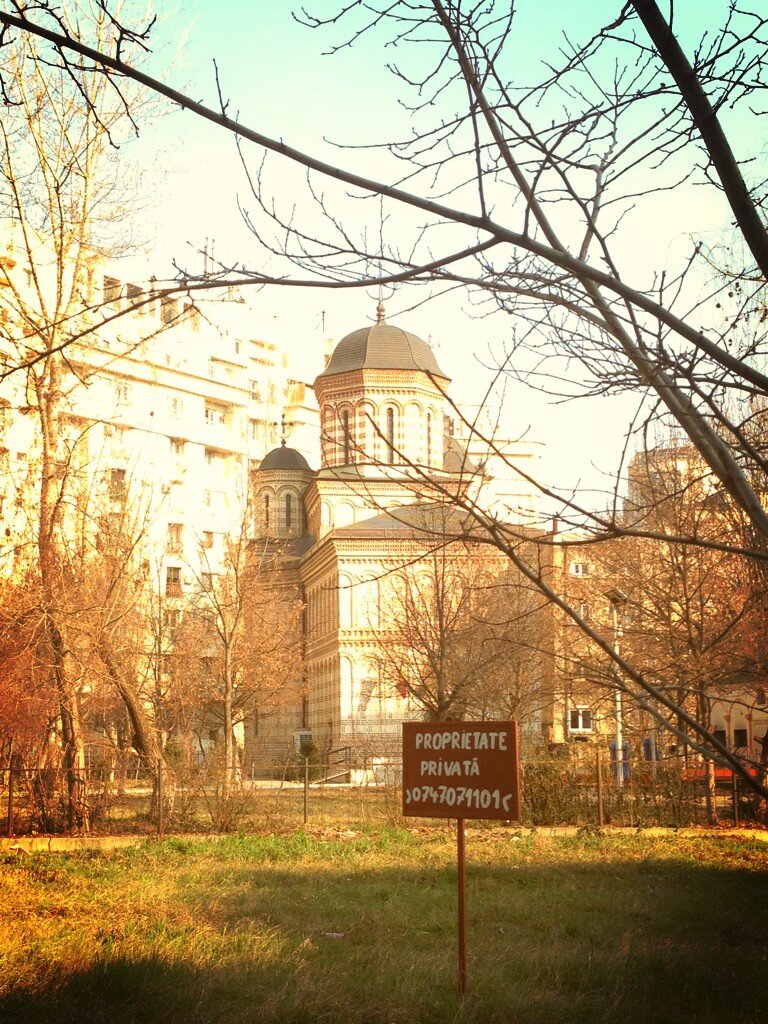
Looking at Bucharest churches in the warm March sunshine


Martin Harris was without his family this weekend and as they do not share his love of looking round churches that meant it was beholden on us to look at some. It was also extremely good weather - Martin's car (clever car) said it was 21°
.


When I was a boy looking at a beautiful church was the present I most wanted for birthdays and it still is. The highlight of today's tour was the church of Sfintii Apostoli, the Holy Apostles, one of the few Bucharest churches that I have visited fairly often. (It's a ten minute stroll from my flat). It was moved on rollers by the Communists and hidden behind apartment blocks; thank God a clever engineer had the idea of the rollers and thereby saved a number of fine churches. But it was the highlight because Martin pointed out 'There is Santa Claus's hand!' and there indeed was St Nicholas's mummified hand. It is not in a very  prominent place and I had previously not noticed it.

Is there a black market for stolen holy relics? If so, they should guard it carefully. Stealing holy relics sounds very mediaeval but so do lots of things that happen in this country, which, I suppose, is why I love this place.

Mihai, our cicerone, who once told me that he is not particularly religious, is quite certain that this is indeed St. Nicholas's hand and that someone tried to steal the relic from the church and died in prison on December 6, St. Nicholas's Day. I would like to believe that St Nicholas was involved in this death, and in fact can at a stretch, but I very much doubted if it really was the saint's hand and said I would look up how many of his hands are to be found in churches in Europe. Yet now I am loathe to do so. Let us leave it that it is the saint's hand indeed. But, just as many towns claimed the honour of producing Homer, so relics of St Nicholas are widely distributed - click here.


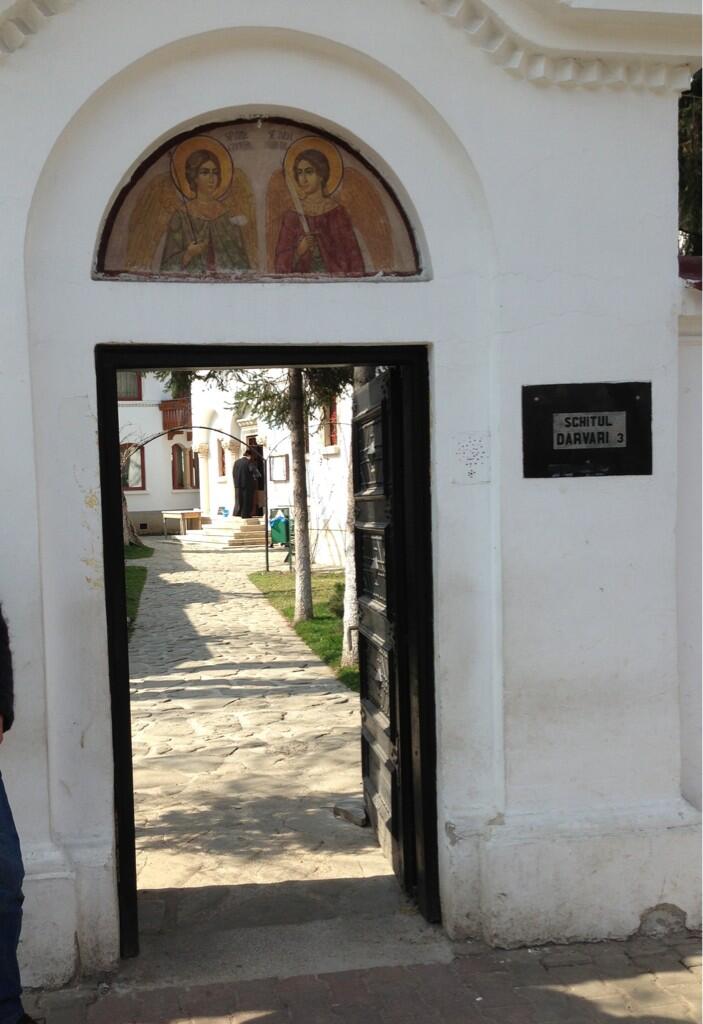
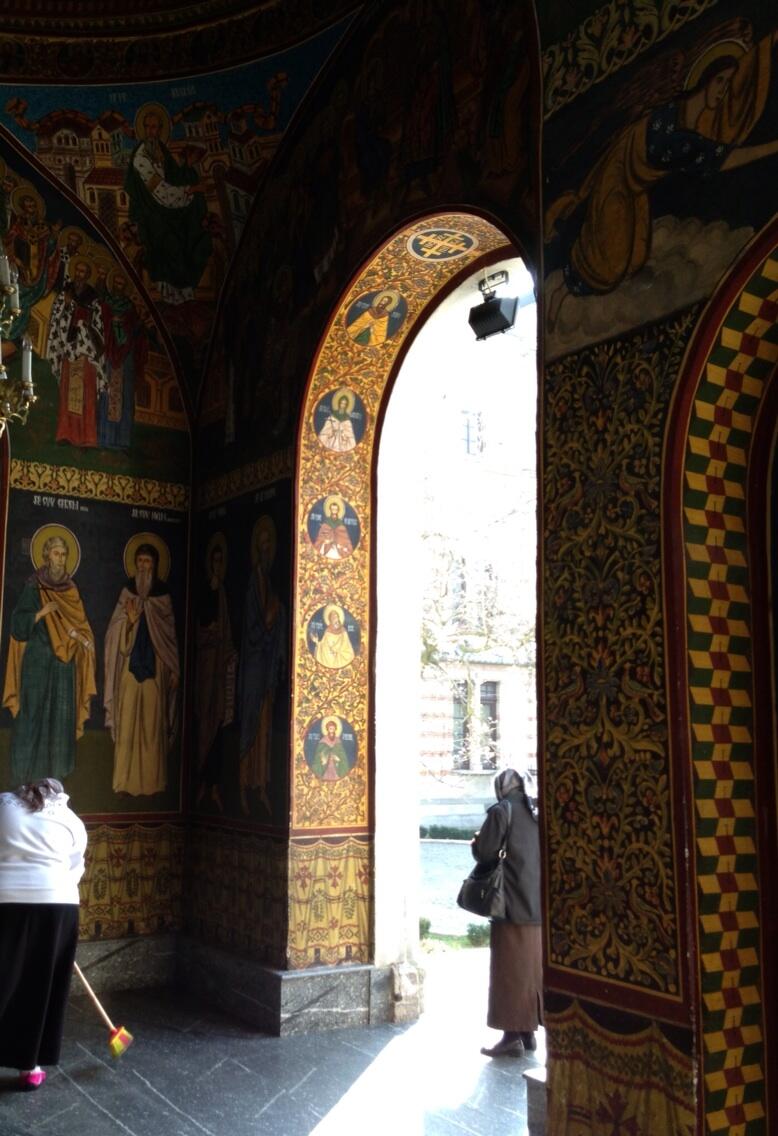
Schitul Darvari. An oasis of calm. Rebuilt 1933, beautiful frescoes from that period. Once under Mount Athos but no more.


It was my idea to go to the wonderful Radu Voda.


In dreams, unfamiliar buildings turn up in familiar landscapes and I, like many people, quite often dream of churches.  It was dreamlike when Mihai took me last year to the wonderful church of Radu Voda, as large, old and beautiful as the Patriarchal Cathedral and yet a church whose existence I had never suspected. I had even seem it a number of times from afar and convinced myself it was the cathedral.


Radu Voda, impersonating the Patriarchal Cathedral

The Bucur church, oldest church foundation in Bucharest but not the oldest church.  A christening was going on - of a girl, which meant the congregation crowded at the door making entrance impossible. With boys the immersion takes place near the sanctuary.
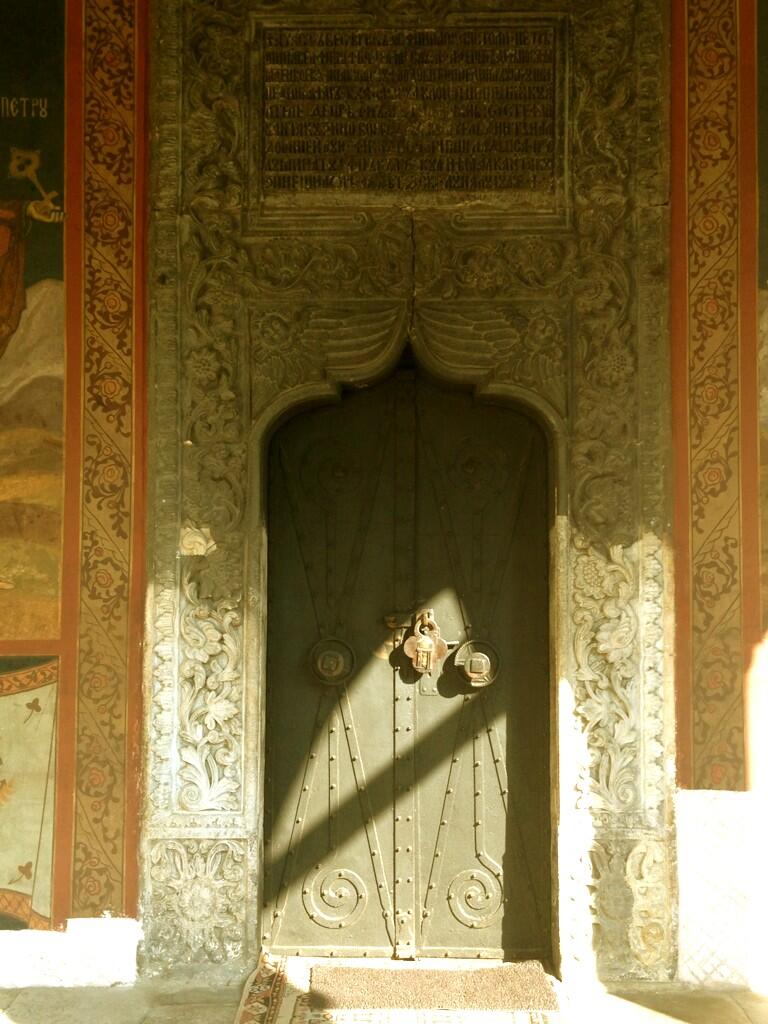
The Church of the Holy Apostles, founded by Matei Basarab in 1636, was closed for renovation, a word that always strikes fear. The doorway is from 1636.


The Mihai Voda church. This one was moved on rollers 300 yards to save it from demolition under Ceausescu's urban plan. 


Friday, 8 March 2013

The barometer question


I once heard Clement Freud tell this story on the wireless - and thought he said he was rector at the university in question. I came across it attributed to Niels Bohr, the Danish physicist, but that cannot be right since I hardly imagine there were many skyscrapers in Copenhagen when he was a student. The omniscient Wikipedia says it really happened, in the early 1960s in America, and that test designer Alexander Calandra wrote that he was the man called in to adjudicate on the student's appeal.

During a physics exam one day, a student was asked to "describe how to determine the height of a skyscraper with a barometer."

"You tie a long piece of string to the neck of the barometer," he replied, "and lower the barometer from the roof of the skyscraper to the ground. The length of the string plus the length of the barometer will equal the height of the building."

The student did not pass his exam. When he appealed, the university appointed an independent arbiter to decide the case. The arbiter concluded that the answer was correct but did not display any knowledge of physics. The student was called in and given six minutes to provide a proper answer.

For five minutes he sat in silence, thinking. When the arbiter reminded him that time was running out, the student replied that he had several solutions, but could not decide which to use. At last, he gave this reply:

"You could take the barometer up to the roof of the skyscraper, drop it over the edge, and measure the time it takes to reach the ground. The height of the building can then be worked out from the formula H = 0.5g x t squared.

"Or if the sun is shining you could measure the height of the barometer, then set it on end and measure the length of its shadow. Then you measure the length of the skyscraper's shadow, and work out the height of the skyscraper using proportional arithmetic.

"You could also tie a short piece of string to the barometer and swing it like a pendulum, first at ground level and then on the roof of the skyscraper. The height is worked out by the difference in the gravitational restoring force T = 2 pi sqroot (l / g).

"If you merely wanted to be boring and orthodox about it, you could use the barometer to measure the air pressure on the roof of the skyscraper and on the ground, and convert the difference in millibars into feet to give the height of the building.

"But I think what I would really do would be to go down in the lift to the basement, find the caretaker and say to him, 'Look. This is a nice new barometer. I will give it to you, if you tell me the height of this building.'"  

Thursday, 7 March 2013

Smoking in Romanian restaurants

I am very sorry for people who smoke and strongly wish they would stop, but seeing people smoke in Romanian restaurants makes me happy to live in a free, civilised country. How many bad things are going to be visited on Romania in years to come, thanks to the EU. At the moment, to quote William Buckley's stirring clarion call, Romania is standing athwart history yelling stop.

When one sees ashtrays in cafés one knows one is one of the last bastions of freedom and respect for property rights in Europe. Who would have thought in 1989 that Romania would soon be far freer than England but it is, by miles.

By the way, smoking is no pleasure at all, none, a vice as pleasureless as avarice. Tobacco is the perfect industry for psychopaths and I wonder how many work in it. I know a female psychopath in a senior job (she never smoked) who loves the fact that the tobacco company she works for kills millions of people. It gives every day a savage zest for her which is in some way linked to sex.

Wednesday, 6 March 2013

Bucharest is the most interesting city in Europe even now

Bucharest is the most interesting city in Europe even now, despite the satanic malls.


Another great picture which could be of almost anywhere in the town (for it is more a town than a city despite its two million inhabitants):

Image may contain: plant, tree and outdoor

I walk past this every day - there are so many scenes like this. When I tell Romanians that being in Bucharest makes me happy each day they think I am crazy or am lying and am here for the girls (who are very handsome).


Bucharest has been so cleaned and tidied up in the fifteen years I have lived here that I forget how sui generis it still is. These pictures bring that out. Paradoxically, and everything in Romania is a paradox, Bucharest is utterly uncool and yet the coolest place there is.

A film noir city.Where people still smoke in restaurants (Romania is still a free country) and where there are still femmes fatales (legions of them). Men here are men and women are women and everyone is happy about this. The most interesting city in Europe. You could almost say it is the last European city. 

Tuesday, 5 March 2013

No dissenting voices as media prays for liberal Pope

This is the best article I read in ages about the Catholic Church - and from a Protestant newspaper, the Belfast Telegraph.  Its points apply not just to the Church but to the world we live in and the propaganda we are fed to make sense of it.
Liberal societies take the view that no one should be allowed to impose their morality on anyone else, but then turn around and do precisely this to people who don't go along with their norms.
How refreshing but how sad to read Pope Benedict XVI's final address to the Roman clergy on Thursday. Talking about the Second Vatican Council, he says: 
...there was the Council of the Fathers – the true Council – but there was also the Council of the media. 
We know that this Council of the media was accessible to everyone. Therefore, this was the dominant one, the more effective one, and it created so many disasters, so many problems, so much suffering: seminaries closed, convents closed, banal liturgy … and the real Council had difficulty establishing itself and taking shape; the virtual Council was stronger than the real Council. But the real force of the Council was present and, slowly but surely, established itself more and more and became the true force which is also the true reform, the true renewal of the Church. It seems to me that, 50 years after the Council, we see that this virtual Council is broken, is lost, and there now appears the true Council with all its spiritual force. 
Where will we find a Pope with Pope Benedict's vision but with the strength to put things right? He may think the virtual Council is broken but I am not so sure.


What a great Pope, responsible for the far better new translation of the liturgy (the liturgy was the Church's single greatest problem) and the reintroduction of the Tridentine Rite in theory, though not, thanks to recalcitrant and disobedient bishops, in practice.

These will be remembered in years to come and if the Tridentine Mass becomes widely celebrated he will be much esteemed for this decision, though this seems at present a very unlikely prospect. What he will be most remembered for, however, will be for his abdication, an inspired decision, which will have vast consequences.

He is a saintly man but his lack of administrative gifts and his diffidence made him question whether he had a priestly vocation. He is outspoken and very honest which has caused problems. But his reign will also be remembered, like Pope John Paul II's, for the terrible, unspeakable revelations about a shockingly numerous minority of priests, though of course only a tiny minority of the whole priesthood, who interfering with boys and girls (mostly boys but girls suffered too). In fact, not only the priesthood but many secular institutions contain far more of these criminals than we would have suspected (this article by Andrew Brown, who I think is not a Christian, is very interesting on this). But, many young lives have been damaged or ruined and, rightly, higher standards are expected from priests than the laity. The harm this has done the Church is the most significant event in church history since the Second Vatican Council. Whether these things were partly a consequence of the false Council and loss of belief in sexual morality or whether they were just as common in the 1950s I really do not know, but these terrible men were the most dangerous enemies not only of innocent children but of the Body of Christ. 

The arms of the Holy See while sede vacante

Sunday, 3 March 2013

If Benedict XVI was not the most intelligent head of state ever, who was?


Professor Father James Schall. who holds a chair in  political science  Georgetown University was asked in an interview recently,  "How do you think history will remember Pope Benedict XVI?" He answered:


It will remember him as the greatest and most learned intellect ever to occupy the Chair of Peter. No public official in our time has been anywhere near his intellectual equal. This disparity is itself the cause of much disorder, if we grant, as we must, that truth is the essence of intellect and indeed order. In reading Benedict, I have always been struck by how familiar he is not just with the Old and New Testaments (in their original languages) but with his constant referring to the Fathers of the Church, especially Augustine, and the intellectual popes like Gregory the Great and Leo the Great, and also Irenaeus, Basil, Maximius, Origen, Bonaventure, and I do not know them all. 

He knows German philosophy well, and always cites Plato. He is at home with all the Marxist philosophers. Indeed, in Spe Salvi, he cited two of the most famous ones as witness to the logical need of a resurrection of the body. Benedict is a member of one of the French academies. No one has really begun to do his homework on what this pope has thought his way through. The media and most universities are, basically, hopeless. I suspect his final opera omni in a critical German edition will equal in length that of Augustine, Aquinas, and Bonaventure.

I also had assumed that Pope Benedict XVI was the most intelligent and most learned Pope in history, but my knowledge of papal history was too slight for me to be certain. 

When was there last as intelligent a head of state, I wonder. No-one comes to mind. I don't think Marcus Aurelius was as bright. I am sure Jefferson and Lenin were less clever nor do I think Alexander the Great had a first class mind (how Cambridge I am), despite being tutored by Aristotle.

Evelyn Waugh: 'In a more civilised age Hans Kung would have been burnt'


Hans Kung

Hans Kung (shouldn't it be Kueng?) describes himself as the harshest critic of Pope Benedict XVI and sums up Benedict XVI's record as almost entirely negative with one significant exception:
In 2005, in one of Benedict’s few bold actions, he held an amicable four-hour conversation with me at his summer residence in Castel Gandolfo in Rome.... 

For me, and indeed for the whole Catholic world, the meeting was a sign of hope. [1] But sadly Benedict’s pontificate was marked by breakdowns and bad decisions. He irritated the Protestant churches, Jews, Muslims, the Indians of Latin America, women, reform-minded theologians and all pro-reform Catholics.
Did you know that Catholic priests were allowed to talk like that about the Pope? Nowadays they are and to publish books denying dogmas such as the Virgin Birth and papal infallibility, denying Jesus's miracles and denying no end of other things. His prose in  'Why I am Still a Christian' is so turgid that I did not find out all the things that he does not believe in  but it comes to an awfully long list. (Yet I remember seeing Westminster Cathedral bookshop with a copy of one of Father Kung's books piled high in all the windows.) 

Ian Paisley, who believes in the Creed, is a much better Catholic than Father Kung. One knows why Evelyn Waugh, whose early death the Second Vatican Council caused, said that 
'In a  more civilised age Hans Kung would have been burnt.'
Father Kung seems a bitter man and notably lacks humility (in sharp contrast to the Vicar of Christ who spent four hours with him).  The Pope's most important act was meeting me! 

Irritating the Protestant churches, Jews, Muslims, women, reform-minded theologians and all pro-reform Catholics might be because Benedict XVI was thoroughly bold and unafraid to speak the truth, but it depends on what you think the truth is. It was indeed bold of the Pope to meet his former friend and characteristic of his humility and graciousness.  

Another bold move which I wish the Pope had made was to have excommunicated Father Kung. After all, Father Kung is not, by any definition, apart from his own, a Catholic. In 'Why I am Still a Christian'  he explains his reason for not leaving the Catholic Church of his own volition: the discouraging failure of people who have broken away from the church in the past. Well, since Luther's day, I suppose he meant.

Non-Catholics imagine we are still forbidden to use private judgement and required to believe what the Pope tells us. If only it were somewhat like that, though Catholics never had to agree with the Pope on everything. In practice, it is now a free for all. A low church Protestant friend of mine with whom I discussed Father Kung's book 'Why I am Still a Christian' said the title should have continued 'Even Though I No Longer Am.'

Father Kung's influence is immense and he advised British Prime Ministers James Callaghan and Tony Blair. He said a few years back that Muhammad was a true prophet but this will not endear him to Muslims because he does not believe in the Virgin Birth, which for them, as for Catholics, is de fide, an obligatory article of faith. 


_______________________________________________________________________
[1] Gosh, Kung has a good opinion of himself. This makes me think of Chesterton:

Are they clinging to their crosses,
F. E. Smith, 
Where the Breton boat-fleet tosses,
Are they, Smith?


Saturday, 2 March 2013

The second half of a man's life

Someone posted this on Facebook, which stopped me in my tracks, from Fyodor Dostoevsky:
The second half of a man's life is made up of nothing but the habits he has acquired during the first half.
Oh no. 

So there is no hope?

I looked up on the net to see whether he said anything else as good and found another quotation from him, less arresting but very true:


If you want to be respected by others the great thing is to respect yourself. Only by that, only by self-respect will you compel others to respect you.

This is profoundly true and profoundly comforting:


Accept suffering and achieve atonement through it - that is what you must do.

Here are some more:

There are things which a man is afraid to tell even to himself, and every decent man has a number of such things stored away in his mind.

The soul is healed by being with children.

It's life that matters, nothing but life - the process of discovering, the everlasting and perpetual process, not the discovery itself, at all.

Thursday, 21 February 2013

Miss South Carolina answers your questions about maps

I was reminded of poor, dear Lauren Caitlin by something someone (a blonde, as it happens, called Sarah) posted on Facebook, which was copied onto Lamebook:
ok just found out that south africa is a country AND its also part of africa witch makes no sense bcause how can a country be in another counry. #confused

Was it really as long ago as 2007 that Lauren Caitlin went viral? If so, without any malice towards the dear girl and just for fun, it's time to post her again, answering your questions about MAPS.

Former Miss Teen USA Contestant Caitlin Upton's Divorce Settled

When I first posted this I was too hurried to be witty about Lauren Caitlin, but this blog is and made me smile. 

I do think she looks wonderful and now I come to think of it I would not know how to answer the question of why Americans cannot find countries on maps. What is the answer? If I were 17 and on live television it would be even more of a difficult one. 

I do think that there is far too much prejudice against beautiful girls, on the part of men and women. Being beautiful is a form of wisdom. It not only needs animal cunning but it implies a healthy attitude towards the universe. Beauty and sex appeal come from within.

There is also a strong dislike of people from the American South on the part of the  Northerners. The South is the sin-eater for Americans and is often written off as stupid, rustic and, above all, racist, racism being the unforgivable sin in modern America. This attitude is exemplified by an American who told me, 'I hate Southerners because I hate racists.' I replied that I hated racism but I didn't hate racists. 'I hate racists', he said firmly and afterwards I realised it was he who was the racist. 

On this subject, an American friend, a Yankee who studied in New Orleans, told me what a Southern friend told him, 'Southerners don't like blacks in general but love them as individuals. Northerners love blacks in general but don't like them as individuals.' 

Who knows? I was never in the USA except for a few hours in Buffalo, New York. Fortunately, blonde jokes are not yet considered racist.


Christians have killed each other


Christians have killed each other, quite persuaded 
That all the apostles would have done as they did. 
(Byron, Don Juan.)

Wonderful lines - Byron was not a great poet until Beppo and Don Juan, where he approaches, at a fair distance, the greatness of his idol, Pope.


Sunday, 17 February 2013

Cosmopolitan Norwich


Ploughing through the innumerable supplements to the Friday edition of the Times, while I was in London last week, my eye alighted on the property section and an article headlined 'Focus on ... Norwich', which begins:


'A cosmopolitan, buzzing and beautiful city...'


Cosmopolitan? 

Norwich?

And why is cosmopolitan a term of approval? 

I hoped Norwich was still provincial. What is the point of Norwich otherwise? If East Anglia is not the provinces where is?

Perhaps nowhere is.

What would Norfolk men such as Sir Thomas Browne or George Borrow have made of a cosmopolitan Norwich? Or the poets of Eastern England like Cowper or Crabbe? Or John Betjeman or H.L. Morton?

I do not want to live in the provinces myself - I should hate to do so. I would not choose to live anywhere but the centre of a capital city, and I love living in an odd, seedy Balkan capital, but I want the provinces to be there and be provincial, the ballast in every country that keeps the boat from overturning.

The article in the Times went on, balefully, to declare that Norwich is one of the ten most important shopping destinations in England. 

Camus said, 'Modern man fornicates and reads the papers. There is nothing more to be said.' Modern man (person, sorry) in our day fornicates, shops and is cosmopolitan.  

All in all, The Times put me off the idea of going to Norwich. Private Lives comes to mind. 


I met her on a house party in Norfolk.

Very flat, Norfolk.

There's no need to be unpleasant.

That was no reflection on her, unless of course she made it flatter.

Minette Marin said in an article a while back that as we grow older we all of us find ourselves living in a foreign country. At least I really do live in a foreign country, Romania, and one that, happily, is reassuringly old-fashioned.

P.S. I looked on the net to see if Sir John Betjeman ever wrote a poem about Norwich. It seems he did not but I found instead a poem that he wrote about somewhere else in Norfolk. It is one of my favourites among his poems and I feel like quoting it here, though it has nothing to do with the subject of this post.


Oh Lord Cozens Hardy Your mausoleum is cold,

The dry brown grass is brittle

And frozen hard the mould

And where those Grecian columns rise

So white among the dark

Of yew trees and of hollies in That corner of the park

By Norfolk oaks surrounded

Whose branches seem to talk,

I know, Lord Cozens Hardy, I would not like to walk.


And even in the summer, 

On a bright East-Anglian day

When round your Doric portico  Your children's children play

There's a something in the stillness 

And our waiting eyes are drawn

From the butler and the footman  Bringing tea out on the lawn,

From the little silver spirit lamp 

That burns so blue and still,

To the half-seen mausoleum  In the oak trees on the hill.


But when, Lord Cozens Hardy, November stars are bright,

And the King's Head Inn at Letheringsett  Is shutting for the night,

The villagers have told me 

That they do not like to pass

Near your curious mausoleum 

Moon-shadowed on the grass

For fear of seeing walking  In the season of All Souls

That first Lord Cozens Hardy,  The Master of the Rolls.


Tuesday, 12 February 2013

A great pope is about to abdicate

"The proudest royal houses are but of yesterday, when compared with the line of the Supreme Pontiffs. That line we trace back in an unbroken series, from the Pope who crowned Napoleon in the nineteenth century to the Pope who crowned Pepin in the eighth; and far beyond the time of Pepin the august dynasty extends, till it is lost in the twilight of fable."  (Lord Macaulay)

I cried when Pope Paul VI died. Pope John Paul II's slow death was terribly moving but I was too old and too wicked to weep. Now, when I met friends for lunch in Victoria, they told me the astonishing news that Pope Benedict XVI has announced that he will abdicate at the end of this month.


Astonishing news and yet not really surprising and exactly the right decision, of a piece with the humility of the man. I remember him at some time pointing out that Catholic Church is the only institution where its leader continues until death. 


The present Pope is the most intelligent and also (not the same thing at all) the best for centuries. When was there so intelligent a head of state? And he has coped well with the huge forces of malice and hatred directed at him and at the throne of St. Peter. He took some steps towards admitting the terrible crimes of wicked priests who interfered with boys and sometimes girls. He made the Tridentine Mass once more the Mass and he is responsible for the vast improvement in the liturgy in English. He sad that it is not a sin to use a condom in marriage for self-protection. He defended the historicity of the Gospels and is one of the few men clever enough to make Christianity seem intellectually respectable.

Of course the papacy, like the English monarchy and many other institutions, has been Diana-ified and the pope was not a theatrical figure like his predecessor (who had been an actor) able to use television. This made the faithful love him less than Pope John Paul II.

Dear BBC, popes do not resign, they abdicate. Or so I thought but the Vatican News Service used the word resign in its English edition. Nevertheless  the Vatican is not infallible on English usage and abdicate is much the better word. The pope used the word renuncio in Latin -  he renounced the papacy. One mistake some have made is to think that only hereditary monarchs abdicate, in which case the throne is automatically filled - the king is dead long live the king. In fact the papacy is an elective monarchy, like the old Polish monarchy.  Doges of Venice also abdicated because although Venice was a republic they were elected princes.

More of this important debate here.

A very wise comment on the abdication by Anna Arco, the Bavarian Editor at Large, at The Catholic Herald:


"I think it’s the right decision on his part as he avoids becoming a pawn in Vatican power games as he gets older, frailer and less able to defend himself. I think it’s sad because I think he was a brave strong man who faced horrible attacks and media storms and didnt grovel like most politicians but would wait to speak and usually say something different, worth listening to that would diffuse the situation.

He was not a slick media operator or a cold manager or icy prince of the church, but a genuine priest, a great theologian, a pastor who loved his flock and everything he said or did comes out of an understanding of reality and human frailty but with a belief also in the framework of the religion and is coloured by love." 

He was not a slick media operator or a cold manager or icy prince of the church, but a genuine priest, a great theologian, a pastor who loved his flock and everything he said or did comes out of an understanding of reality and human frailty but with a belief also in the framework of the religion and is coloured by love." 

Another good comment was this, that someone posted on Facebook:


By the way, I do not agree with Macaulay about the origins of the Papacy being lost in the twilight of fable. Eamon Duffy, carpingly, does not think St Clement I was Bishop of Rome but only in charge of corresponding with other churches. This it is clear he was, but St Clement was certainly one of the leading figures in the church at Rome and he sounds like he may have been its leader to me. The office of bishop was not of course in his day very defined. He lived in the 1st century and was said to have known and conversed with the Apostles. Tertullian says he was consecrated by St. Peter. 

Thursday, 7 February 2013

Romanians make good immigrants


Admitting a million Poles, even though in good manners, industry, church attendance and many other ways they put the English to shame, was certainly a mistake on the part of the UK. We know this because ministers said they expected tens of thousands to come. Still, if Britain and other Western European countries have decided that they need immigrants, and they have, they should be very grateful that the EU has a supply on hand of Eastern European would-be immigrants. Yet while the British press worry about an influx of Romanian and Bulgarian immigrants after January 1 2014, David Cameron announces that 


‘There is no limit on the number of  students who can come from India to study at British universities, no limit at all. All you need is a basic English qualification and a place at a  British university. What’s more, after you’ve left a British university, if you can get a graduate-level job there is no limit to the amount of people who can stay and work, or the time that they can stay at work.’


Romanians, like other people from the former Eastern Bloc,  are highly-educated, conservative, Christian and European. Romanians come from a Near Eastern culture, unlike the Poles, who are Catholics and Central Europeans, but they bring with them so many qualities that the British seem to produce less often than in the past. Romanian women are womanly (and very often beautiful), Romanian men are virile even if they seem very effete at first sight. Romanians are family minded, esteem education and usually believe in God. Best of all, they come from a part of the world where the 1960s never happened.


Romanians were disappointed but not in the least surprised by the noisy British reluctance to let them settle in the UK. As far as Romanians are concerned, they blame this reluctance on confusion abroad between Romanians and Roma. (Roma is the modish, EU-approved term for gypsies.) It is no use saying to Romanians that Romanian gypsies are both Romanian and Roma. ‘Romanian’ is understood here as an ethnicity not a citizenship. A Romanian man I know, for example, always says that he is Greek not Romanian, even though his family came to Romania in the t860s. Similarly, few ethnic Romanians think Romania’s Hungarians, German or Jewish minorities are Romanian. Children of mixed marriages do though.

Romanians usually have a very high opinion of England, based partly on books and films. I would expect Romanians to be disappointed by the reality of violent crime, binge drinking, feminism and innumerable rules. Romania, where people smoke in bars and say whatever they like about most things, is a much freer country these days. But no, Romanians usually love England and so they should. Things work in England and people are kind and honest, though the trusting nature of the English provokes wonder and seems naive. Britain is still a wonderful country and London is the only big city in Europe which is not a museum. The small minority of Romanians I spoke to who did not like England gave as their reason the number of non-white people there.

Beauty is a short lived tyranny


Beauty is a short lived tyranny. (Socrates)


A tyranny made perhaps more protracted by the lights of perverted science. (Churchill)

Saturday, 26 January 2013

Danielle Lloyd and other wags


Danielle Lloyd is a mildly famous British WAG (WAG is a back-formation from WAGs, which means footballers' wives and girlfriends). She is famous because her picture sells newspapers and gets clicks on websites, including, I hope, mine, and famous for racist bullying of an Indian contestant on the reality television show Big Brother, though that was years ago. She should be famous for this answer that she gave on BBC One's quiz show, Test the Nation (sic). She was asked: "Who is Winston Churchill?" and answered: "Wasn't he the first black president?"'


More quotations:


Judge: I have read your case, Mr Smith, and I am no wiser now than I was when I started.
F. E. Smith: Possibly not, my Lord, but much better informed.


Judge: Are you trying to show contempt for this court, Mr Smith?
 
Smith: No, My Lord. I am attempting to conceal it.


Judge: Mr Smith, you must not direct the jury. What do you suppose I am on the bench for?
 
Smith: It is not for me, your honour, to attempt to fathom the inscrutable workings of Providence.


What is a man, after all, but his old jokes?
John Mortimer

Lord Kilmuir, who heard about his dismissal from the woolsack on the wireless: You have given me less notice than I would a housekeeper.
 
Harold Macmillan: But good housekeepers are so hard to find.

We cherish our friends not for their ability to amuse us, but for ours to amuse them. -- Evelyn Waugh


Prince Phillip, in 2000: ‎"People think there’s a rigid class system here, but dukes have even been known to marry chorus girls. Some have even married Americans."


When a Protestant sins he has no-one to whom to confess except his solicitor. Philip Guedalla